Changing rocks, changing ideas : 200 years of metamorphism
Richard Edwards – Wed 10 March 2010
Slide 1 – Introduction
Much of the focus of the talk is on the evolution of ideas.
Metamorphic processes are beyond our direct experience in contrast to sedimentary and volcanic rocks.
Con Gillen suggests that metamorphism occupies the “haunted wing” of geology!
Aristotle said: “He who sees things grow from the beginning will have the best view of them”.
Slide 2 - Neptunists versus Plutonists
The Protagonists
Abraham Gottlob Werner (1749 – 1817)
Werner was the foremost advocate of the Neptunist school. He was essentially a mineralogist and for most of his life held a teaching position at the Mining School in Frieburg, where he attracted students from across Europe. Cuvier ‘He treated his subjects in such an admirable manner that he aroused the enthusiasm of his hearers and inspired them not only with a taste but with a passion for his science.’
Werner was described as a man with flashing blue eyes, friendly disposition of medium size, always clean shaven and wearing a peruke.
Werner differed from many of his predecessors in carrying out fieldwork but this was mainly confined to Saxony because he had rather poor health. His ideas therefore suffered from a limited field experience and in some cases misinterpretation of the outcrop he was examining. Werner exerted enormous influence through his teaching but published very little.
James Hutton (1726 – 97)
Born in Edinburgh and entered his local university at the age of fourteen to study Chemistry but switched to Medicine, studying in Edinburgh, Paris and Leyden. In 1750 he abandoned medicine and ran a farm in Berwickshire which he had inherited. In 1752 he travelled to Norfolk to study innovative methods of farming and during his travels became interested in the rocks that he passed. His geological studies in Scotland and England culminated in his “Theory of the Earth” – first presented as a paper to the Royal Soc of Edinburgh in 1785. The full paper published in 1788.
Slide 3 - Foundation of the Neptunist Theory
The intellectual framework within which Werner developed his ideas was a general stratigraphic sub-division of the earth’s crust which had been developed by several generations of naturalists e.g. Strachey 1719, Swedenborg 1722, Lehman 1756 and Rev John Mitchell 1760.
The earth’s crust was interpreted as having four main sub-divisions
i) Granite, gneiss and similar rocks – these were interpreted as being the fundamental basement on which all other rocks were deposited. Granite was interpreted as crystallising from a hot aqueous fluid
ii) Transitional strata – a term introduced by Werner which was applied to greywackes and sandstones such as found in the Lower Palaeozoic
iii) Floetz strata – a broad class of bedded rocks which had been sub-divided into 12 units
iv) Swept together strata – unconsolidated sands and gravels
Volcanic rocks formed a further division but these were regarded as being of only recent origin.
Slide 4 – Three Wernerian beliefs
Werner developed his theory of earth history on this stratigraphy. Initially the earth had cooled from a molten state and in cooling the surface had contracted to an irregular surface with mountains and valleys. This phase constituted the nucleus of the earth – not accessible to observation. The earth had then been covered by a deep primeval ocean which covered the highest mountains. Deep turbid waters held materials either in solution or suspension. The initial deposits were granite – a chemical precipitate. The dip of inclined strata were compared to chemicals precipitating on the side of a glass vessel. As time passed more mechanically transported sediment was deposited.
Note that Werner’s theory was supported by key intellectuals such as the Swiss Saussure who had initiated geological studies in the Alps.
Neptunian ideas were also in accord with Biblical perspectives of a great flood.
Slide 5 - The Schiebenberg – evidence that basalt is sedimentary
In 1787 Werner visited the hill near Schiebenberg in the Erzgebirge where he found basalt overlying sand and clay and ‘wacke’. From examination of this occurrence he became firmly convinced that all these rocks belonged to the same group and that they were all aqueous in origin ,forming part of the Floetz strata.
Slide 6 - James Hutton (1726 – 97) – the father of geology?
James Hutton was a giant in the history of the development of Geology. His contributions to Geology are two-fold. Firstly from his observations at Siccar Point and other localities he realised the enormous period of time which must have elapsed in deformation of Silurian and deposition of overlying Devonian. His observations led to the famous dictum “no vestige of a beginning, no prospect of an end”.
Slide 7 - Hutton’s Plutonic Theory
Hutton believed that earth processes were driven by heat deep within the earth. This opinion was based on field studies in Scotland of igneous intrusions such as Salisbury crags. One of his lines of evidence was his interpretation of a sample of granite from Portsoy on the Banffshire coast. The granite is characterised by a graphic intergrowth of quartz and feldspar. Hutton concluded ‘there is sufficient evidence of this body having been consolidated by means of fusion and in no other manner’. This was not confirmed experimentally until 1986!
Hutton thought of the Earth as a heat engine – a device that turns thermal energy into mechanical energy. He believed the internal heat of the earth was responsible for building mountains and consolidating sediment.
He was uncertain about the nature of the Earth’s internal heat.
Why the ? after father of geology. Firstly there were others with similar views. For example the Italian Giovanni Arduino (1714- 1795) who stated in 1778 “the earth as we now see it is not in its primitive state. It has undergone repeated upheavals and subsidences, many revolutions and metamorphoses. These have been brought about by injection of volcanic rocks. Arduino has been called “The father of Modern Italian Geology”.
Slide 8 - The discovery at Glen Tilt (1785)
Hutton realised that the relative age of granite and adjacent sediment could be determined from the field relationships. If the granite was younger one might expect to find evidence of it penetrating the older rock. Hutton realised that the area between the Dee and Tay Rivers had the potential to confirm his theory. In the rocks exposed in the river Tilt Hutton found the evidence he was searching for and was suitably excited.
Playfair comments ‘ The sight of objects which verified at once so many important conclusions in Dr Hutton’s system filled him with delight…… the guides who accompanied him were convinced that it must be nothing less than the discovery of a vein of silver or gold that could call forth such strong marks of joy and exultation”.
Later Hutton wrote “We may now conclude that, without seeing granite actually in a fluid state, we have every demonstration possible of this fact; that is to say of granite having been forced to flow, in a state of fusion, among strata broken by the subterranean force and distorted in every manner and degree.
Hutton’s observations effectively destroyed the basis of Wener’s theory. However, the Neptunian ideas took some decades to disappear. For example Charles Darwin attended a field trip to Salisbury Crags with Professor Jameson in 1825 who argued that a dyke was a fissure filled with sediment. Darwin commented “When I think of this lecture I do not wonder that I determined never to attend to Geology”.
Slide 9 - Charles Lyell (1797 – 1875)
Charles Lyell was the eldest of ten children. His father, also Charles, was a lawyer and amateur botanist. Lyell studied Classics at Oxford and practised Law for about seven years.
Lyell made several important contributions to Geology and perhaps his most important legacy was the belief that Geology could be best understood by observing processes taking place at the present day – the present is the key to the past. His ideas were expounded in his classic “Principles of Geology which was hugely influential amongst scientists at that time. For example Darwin took a copy of the book with him on the Beagle and commented that he looked at the rocks “through Lyell’s eyes”.
Lyell also carried out innovative research on Tertiary rocks and devised the system of classification which is still used today.
Slide 10 - A geological honeymoon
In July 1832 Lyell travelled to Bonn in order to marry Mary Horner, whose father was associated with the Geological Society. The new couple spent their honeymoon on a geological tour of Switzerland and Italy.
They travelled via Strasbourg and Frieburg to Bern where Lyell wished to meet the Swiss geologist Bernhard Studer who had published on a group of rocks exposed the Northern Alps which he grouped together as a single formation termed flysch. The significance of Studer’s work was his demonstration that sedimentary rocks passed without any distinguishable boundary into slaty rocks known as schists and sometimes into gneiss. Studer was able to show that that the schist and gneiss were simply strata that had been altered by heat and pressure.
Studer’s interpretation had been influenced by the Genevan naturalist, Necker de Saussure who had observed granite veinlets penetrating fossiliferous sedimentary rock at a locality called Valorsine. On 21st August 1832 Lyell set off with an English acquaintance to examine the Valorsine exposure for himself – they were away for 16 hours! It was from his observations at Valorsine that Lyell created the concept of the class of metamorphic rocks.
I wonder why he had not travelled to Scotland to observe the exposures described by Hutton? Not such an attractive honeymoon destination?
Slide - 11 Metamorphism is recognised
This image taken from the cover of Lyell’s ‘Principles of Geology’ shows metamorphic rocks within the earth’s crust
Slide 12 - Metamorphic rocks in the Alps
Discuss foliation and the main features of a gneiss.
Origin of the terms gneiss and schist?
Note the term ‘gneiss’ used in 18th century geological column used by Werner – but not schist.
GNEISS a term used by miners of the Harz Mountains to designate the country rock in which the mineral veins occur
SCHIST a term derived from the Greek and meaning “to split”
Note that these terms actually pre-date Lyells’ recognition of a distinct class of metamorphic rocks.
Slide 13 - Lyell sets out the case for metamorphism
In 1871 Lyell set out his views on metamorphism in his textbook “Elements of Geology”. It was a fairly defensive coverage of the subject and clearly the concept of metamorphism had not received universal acceptance.
Lyell begins by setting out the main types of metamorphic rock: gneiss, mica schist, hornblende schist, chlorite schist, metamorphic limestone, quartzite and clay-slate.
Its interesting to note that the term hornfels is not mentioned here.
Lyell also established that although metamorphism could best be demonstrated at the margins of granite intrusions, metamorphic rocks could be distributed over ‘vast dimensions’, citing Norway as an example. At this stage no distinction is made between contact and regional types of metamorphism.
The case for metamorphism rested on a number of observations:
i) the clear change in rock type as sedimentary rocks are traced towards a granite contact which indicates the importance of heat
ii) the role of steam and gas in metamorphic processes was deduced from the known association of these with volcanic activity
iii) The role of parent rock with some rock types being more susceptible to change than others
There is no mention in ‘Elements” of a role for pressure in producing the foliation which is characteristic of most metamorphic rocks. This is surprising as Sedgwick (1835) and Darwin( 1846) had published papers on the link between cleavage and folding.
Slide 14 - Henry Clifton Sorby (1826 – 1908) Sheffield’s Greatest Scientist
Born into a wealthy middle class family in Sheffield. His family could easily have afforded to send him to University but he wanted to become a scientist. At that stage (mid century) there were no University courses dealing solely with the sciences and so he studied at home with a tutor. His father died when he was 21 leaving him with a comfortable private income. He established a laboratory and workshop in his home and devoted the rest of his life to the pursuit of different aspects of applied science.
Sorby’s main achievements were in geology and in particular his development of petrography. This innovative approach to the study of rocks entailed cutting a slice of rock and then gradually grinding it down to one thousandth of an inch. At this point the rock becomes translucent. Sorby developed this new method of studying rocks.
Sorby also carried out important marine research having equipped a yacht “The Glimpse” as a floating laboratory. He cruised up and down the east coast of England every summer studying marine biology and to a lesser extent geology, botany, meteorology, archaeology.
He also studied architecture, archaeology, old churches, medieval art, Egyptian hieroglyphics, illuminated manuscripts and painted in water colours for relaxation.
In spite of Sorby’s major contribution to petrography he is not mentioned in Miyashiro’s outline of the history of the subject.
Slide 15 & 16 - Solving the slaty cleavage problem
Slaty cleavage is manifest as a series of parallel planes within a fine grained clay-rich rock. In the 19th century some geologists confused slaty cleavage with bedding which led to some major controversies – notably concerning the geology of the Scottish Highlands.
Slide 17 - Bedding and cleavage
Sorby was one of several eminent geologists who believed that slaty cleavage was a metamorphic phenomenon. Sorby believed that cleavage was due to the rotation of crystals in response to pressure with their new alignment positioned at right angles to the direction of maximum pressure. He conducted experiments with clay and wax and succeeded in producing fissility perpendicular to the applied force. Sorby also believed that preferred orientation could be enhanced by the growth of new micaceous minerals in the plane of cleavage.. He was the first to demonstrate situations in which pressure solution transfer had been important during cleavage formation.
Slide 18 - The spectrum of metamorphic rock types
Darwin recognised that slaty cleavage was a re-crystallisation phenomenon and that it formed part of a spectrum of continuous metamorphic alteration to which coarser schists and gneisses also belong.
Despite Darwin’s insight geologists continued to confuse sedimentary layering(bedding) with metamorphic foliation.
Slide 19 - Classifying metamorphic rocks
During the latter part of the 19th century the French geologists Elie de Beaumont and Gabriel Daubree recognised the two main types of metamorphism : Contact and Regional. Contact metamorphism was known to be found at the margins of igneous intrusions and was normally confined to a mile or so from the contact. However, Lapworth believed that contact metamorphism could sometimes be developed on a gigantic scale. This view was supported by Barrow whose work in the Grampians will be studied next. Barrow stated that there was not much difference between the two types of metamorphism.
Regional metamorphism was recognised as being developed on a very large scale and being associated with mountain building processes. However, the mechanism was poorly understood at this stage.
Slide 20 - State of the Art 1899
I have taken my information about this period from a textbook written by Charles Lapworth published in 1899. Lapworth was one of the most distinguished geologists of his generation. He had been deeply involved in the debate concerning the sequence of rocks in the NW Highlands where his adversaries had been Murchison and Geikie.
His experience in Scotland meant that he was very familiar with metamorphic rocks and especially those associated with thrust zones. Lapworth admitted that studies of metamorphism were in their infancy.
Lapworth considered the agencies and controls of metamorphism were as follows:
Hydro-metamorphism – water is the main agent (today this would be considered as chemical weathering)
Hydrothermal metamorphism – water and temperature are important ( today this would not be considered as metamorphism. Hydrothermal alteration is often associated with mineral deposits and involves major changes of chemistry whilst metamorphism is essentially a mineralogical and textural change)
Thermal metamorphism – heat is the main agent – the context of contact metamorphism
Dynamo-metamorphism – pressure and temperature are the main controls ( today this is seen as a type of metamorphism associated with major shear zones)
One of the major contrasts between Lapworth’s view and our knowledge today is the major role of water envisaged by Lapworth. Of course he had no knowledge of either temperature/pressure conditions or the timing of events during mountain building.
Slides 21 & 22 - Minerals formed by metamorphism: biotite, staurolite, kyanite, sillimanite
In addition to having a characteristic structure – cleavage, schistosity, gneissose banding – metamorphic rocks also have a distinctive mineralogy which depends partly on the parent rock and partly on pressure/ temperature conditions.
The minerals staurolite, kyante, sillimanite are found in rocks derived from fine grained sediments (pelites).
It soon became apparent that mapping in metamorphic terrain had to be supported by petrographic studies as the traditional use of fossils for correlation was no longer feasible.
Slide 23 - The Geological Survey heads north
a) The Highlands Controversy
Main protagonists: Murchison & Geikie – Heads of English and Scottish Geological Surveys. Nicol and Lapworth – academics
M&G insisted on applying the law of superposition to geology of NW Scotland. They believed that rocks became progressively younger as they were traced eastwards.
N & L believed that older rocks had been thrust over the top of younger ones (section required)
Mistake made by Murchsison was interpreting thrust planes as bedding planes
b) Geological Survey maps the Grampians
Slide 24 - Barrow’s metamorphic minerals and zones
See obit for interesting insight into his early career
Barrow’s achievements
Barrow was considered to be one of the better geologists mapping in the Grampians.
Extract from his obit “ Barrow’s work in Scotland was in advance of his time…. His early appreciation of the more delicate shades of metamorphism, the value of clastic and regenerated micas as indices and the conditions which controlled the formation of certain mineral assemblages and crystal growths led to his laying the foundations of the study of progressive metamorphism.
Teall pointed out in discussion of Barrow’s paper that his boundaries between indicator minerals could be viewed as isotherms.
What Barrow did not appreciate was that his intrusive granite was in fact a migmatite – a mixture of metamorphosed sediment and granite which represented a phase of incipient melting
Barrow stated that he did not think there was much difference between regional and contact metamorphism.
Slide 25 - Kennedy’s thermal anticline
During the 1920’s/30’s Barrow’s mapping of metamorphic zones was extended by other geologists, notably Tilley. Kennedy (1948) discovered that when allowance was made for the 65kms displacement along the Great Glen Fault a consistent patter of mineral zones could be established. Kennedy pointed out that the pattern could be interpreted as a thermal anticline pitching to SW.
Slide 26 - Metamorphic zones and the tectogenic root
Kennedy interpreted the thermal anticline as a consequence of downbuckling of the continental crust during orogenesis with partial melting and migmatisation at depth and an associated pattern of prograde regional metamorphism . Kennedy invoked heat transport by remelted granitic material rising from the tectogenic root.
This interpretation not much different from Harker/Barrow.
Slide 27 - Migmatite
The term migmatite was introduced by the Finnish petrologist Jakob Sederholm in the early 1900’s. The term means a mixed rock i.e. it contains elements of both metamorphic and igneous material
Migmatites are the product of partial melting and exhibit a wide range of structures.
Slide 28 - Experimental petrology provides the numbers
Early work on the temperatures of metamorphic reactions was carried out by the Norwegian V.M. Goldschmidt. In 1903, at the age of 23 he used thermodynamic data to calculate the equilibrium curve for the creation of the metamorphic mineral wollastonite.
From the 1950’s the results of experimental work on pressure/ temperature conditions of metamorphism started to flow from major laboratories in the USA.
Key landmarks included defining the limits of the prehnite/pumpellyite and zeolite facies which showed a clear separation from the weathering environment (early 1960’s). Accurate determination of the Al2SiO5 triple junction was also of key importance in demonstrating that partial melting of metamorphic rocks could take place within the parameters of crustal conditions.
Slide 29 - From metamorphic zones to metamorphic facies
We have already seen the important work carried out by Barrow in the Grampians and his use of metamorphic indicator minerals to demarcate zones of increasing metamorphism. This approach has limitations because the indicator minerals are mainly developed in rocks which started their life as muddy sediments with a high clay content. Barrow’s zonal minerals are therefore characterised by a high alumina content. However there are many rocks which lack this initial chemistry – the ingredients are not present - and so recrystallise during metamorphism to quite different minerals.
The Finnish geologist Eskola devised an approach which resolved this problem. Eskola recognised that different rock types tend to re-crystallise into mineral assemblages which are defined in part by their original chemistry and in part by the temperature/pressure conditions. In 1921 Eskola introduced the concept of metamorphic facies in these terms: ‘ a mineral facies comprises all the rocks that have originated under temperature and pressure conditions so similar that a definite chemical composition has resulted in the same set of minerals, quite regardless of their mode of crystallisation… or by gradual change of earlier minerals’.
It is interesting to note that Eskola seminal work on metamorphic facies was totally ignored in the classic British text on metamorphism by Alfred Harker (1933,1939).
So much for the international brotherhood of geologists. This was partly a clash of generations and partly the relative obscurity of Eskola’s early publications in Finland.
Slide 30 - Metamorphic facies explained
Now the emphasis is on the total mineral assemblage rather than just the indicator minerals used by Barrow.
Con Gillen has cited a number of problems associated with the use of metamorphic facies.. Rocks of suitable composition must be present and the approach does not make allowance for variation in the composition of fluids. Gillen, writing in 1982, states “the difficulties involved in applying the metamorphic facies concept to actual rock associations have led to its being largely abandoned in the last few years”. I think this is something of an overreaction and the different facies are still used to describe metamorphic rocks. For example in describing the metamorphosed rocks of the Malvern Hills Barclay & Pharaoh (2000) refer to “metamorphism at upper greenschist/ lower amphibolite facies”.
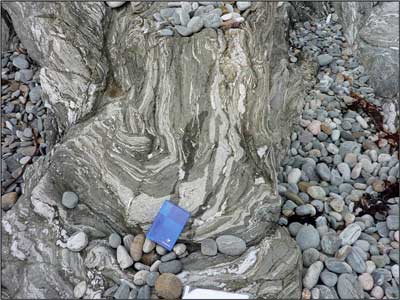
Some examples of Metamorphic rocks
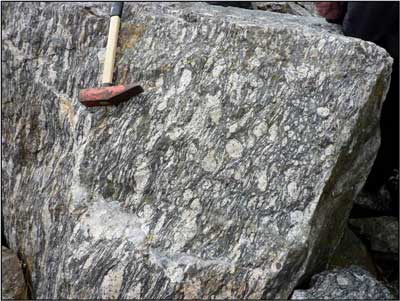
Shetland gneiss
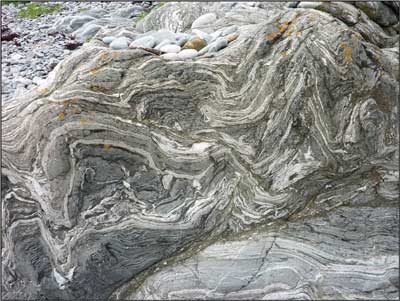
Metamorphism of impure limestone
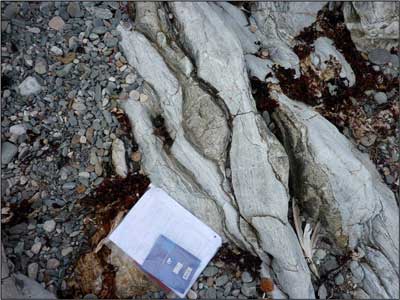
New structures develop
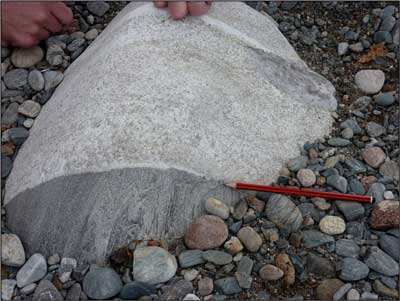
Rocks start to melt
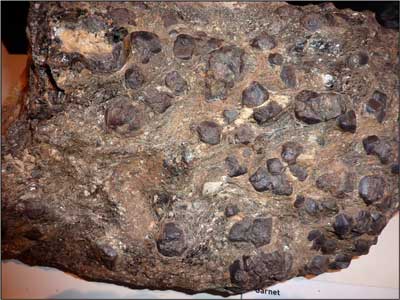
Garnets in a biotite gneiss
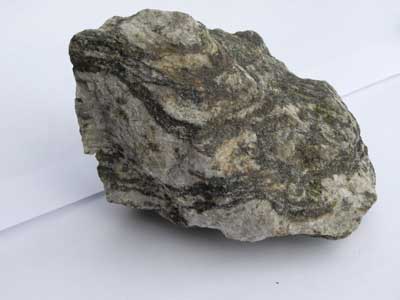
Augen gneiss (Shetland) - the large crystals of feldspar are referred to as porphyroblasts. The term augen comes from the German for eye.
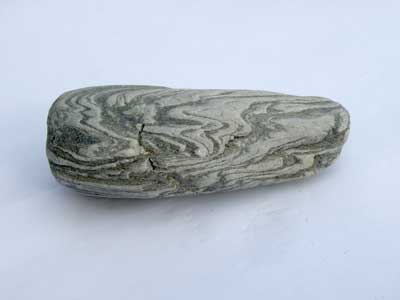
Folded calc-silicate rock. (Shetland). This specimen would have originally been an impure limestone.
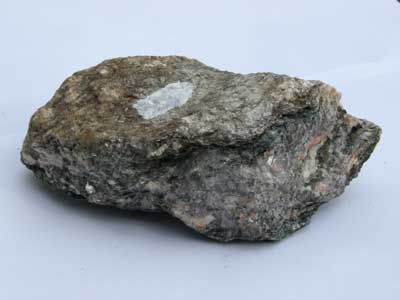
Muscovite schist (Shetland)
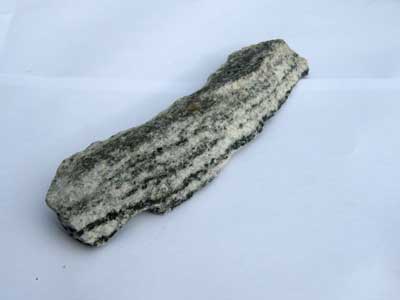
Biotite gneiss (NW Scotland). This is the Lewisian gneiss, the oldest rock in the British Isles.
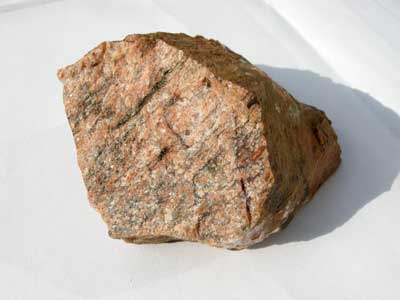
Foliated granite from Dingle Quarry, Malvern.
Bibliography
Adam Frank Dawson 1938
The Birth and Development of Geological Sciences
Dover Edition in 1954
Very informative about the early stages in the development of the science in 19th century.
Gillen Con
Metamorphic Geology
George Allen & Unwin
A short, well written account which summarises the main elements of metamorphism.
Hallam A. 1989
Great Geological Controversies
Oxford Science Publications
Covers a range of controversial issues including an account of the Netunist/Plutonist arguments.
Harker Alfred 1939
Metamorphism: a study of the transformation of rock masses
Methuen & Co Ltd
A classic textbook which was very influential amongst geologists in the 1940’s and 1950’s.
Lapworth Charles 1899
An intermediate Text-Book of Geology
William Blackwood & Sons
An insight into geological thinking at the end of the 19th century by one of the foremost geologists of his generation. Pity about the title!
Lyell Charles 1830 – 1833
Principles of Geology
Penguin Classics
Probably the most influential geology textbook ever written and impressed Darwin who claimed that he saw rocks “through Lyell’s eyes”. Also includes an excellent introduction by James Secord.
McIntyre DB and McKirdy A 1997
James Hutton: The founder of modern geology
HMSO Edinburgh
A short and well illustrated account of Hutton’s career.
Miyashiro A. 1973
Metamorphism and Metamorphic Belts
George Allen & Unwin Ltd
This textbook is mainly concerned with the large scale aspects of metamorphism. However, the last chapter is a rare account of the history of ideas in metamorphism. I discovered it after I had prepared this lecture!
Rothery David 2002
Internal Processes
Open University S260 Block 3
A concise and up to date account of metamorphic rocks and processes with good images.
Oldroyd David 1990
The Highlands Controversy
University of Chicago Press
A lengthy but interesting account of the dispute concerning the geology of the Scottish Highlands in the mid 19th century.
Wilson Leonard G 1972
Charler Lyell: the years to 1841 – the revolution in geology
Yale University Press
A very detailed account of the formation and creative period of Lyell’s life.