GEOLOGY AND NATURAL HISTORY OF SHETLAND
9 November 2011
Richard Edwards and Alan Parry
Click here for:
Write up on the talk by Colin Weeden
Write up on the talk
This talk and film show played to another packed audience at the Church Hall. Latecomers beware, you may have difficulty finding a seat and your view could be obstructed!
The well-illustrated talk by Richard described the visit of the Geology Section of the Woolhope Club to Shetland in July 2009. A party of seven were guided around the main geological and archaeological sites for a week and saw a wide range of features. The majority of rocks are Precambrian in age, and many have moved considerable distances as a result of plate tectonics and extensive faulting. The Caledonian Orogeny and the closure of the Iapetus Ocean resulted in oceanic crust being thrust over continental crust as seen on the island of Unst. Major fault lines running primarily N/S produce some spectacular fractures which the sea erodes inland along the line of weakness, as at the Walls Boundary Fault for example. Elsewhere there is widespread evidence of igneous activity both intrusive and extrusive. Extensive exposures of granite and diorite can be seen with complex mixing of the two rocks. Volcanic activity was also once widespread and the remnants of an extinct volcano are still evident in dramatic coastal exposures at Eshaness. Here there are examples of pyroclastic rocks, bedded tuffs, and andesitic lavas. In addition ignimbrites occur which formed from the downhill flow of gas and lava at speeds of up to 100 mph.- these are termed nues ardentes. The igneous activity occurred at the peak of Caledonian mountain building in Early Devonian times. By Middle Devonian times the main geological process had become rapid erosion which produced thick sequences of conglomerates and breccias which are well exposed on the south–east coast of Mainland Shetland.
In the session after the break we were shown a very professional film of the Woolhope visit, made by Alan Parry. As well as having both close up and panoramic views of many of the geological features we also saw some of modern day Shetland and a range of wildlife and local fauna. Despite looking similar to Scotland in terms of architecture the people of Shetland have Nordic roots. The impact of oil in recent times is also evident as Shetland acts as a base for offshore drilling. For those who like bird spotting we were treated to some close ups of native species including ( noisy) oyster catchers, starlings, puffins, and arctic terns who one had to be careful not to step on as they nested in the pebbles on the beach. Humans too had long been on the island with evidence of Iron Age burial chambers, Viking villages and medieval settlements. Some of these were recent discoveries and still in the process of being excavated.
The talk and film gave a very thorough overview of Shetland which will undoubtedly tempt others to visit these most northerly parts of the British Isles. Some images of Shetland geology are included below.
Pictures
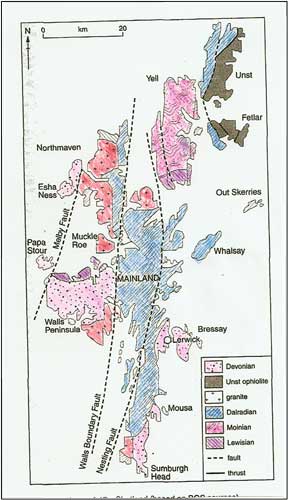
Geology of Shetland. Note the
north- trending grain of the geology which is a consequence of Caledonian
deformation.
The configuration of the islands themselves reflect this trend.
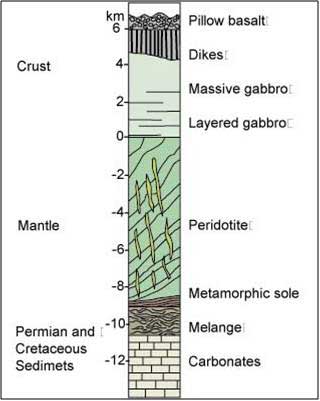
General cross-section showing the
main layers of an ophiolite
(ocean crust).
Note that there are no Permian
or Cretaceous sediments
on Shetland.
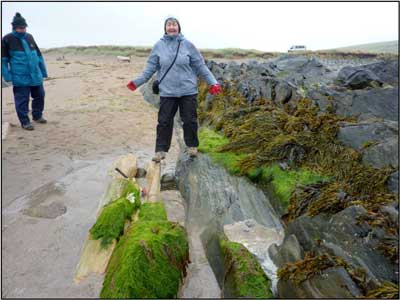
Janet Parry with a foot in both
camps. The light-coloured rock was originally peridotite (now altered to a
talc-rich rock).
The dark rock is Dalradian
meta-sediment (phyllite).
Location Unst.
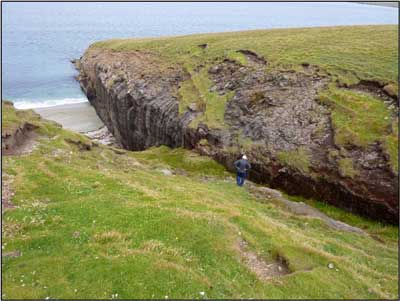
Boundary Fault. The sea has
selectively eroded along the relatively weak fault gouge.
Location NW Mainland.
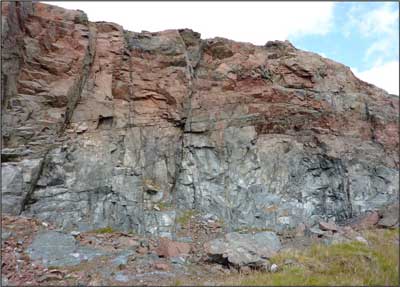
Mixing magmas. Granite (pink) and diorite (grey) occur in close
spatial association with complex relationships.
Location NW Mainland.
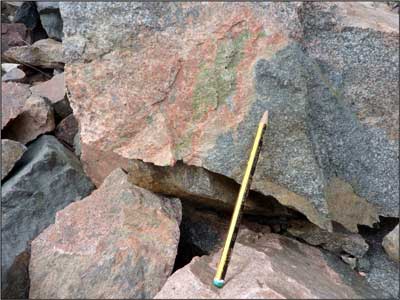
A xenolith of granite within diorite which suggests that the granite is the older rock.
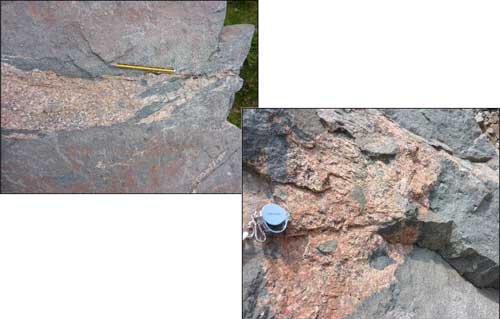
Granite cross-cutting the diorite, a more typical situation.
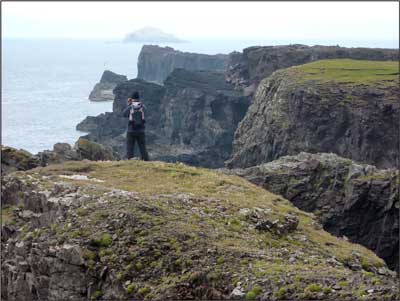
The spectacular coastal scenery
at Eshaness (NW Mainland) formed by a sequence of Devonian volcanics.
The island in the distance is formed by the central pipe of the volcano.
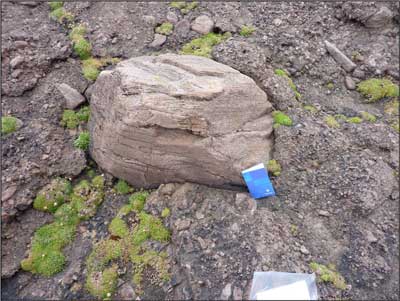
Lithic tuff, Eshaness, formed by a violent volcanic explosion.
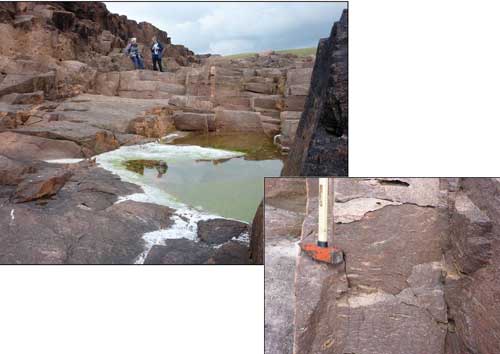
Ignimbrite, Eshaness. Left image shows a channel cut in the cliff top during violent storms.
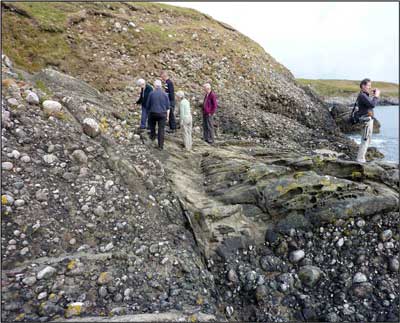
Devonian conglomerate formed by erosion of the Caledonian mountains.