From Sediment to Sedimentary Rock
Richard Edwards – 8th February 2012
Overview
This lecture by Richard Edwards (the 5th in the 2011 – 2012 series) explained the varied and complex processes by which ‘gloopy mud is turned into rock’. The processes include pressure, temperature, chemistry and above all lots of time. The lecture also included a section on Petroleum Geology explaining how reserves of hydrocarbons such as oil and gas are created and accumulated.
The Rock Cycle
The whole process of erosion, sedimentation, and rock formation must be viewed as a repeating cycle where the sedimentary rock itself undergoes later melting with the formation of igneous and metamorphic rocks. These rocks then later become mountains through plate tectonic forces and are then eroded into sediments thus completing a cycle.
Erosion and Sediment Formation
Hard rocks are eroded by rain, snow and ice and the scree thus formed is washed down into rivers and eventually ends up deposited close to the sea in a river estuary or beach.
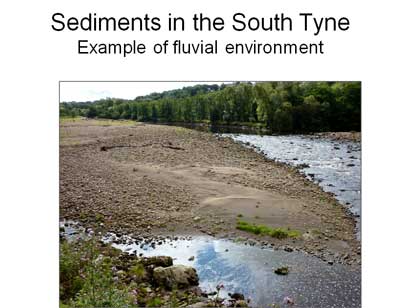
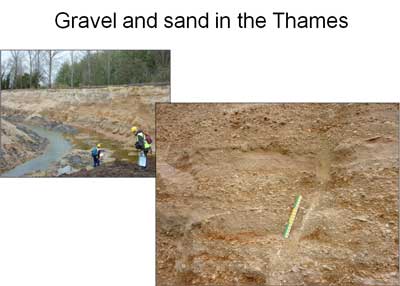
The constituents of siliciclastic sediments are:
· Rock fragments
· Quartz
· Feldspar
· Clay Minerals
· Organic Matter
Even river sediments will still contain bits of original rock mixed in with finer quartz sand particles and minerals. Some minerals, such as feldspars, will break down more quickly than others.
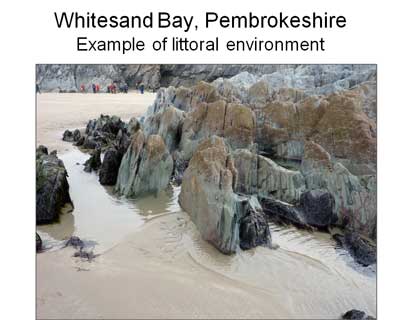
In the littoral environment (beach) the deposits will mainly be of sand where all the larger rock fragments have gone but with smaller grains of the original rock remaining.
Sediment and Rock Classification
Rocks form from three basic starting materials:
· Visible Grains
· Clay Sized Grains
· Chemicals in Solution
Siliciclastic Rocks (e.g. Sandstone, Mudstone etc.) form from combinations of ‘Visible Grains’ and ‘Clay Sized Grains’. Chemical Rocks (e.g. Oolitic Limestone, Gypsum, Chert etc.) and Biochemical Rocks (e.g. Chalk, Peat, Coal etc.) form from concentrated solutions of chemicals such as CaMg(SO3)2, CaSO4, NaCl, SiO3 mixed with organic matter.
Different varieties of sandstone will have varying ‘maturities’. If the sediment is formed and buried quickly it is termed ‘immature’. An example of this would be ‘Arkose’ which has a high content of feldspar. Another example of immature sandstone would be ‘Quartz Wacke’.
If the sediment is not buried quickly but is first washed back and forth, say in the littoral environment, the resulting rock is termed ‘Mature’. An example of this would be ‘Quartz Arenite’.
Diagenesis
Diagenesis may be defined as all the physical, biological and chemical processes that take place in a sediment or sedimentary rock between deposition and either metamorphism or uplift and erosion. This is effectively the process that converts the sediment into rock. Diagenesis occurs approximately down to a depth of 10Km.
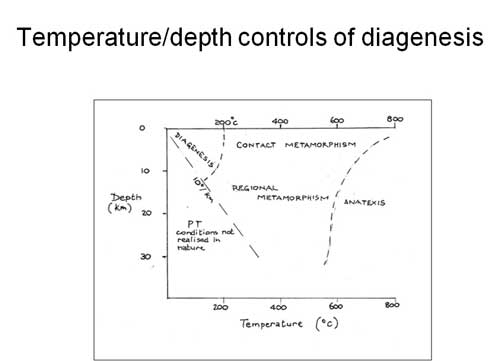
The principal diagenetic changes are:
· Organic Reworking (Bioturbation)
· Growth of New Minerals
· Physical Compaction
· Pressure Solution
· Cementation
· Dissolution by Pore Fluids (usually sea water)
Bioturbation by organisms living in the sediment can lead to disruption of the natural bedding planes which are visible in the mature rock.
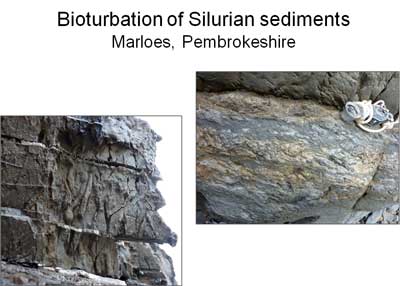
The growth of new minerals via chemical reactions between constituents of the sediment occurs, for example, in the reaction between iron and sulphur to produce Iron Pyrites (‘Fools Gold’).
A good local example of diagenesis can be found in Whitmans Hill Quarry, Storridge, where you can find ball shaped structures within the mudstone of the Silurian Coalbrookdale Formation..
Porosity and Permeability
Porosity is a measure of the pore space between grains in a sediment or rock. Permeability is a measure of the ability of a sediment or rock to transmit fluids. For example:
· Sediments
o Gravel – Medium porosity; high permeability
o Clay – High porosity; very low permeability
· Rocks
o Conglomerates – Moderate porosity; high permeability
o Shale – Low porosity; low permeability
Compaction and Cementation
Compaction compresses particles together reducing pore space and increasing pore liquid pressure and leads to minerals going into solution at the particle points of contact (Pressure Solution). New minerals can now also form in the liquid filled pore spaces and deposited to act as cements. Sea water is usually the initial pore fluid and the salt plays a major role in the chemistry of the mineral formation. The most common cements are quartz and calcite. Rocks cemented with quartz are generally very hard while those cemented with calcite are much softer.
Organic Matter
Vegetable matter is normally converted to peat on or near the surface. Subsequent burial with an increase in pressure and temperature alters the peat to coal as oxygen and hydrogen are driven off.
Organic matter trapped in muddy, oxygen-poor marine sediments is transformed into fatty and waxy substances called Kerogens with increasing temperature and pressure at depth. Kerogens are the precursors of oil and gas.
Petroleum Geology
The necessary conditions for the creation of a petroleum reservoir need to be the co-location of:
· Source rocks - where hydrocarbons originate
· Reservoir rocks - where oil and gas accumulate
· Cap rocks - sealing the reservoir
· Traps - creating the right geological conditions
Source rocks would be fine grain mudstones/shales high in organic content which were buried rapidly to avoid oxidation. This will form Kerogens in a temperature range 60 to 140 °C corresponding approximately to depths of 1500m to 5000m (Note that gas formation can be over a much wider temperature range and at much greater depths).
Over time the Kerogens are then converted to Petroleum.
The reservoir rocks must of course overlay the source rocks and be porous. This would typically be a poorly cemented sandstone.
Overlying the reservoir rock there need to be impermeable cap rocks to contain the petroleum. These would typically be impermeable mud rocks.
In addition to appropriate rock types there is also a requirement for a suitable trap in which the petroleum or gas can accumulate
The three main types of trap are:
· Anticline Trap – Most classic case
· Fault Trap – Classic case
· Salt Dome – Minority case
Most oil and gas wells are of the first two cases.
After the lecture the following questions were raised:
Q1: Can you explain ‘Fracking’ to open up new gas
reserves?
A1: Not enough knowledge to give a good answer.
Q2: How are Tar
Sands formed?
A2: They are an example of a Kerogen-type deposit which has not undergone the
full process of alteration to petroleum.
Q3: Does an oil reserve refill when the pressure is relieved
after emptying?
A3: No - it refills with water.
Q4: Breccia
– Igneous or sedimentary?
A4: Breccias are characterised by angular fragments (clasts) of rock and may be
formed in a sedimentary environment or within a fault zone. The clasts in a
sedimentary may have an igneous origin but the rock remains classified as a
sedimentary one.
Q5: Are there deeper oil and gas deposits?
A5: Two points here. Firstly you can have areas with a low geothermal gradient
which may retain petroleum reserves at depth. Some Russian geologists argue
that petroleum can form as a result of igneous processes and perhaps this will
lead to discoveries in area not previously thought to be prospective.
Dick Harris