THE HEREFORDSHIRE LAGERSTÄTTE
12th November, 2014
SILURIAN SOFT-BODIED FOSSILS FROM A 425 MILLION-YEAR-OLD VOLCANIC ASH
Prof. David J. Siveter, DSc, FGS.
Department of Geology, University of Leicester

On the 12th November, 2014 we heard about some new and spectacular research from the UK’s leading geologist on micro-fossils.
Prof Siveter’s research concerns the palaeobiology of fossil invertebrates, in particular fossil arthropods. His principal themes being the faunas of the Herefordshire (Silurian; UK) and the Chengjiang (Cambrian; Yunnan Province, China) Konservat-Lagerstätten.
The presentation illustrated on-going research on spectacular fossils recovered from Wenlock Series rocks (~425 Ma) of Herefordshire in the Welsh Borderland. Representing one of the rare Silurian lagerstätten, this is a biota of global importance. It contains representatives of many major groups of animals, including molluscs, echinoderms, brachiopods, polychaetes, and most especially a range of arthropods. At this time Herefordshire was located about 20 degrees South with a sub-tropical and warm climate.
Prof Siveter described that our understanding of the history of life on Earth relies heavily on the fossil record, and especially on rare cases of exceptional preservation, where soft parts of animals and entire soft-bodied animals are preserved. Such exceptionally preserved fossils provide an unparalleled view of animal paleobiology and the true nature of animal biodiversity.
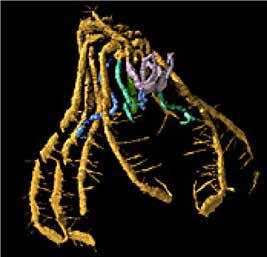
Haliester dasos
(virtual fossil), Pycnogonid (sea spider).
Silurian Herefordshire. (4mm long).
The animals preserved are primarily epibenthic [organisms living at the surface of the sea bed or lake floor], but infauna [aquatic animals living within the matrix of bottom sediment] and nektobenthic [marine life that exist just above the ocean bottom and occasionally rest on it] forms are also represented. The fossils are preserved as three dimensional calcite void-fills in carbonate nodules and are impossible to extract by standard methods. We heard that the specimens are studied using tomographic techniques to produce high fidelity three-dimensional virtual fossils that yield a wealth of palaeobiological information. By taking the specimen, slicing it at 20 micron intervals and recording each image, a three-dimensional computer realisation of the animal is made (see images for examples).
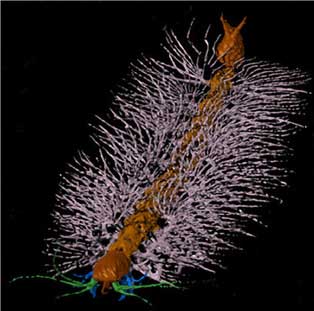
A newly discovered fossil arthropod, christened Enalikler aphson, in 425 million year old rocks in Herefordshire, by Prof. Sileter’s group. In belongs to an extinct group of marine-dwelling ‘short-great-appendage’ arthropods, Megacheira, defined by their claw-like limbs (2.4 cm long).
These fossils are crucial in helping to fill a gap in our knowledge of the history of life and to resolve controversies about the relationships and evolution of animals still alive today.
Because of the remarkable conditions of the bentonite matrix [fine volcanic ash] prevailing at the time of death a state of preservation, presumed to have encapsulated the animal moments (much less than a single day – perhaps even seconds) after death, enabled even the soft body parts of these tiny creatures to be seen. This unprecedented state of preservation, currently unexplained, exceeds the renowned Burgess Shale micro-arthopod [invertebrates with segmented bodies and jointed legs - includes spiders, insects and crustaceans] specimens in their detail and fidelity. For some of these micro-fossils it has been possible to identify their gender and others (ostracods) have clearly visible egg sacs – again illustrative of the remarkable state of preservation.
Since the days of Murchison the geology of this region has been studied and discoveries made. This discovery being the latest and most incredible (believed unique in the world) in the continuing understanding of the flora and fauna of our region.