Exotic Rocks and Fossils from NE Arabia
Glimpses of a Former Permian Ocean
Wed14 Jan 2015
By Alan Heward
Alan has worked and lived in Oman over many years in the oil exploration industry. During this time he developed a lifelong interest in the geology of this area of the world and in particular in its fossils.
The geology of the Gulf of Oman is characterised by what is probably one of the best examples of an Ophiolite in the world. This Ophiolite was originally formed in the Tethys Ocean some 100 MYA by tectonic action resulting from the Northwards movement of the India into the Eurasian plate. This started to close the Tethys Ocean and formed the Ophiolite around the original spreading ridge that even earlier had opened up the Tethys Ocean. As the Tethys Ocean continued to close the Ophiolite was pushed up onto the Arabian Peninsula to be where it is now around 25 MYA. The current Gulf of Oman is what remains of the old Tethys Ocean

The Ophiolite is so extensive that it can easily be seen on Google Earth!
Because of its origin the rocks of the Ophiolite are completely different (exotic) to those of the Arabian interior and contain ‘jumbled up’ rocks scraped up from the bottom of the Indian Ocean mixed with the serpentinite rocks of the Ophiolite.
In parallel with his day job in the oil industry Alan has studied many sites in this area and in particular has accumulated a vast collection of fossils. Because the fossils were created quite a long way away and a long time before the present geography of this region it is possible to make links to fossils found in other continents that were once joined or closer together. In particular Permian Crinoids found in Oman are directly related to those found in Timor and Western Australia. This kind of evidence is important in unravelling how the continents have moved.
Since retiring Alan has sent many of his fossils to international experts for dating and analysis. This has shown that the Oman fossils were laid down in a period from the Lower Permian (273 MYA) through the Middle Permian (266 MYA) to the Late Permian (252 MYA). The range and types of fossils are very large and represents a period of massive fauna evolution. All the main marine species are present including:
- Crinoids
- Trilobites
- Fusulines
- Conodonts
- Brachiopods
Dating techniques using fossils include the use of Fusilines and Conodonts. In the case of Fusilinids (extinct shellfish) many species only lived over relatively short time periods in geological terms (~100KY) and therefore are good index fossils using shell structure and shape. In the case of Conodonts (‘eel like’ animals) the main fossil is dissolved in acetic acid leaving behind the teeth. The precise arrangement and shape of these teeth define their age. In addition the colour of the teeth changes with heat and can therefore be used to provide evidence of the amount of ‘cooking’ they have undergone and hence the history of the depth and temperature of their incorporation in the surrounding rock.


One very important aspect of the collection is that it immediately precedes the great Permian extinction when 82% of all genera and up to 97% of all species disappeared. The reasons for this extinction are still speculative and so far no evidence has been found in Alan’s collection that sheds any new light on this.
However recent expert analysis has identified some interesting results:
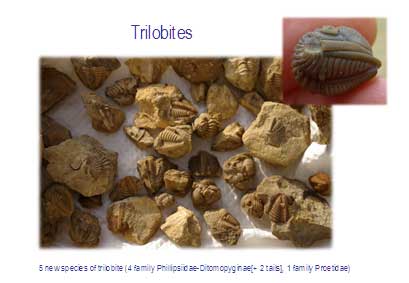
Trilobites
- 6 different new species have been identified
- The species diversity was much greater before the Permian extinction than afterwards
- The pre-extinction species were more like scavengers that afterwards
- The distribution of species along what would have been the Eastern side of Pangea suggests transport by ocean currents from what is now Turkey, India and Australia in the Palaeotethys ocean.
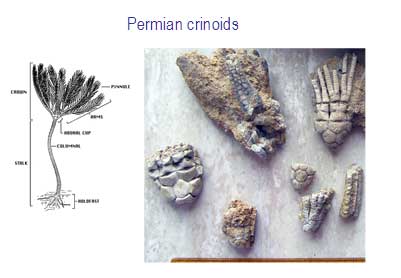
Crinoids
- Species found that had never been reported outside of West Timor
- Evidence of ‘Micro Crinoids’ found on the surface of the Crinoid fossils
Brachiopods
- Oman specimens are very well preserved
- Similar species can be found in Italy, Sicily and Turkey
- More evidence of ocean current distribution on the Eastern side of Permian Pangea
Copepods
On one field trip one of Alan’s party found a piece of black ‘rock’ that turned out to be bitumen. This must have formed from oil seeping onto the surface. Subsequent analysis involving dissolving the bitumen revealed the presence of fossilised Copepods. These are very small crustaceans found in almost any kind of water (including unfiltered domestic supplies!). However subsequent dating put back the earliest date for Copepods by some 300 MY!

Alan has had his fossil collection for many years and has only shown them to experts in recent times not knowing how valuable they are. His final remarks were that if you think you have a good fossil show it to an expert as soon as possible!
Dick Harris
January 2015