Lapworth visit
The U3A geology group visited the Lapworth geology museum at Birmingham University on the Wednesday 17 June 2009.
Click here for:
o A write up on the visit by Jeanne Titley, one of the U3A members.
Pictures of:
Don’t forget to click down into web links for additional information. These are generally accessed via highlighted words on the titles of the pictures.
Visit report
When Jim Handley proposed to organise and lead a visit to the Lapworth Museum of Geology at Birmingham University, I rushed to get my name down. That was a wise move: we had a wonderful time.
On arrival we were welcomed by the archivist who was to be our host and guide for the day.
The museum, named after Charles Lapworth, the first professor of geology there in 1881, is a major geological museum. It houses an extensive range of over 250,000 specimens, as well as rare early geological maps and the detailed Lapworth Archives.
We were told about, and shown, slides of the history of the museum, as well as being given fascinating information about the early geologists. We were also able to see and handle early maps as well as some of the amazing fossils in the collection. Among these were examples of some of the 700 fossil species found in the Wenlock limestone at Wren’s Nest, a national nature reserve at Dudley. These were deposited about 420 million years ago at a time when this part of Britain was under a warm shallow sea. Imagine that in Dudley!
Among the fossils are a small number of fakes. A few legs does not make an impressive fossil but put them together with a head and the forger has a valuable fossil of a trilobite to sell. So much for Victorian values!
One particular exhibit was that of a spider trapped forever in a piece of amber. This poor creature was unable to escape from the sticky resin and died enjoying his last delicious meal. I suppose there can be worse ways for a hungry spider to go.
Handling nuggets of gold and platinum was instructive too. Two pieces were about the same size but the difference in weight was pronounced. Needless to say we were not allowed to bring them back to show off our knowledge but we could take photographs so please look for these on our local U3A web site.
The day was made even more enjoyable because it was not tiring. The walk from the station was short and level. Coffee, tea and biscuits were available throughout the day and we were able to sit down for most of the time.
Many thanks to Jim Handley for organising an informative and hugely enjoyable day. If he can be prevailed upon to organise another visit to Lapworth, get your name down fast!
Jeanne Titley
Geological maps
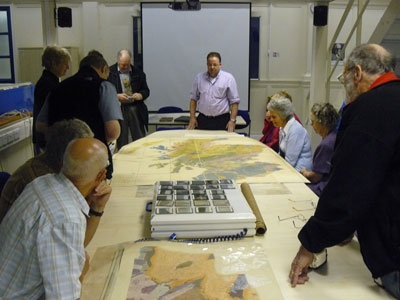
Viewing the collection of geological maps.
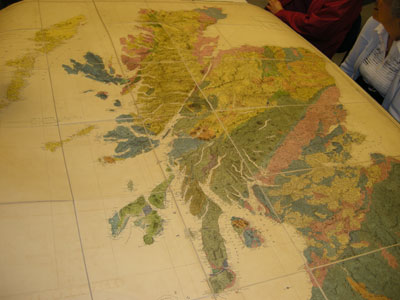
MacCulloch’s 1836 map of Scotland.

Murchison’s map of the Midlands.

One of Charles Lapworth’s maps.
Vertebrate fossils
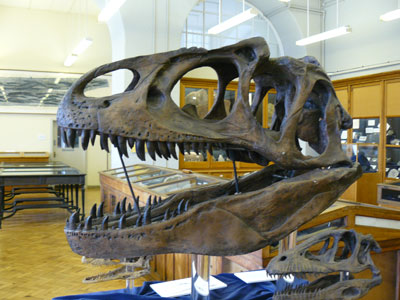
A cast of the first specimen discovered in 1902.

Eryops Megacephalus. Early Permian, 295 million years old.

Smilodon or Saber-Toother Cat.
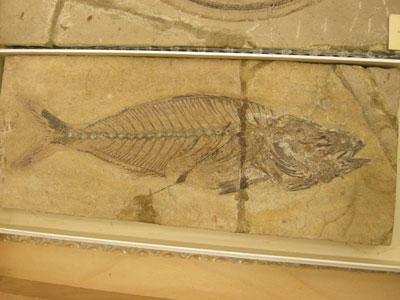
An Eocene fish.
Invertebrate fossils
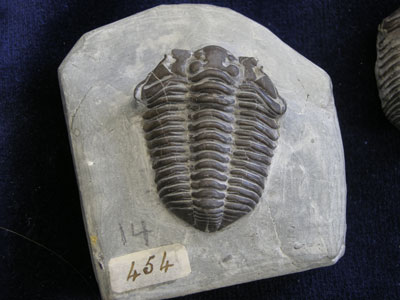

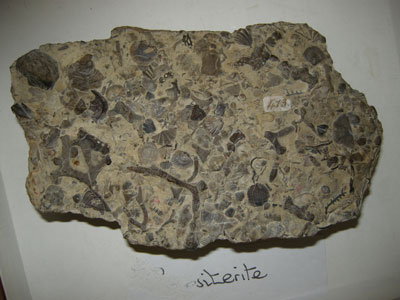
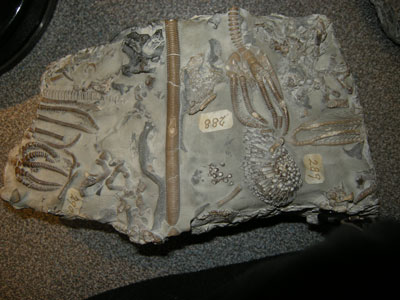
Silurian fossils from Wren’s Nest, Dudley.
Other interesting miscellanea

Viewing the mineral collection.


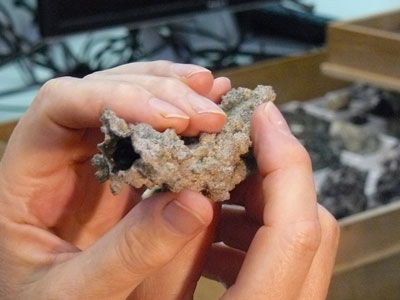
A fossilised lightning strike (a fulgurite).