Malvern Town Centre walk
The U3A geology group visited Malvern Town centre on Thursday 13 Aug 2009.
Click here for:
o A visit report on the visit by Jim Handley, our group leader.
If you want to repeat our walk, you will need the Great Malvern Earth Heritage Trust trail guide. This can be purchased from Herefordshire and Worcestershire Earth Heritage Trust; Geological Records Centre; University of Worcester; Henwick Grove; Worcester WR2 6AJ (01905 855184) ; cost around £2.
Don’t forget to click down into web links for additional information. These are generally accessed via highlighted words on the titles of the pictures.
Visit report
What have Elgar’s Enigma Fountain, Robson Ward Kitchen Courtyard and the Shaw Trust charity shop got in common?
In August, 22 of us focused on the story of geology displayed in the building blocks of Malvern town centre. Brain Iles kindly let us first look at the Museum’s geological displays. We then looked at the history of the Priory Gatehouse through its building materials. Just stand underneath the archway and look at the original green [probably Cradley] sandstone blocks contrasting with the red sandstone used when it was extended in the 1560’s.
Elgar stands beside a Yorkshire sandstone fountain with local granite, epidote and diorite in the wall behind him. Lloyd’s Bank shows off its Jurassic oolitic limestone and have you seen the shells in the same limestone in the window sills of the Tourist Information centre. Down Church Street the frontage of Shaw Trust brings an international flavour – the blue polished stone is larvikite from near Larvik in Norway. The large crystals within this igneous rock, which cooled slowly within the earth’s crust, are iridescent if you catch the sun shining on them.
The Priory is an absolute palette of various coloured stone and a classic example that stones erode at different rates and need replacing. Just look close up at the erosion of the red sandstone at the east end. There are at least 10 varieties of building stone creating the glorious current jigsaw effect outside. Inside the Norman columns are more Cradley green sandstone but do look up above the arches where some local Malvern stone was originally incorporated.
As for the Kitchen Courtyard – walk under the archway near W.H. Smiths and go to the far back right hand corner and you will find one of the local wells. Take a torch and look at the back wall. The bottom wall is red Triassic sandstone but on top of it is a layer of unconsolidated pre Cambrian rocks set into a clay/sand mix and called head. This head only arrived here about 20,000 years ago when Malvern had a periglacial climate. Surface rocks were shattered by the extreme cold and intermittent thawing and gravity took over!
So now you know, many of the buildings or monuments in Malvern have geology waiting to be noticed if we just take a few moments to stand and stare!
Visit to Malvern Museum
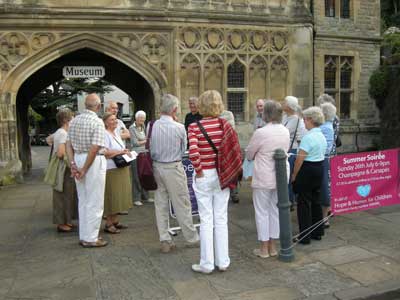
The geology group arrive outside Malvern Museum
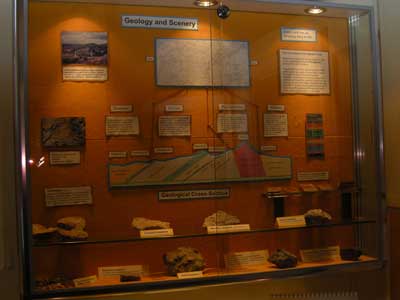
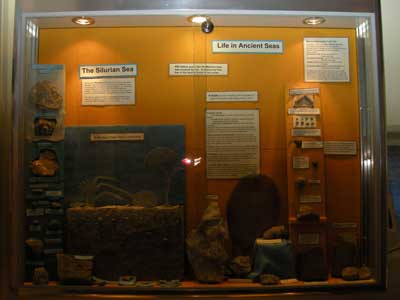
Two of the displays in the Museum, based around the geology of the Malvern area.
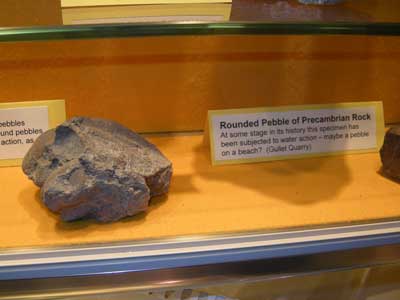
Precambrian pebble displaying evidence that there was a sea shore in those times.
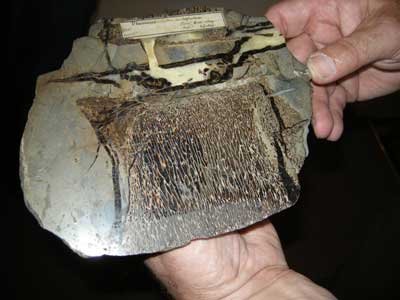
Fossilised dinosaur skin from a Pliosaurus
Pictures of the walk
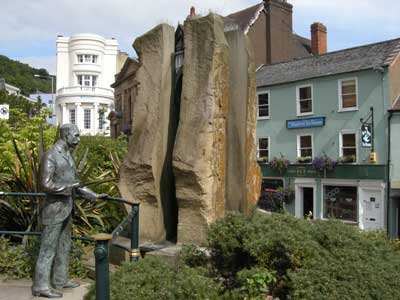
The Enigma fountain on Belle Vue Terrace, erected in 2000. This is carved from a buff coloured Yorkshire sandstone of Carboniferous age (345 million years old). On one face of the fountain you can see orange-brown stains where the iron-rich layer in the sandstone has oxidised to rust.
We examined the building rocks in the wall behind the fountain. These are from local quarries and are of Precambrian age (700 million year old). They are either igneous or metamorphic.
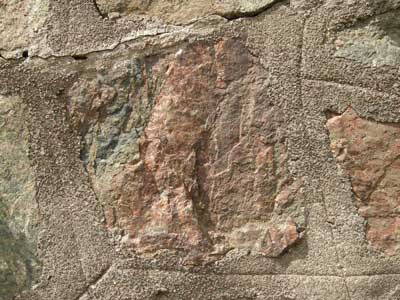
Pinkish – granite.
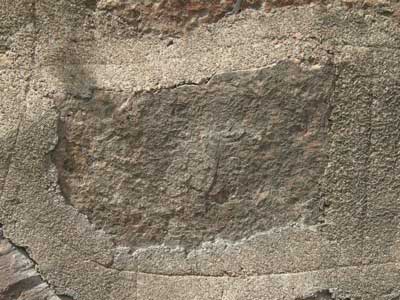
Black / dark grey – diorite.
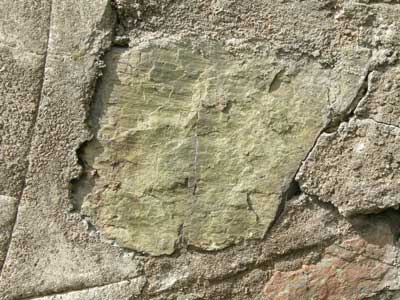
Yellow / green hue – epidote.
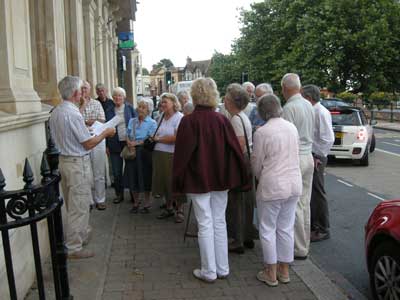
The group examining the building stones at Lloyds TSB Bank, Belle Vue Terrace.
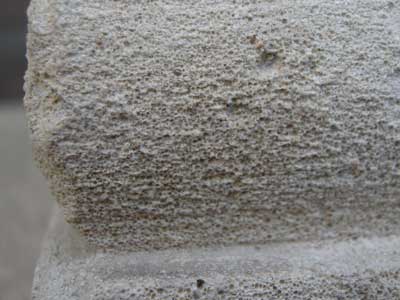
Close up of the building stones at Lloyds TSB Bank. This is Jurassic shelly oolitic limestone (195 million years old). As the rock weathers the ooliths (spherical grains) can be clearly seen.
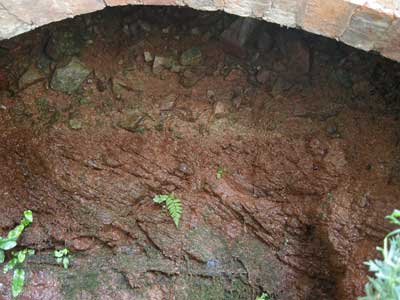
Robson Ward Kitchens Courtyard. In the courtyard near W H Smith there is a natural spring. At the back of the spring there is a natural outcrop of bedrock. There are two separate visible layers forming an unconformity. The lower rock is Bromsgrove Sandstone which is Triassic (230 million years old). There is then an unconsolidated layer overlaying the sandstone. This is known as periglacical (cold climate) head. It is Quaternary in age, perhaps 20,000 years old. Head is a chaotic mass of sand, clay and larger angular rock fragments. It is produced when thawed material slides downhill from frozen ground in a tundra landscape.
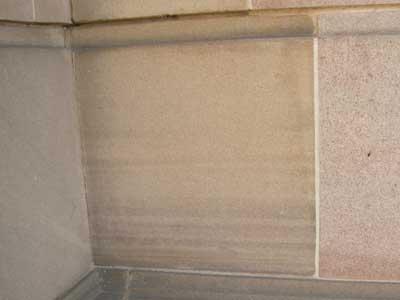
HSBC Bank. The building stones used here hard sandstone. The laminations in the block shown are horizontal, the same as the manner it was laid down in.
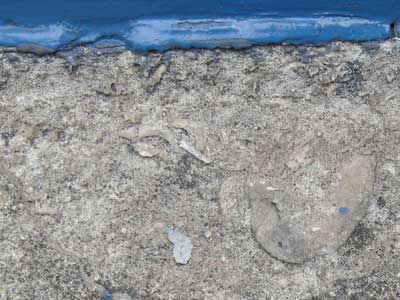
The Tourist Information Centre on Church Street. On the wall beneath the window sill you can see fossil shell fragments and ooliths in the shelly oolitic limestone. These is Jurassic in age.
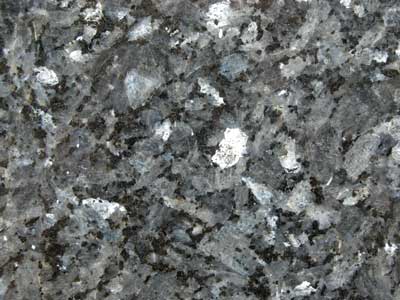
The Shaw Trust shop, 59 Church Street. The attractive facing stone is polished Larvikite. This was quarried from the hills above Larvik in Norway. The crystals within the rock are iridescent, light is reflected from different surfaces within the crystals to produce a shimmering effect. It is an igneous rock that cooled very slowly within the Earth’s crust thus allowing large crystals to form.
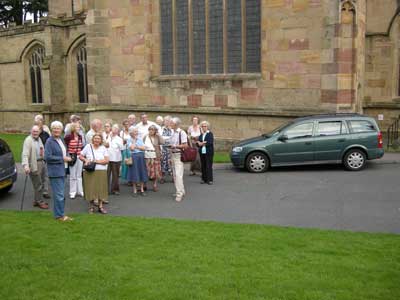
The group examining the variety of building stones used during the construction of Malvern Priory. These are mostly sandstone which has the advantage of being easily worked by the stonemasons.
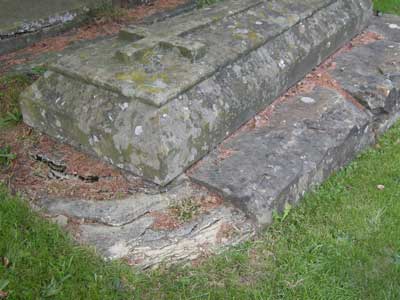
A sandstone tomb showing differing effects of the weather. The softer layers in the near corner have been weathered away, whilst the harder layers remain and stand proud.