Lapworth visit 2010
The U3A geology group visited the Lapworth geology museum at Birmingham University on the Wednesday 19 May 2010.
Click here for:
· Archives
Visit report by Cec Roberts
A group of about twenty Malvern U3A Geology Group Members arrived on The Birmingham University Campus at Edgbaston with some excitement and expectation, but few could have imagined or anticipated the delights that were to unfold during the day.
John Clatworthy, curator of the Lapworth Museum of Geology, welcomed us. Jim Handley, who had organised the visit, light-heartedly, introduced us as a group of PhD's. but in reality we were of mixed ability, some of us being quite new to geology. John and his assistant, also John, were to be our hosts for the day. Our visit was to be very much hands-on, they were to show us some of the geological collections and take a look behind the scenes.
A schedule for the day had been planned in advance: -
· Arrival. Brief introduction. Tea and biscuits, and an opportunity to view the geological collections in the main exhibition hall.
· Illustrated talk:- History of the museum. An overview of the collections. A conducted visit to the archives.
· Packed lunch in the main exhibition hall, with another chance to see the exhibits.
· Illustrated talk:- a more detailed look at some of the more important and interesting specimens from the collections.
ILLUSTRATED TALK (am. session)
History of the museum.
The Museum is named after Charles Lapworth. In 1880 the Museum was located on the top floor of Mason Science College - Geology was one of the original college departments and Charles Lapworth was the first professor of geology. A role in which he continued when it became The University of Birmingham, in 1917 the collections were moved to the present Edgbaston Campus.
The Museum is home to more than 250,000 specimens, of fossils, rocks and minerals, plus a diverse range of objects including early scientific instruments, geological maps, photographs and other archive material as well as zoological exhibits.
The Fossil Collections include around 4500 type and figured specimens, designated biological and zoological type specimens, including the Trilobite type specimen.
Wenlock:- Many of the finest fossils are from the Wenlock Limestone, which extends from Walsall across the West Midlands to the Welsh Border. Wenlock was a marine environment, with shallow, clear water, warm seas - what we today, would call Tropical - with a build up of organisms on a shallow sea floor as reef structures around 425 Ma. Wenlock limestone is common around Wren's Nest Dudley.
Trilobites are extremely variable, and with predatory fish developing, over time they evolved defensive mechanisms in the form of spines etc.
Wenlock fauna includes:- well preserved trilobites; crinoids; corals - bun, chain, branching; and the "problematica" - we don't really know what they are!
Cosley:- The coalfields just to the north of Dudley reveal terrestrial fossils of carboniferous age. A lacustrine delta environment covered this area with humid, dense, waterlogged swamps - ironstone nodules formed about 305 Ma.
Coseley fauna is very diverse and well preserved; it includes giant millipedes, dragonflies, spider mites, crabs and fish.
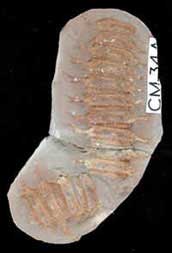
A millipede from the Coseley collection.
Lapworth:- A collection of graptolites.
The Mineral Collections are similarly diverse with around 15,000 specimens from all over the World.
Dr. John Percy. - Metallurgist - a collection of 1200 specimens.
William Murdock's mineral collection. Murdock was an engineer and inventor.
Other Collections:-
The Samuel Allport collection of rock and mineral slides.
Humphrey's dentistry collection of fossilised teeth and jawbones.
Early Scientific Instruments, which includes the first seismograph- earthquake recorder- by J.J.Shaw 1873-1948. He was a pawnbroker.
BMAG Collections are being relocated in The Lapworth Museum.
Lapworth Archive:- This is one of the most important and complete scientific records of its time - late 19th. to early 20th. century - probably second only to Charles Darwin. He kept everything! Charles Lapworth was an arts teacher from Oxford prior to his geological studies of the Southern Uplands of Scotland. He was able to unravel the formation of the Scottish Highlands through the study of graptolites. Graptolites are an extinct group of marine colonial plankton. Lapworth became a World Authority on graptolites. His arts background enabled him to make detailed drawings of the fossils and superb geological sections of the areas he studied - we were able to see the original drawings he made around Dobbs' Linn near Moffat - they really are exquisite!
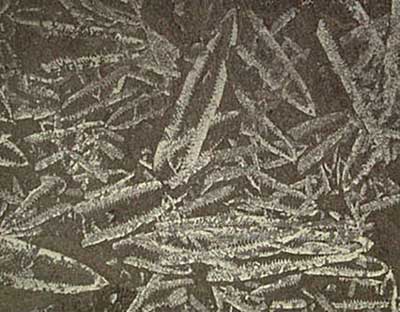
Graptolites from the Lapworth Archive.
Shotton Archive:- Fred Shotton was Professor of Geology at Birmingham and played an important top-secret role in the 1944 D-Day landings. Original maps are in the collection, which assessed the geology of the Normandy beaches.
Map Room:- A selection of original early geological maps of The British Isles were on display - On the earliest maps many parts of Scotland had yet to be surveyed. Stratigraphical Columns through colliery mine shafts were also on display dating back as far as 1825. Early and current geological maps of our local area were also laid out for us to compare.
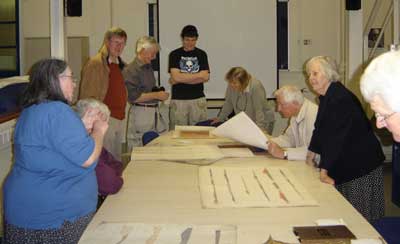
The group looks at the map collection.
The Lapworth Museum has a fine collection of early geological maps published by many of the most important, and distinguished, geologists of the nineteenth century and include:- Geological maps by William Smith; George Bellas Greenough; John MacCulloch; Sir Roderick Murchison and an attractive map, is Walker's Geological Map of England, Wales and part of Scotland.
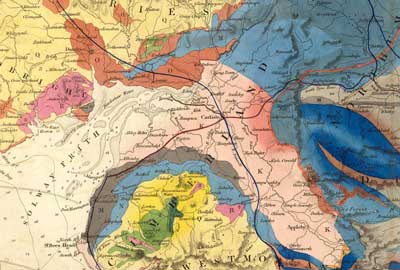
An area of one of Walker’s maps.
William Smith was employed as a surveyor and spent many years travelling the country working on the construction of new canals, this gave him the opportunity to study the rocks and fossils in great detail. He produced the first large-scale geological map of England and Wales, which was published in 1815. Later, Smith produced a number of County geological maps of which the Lapworth Museum has various copies.
ILLUSTRATED TALK (pm. Session)
A more detailed look at some of the specimens from the museum’s collections through an excellent presentation by John Clatwothy and John his assistant. The talk was illustrated via a multi-screen projection system, which enabled all of us to see the specimens displayed in fine detail, and there was a hands-on inspection of the specimens discussed. John explained that the exceptional preservation of so many of the fossil specimens was due to the very rapid deposition of very fine grain sediments, almost mud, in a low oxygen environment. In other cases fossils had been preserved under layers of volcanic ash.
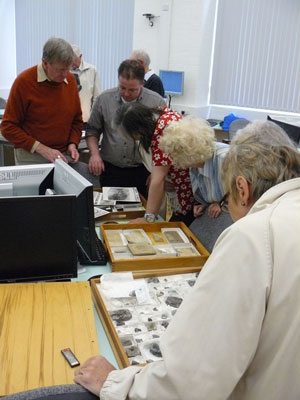
The group viewing the specimens in the museum’s collections.
Some of Samuel Allport's rock and mineral slides were shown and discussed. The very thin section rock slides were cut with a diamond saw, ground down then lapped and polished by hand. The first book of slides published in 1880 described - the "best slides" were those produced by Samuel Allport. Samuel Allport was the first to use a polarised light microscope to view slides of rock and mineral specimens. Use of polarised light for this purpose was demonstrated on modern slides. A range of features and colours can be seen through polarised light that are not visible with an ordinary light source. The specimens were rotated and switched between the two light sources for comparison.
Many rock and mineral specimens were displayed, discussed and passed around for inspection.
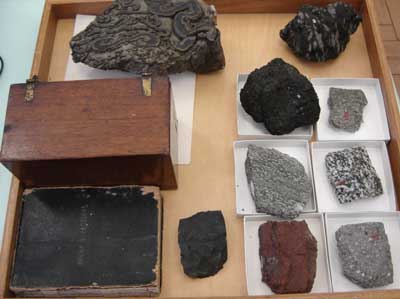
A small part of the rock and mineral collection.
Fulgurite: John explained that this is essentially a very fragile glass tube encased in sand grains - a fossilised lightning strike. These can be several metres long, but due to their fragility almost impossible to extract.
Kenyte: The specimen shown came from Mt. Erebus, Ross Island, E. Antarctica.
Kenyte (a variety of phonolite) is very rare and is a volcanic rock type found only in Antarctica and Kenya.
Amphibolite: Sir Martin Frobisher the explorer collected this specimen from Baffin Island in Canada, around 1580, making it the earliest collected specimen within the museum. He had been searching for "black earth rich in gold", but the "ore", he had collected proved to be worthless, gold-free amphibolite.
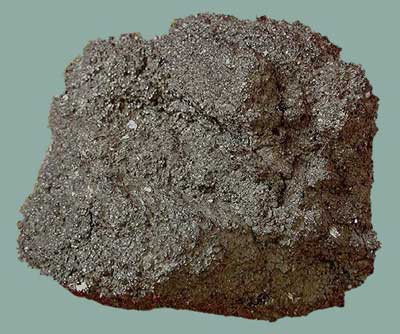
Amphibolite from the Frobisher collection.
Meteorite: The oldest objects in the museum at around 4,500 Ma.
A complete specimen and a sliced section were shown and passed around. The Iron/Nickel alloy slice had the appearance of today's stainless steel.
Gold and Platinum nuggets: Hands-on but no free samples.
Many fossils were similarly shown and included :-
Outstanding fossil fish 50 Ma from Verona Italy, with exceptionally well preserved tissue.
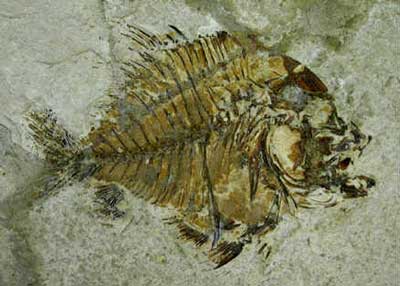
Fossil fish from Verona, Italy.
Dragonfly with 10cm wing - wing span 20cm - again very well preserved.
Fine dendritic mineral growth also appeared on this specimen.
Crinoids: From the Sir Charles Holcroft collection - Holcroft was an iron and coal master in the Dudley area. We were shown the detailed hand-written "fossil register" that he kept of his collections, with information on each specimen and of the payments he made to quarry workers for particularly fine or rare specimens. Again all specimens were in a high state of preservation.
Trilobites: The actual type specimen was shown - it's worth a small fortune.
Other specimens were shown with remarkable preservation revealing every detail of trilobite eyes - compound eyes made from calcite.
Spider mite: A giant specimen 6 cm long, embedded in a nodule.
John explained that modern non-destructive CT scanning techniques are now being used to "see" detail on the underside of embedded fossils.
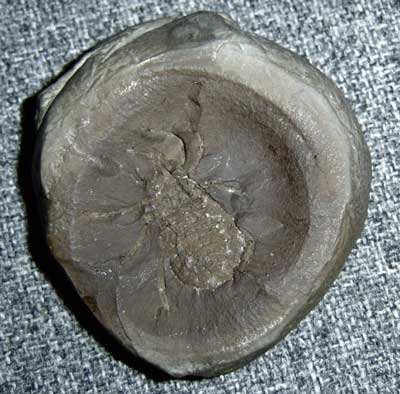
Spider mite nodule.
Insects: Embedded in amber were on display.
And finally a slab of flexible sandstone from India - some thought that this was a trick specimen and despite John's plausible scientific explanation of how it had been formed, some were still not convinced!
We had a very interesting day - a day to remember. We all gained from the experience, which exceeded our expectations. Many of us now realise that we have only just scratched the surface of what lies beneath our feet.
The whole day was well planned and organised. Our thanks go out to Jim Handley for his organisational skills, it all went like clockwork and to John Clatsworthy and his able assistant John for their knowledge, helpfulness and enthusiasm that made our day informative and most enjoyable.