Cirencester
The U3A geology group organised a coach trip to Cirencester town centre on Wednesday 17 August 2011.
The walk was based on the town trail guide, “Cirencester in Stone”, produced by the Gloucestershire Geology Trust. For more details, click here. Also available by post, “The Tithe Barn Centre , Brockworth. GL3 4QU”.
Visit report by Rosemary Fretwell
Click here for: Morning, Lunchtime, Afternoon.
The bedrock on which Cirencester was built is from the Middle Jurassic period, the Great Oolite Group. It was laid down in warm shallow seas between 167 and 164 million years ago. Many of the buildings in the town are made from stone in this group, but some are constructed from the slightly older Inferior Oolite Group which occurs further north. Some gravels from the ice ages of the Pleistocene period also occur, but nothing from the Upper Jurassic, Cretaceous or Cenozoic periods. If deposits were laid down in this area during those times, all traces of them had eroded away before the Pleistocene Ice Age between 500 000 and 10 000 years ago.
The Great Oolite Group is a limestone, so it is full of fossils. But the ooliths themselves are not fossils. They are rounded humps which grow around shelly fragments or grains of sand. They give the limestone the appearance of a frozen semolina pudding!
Morning
We followed part of the Town Trail using the guide book ‘Cirencester in Stone’ which is produced by the Gloucestershire Geology Trust.
1. The Roman Wall
The wall was built using blocks of Great Oolite Limestone. The ooliths were clearly visible through a hand lens.

The Roman Wall. This is the only remaining section of the wall which once encircled the town. Made of Jurassic limestone.
2. The Abbey Gateway
The roof is made of ‘Cotswold slates’ which are not slates at all! They are a fissile limestone from the Jurassic sequence which splits naturally into thin layers. The arch is oolitic limestone, though there is some local sandstone and a shelly limestone as well. Also a dark brown coarse-textured shelly limestone — all from the Jurassic sequence.

The Abbey Gateway. The only major part of the medieval abbey still standing today.
3. Dry stone wall
A dry stone wall in the Abbey grounds has been constructed using shaped blocks of Jurassic limestone. Much neater than its country counterpart where rough stones are used.

The dry stone wall, to the western side of the Abbey grounds.
4. Dyer Street
The Woolmarket area is paved with York Stone which comes from the Carboniferous Coal Measures near Leeds. There are harder inserts of Cornish granite.
The archway at the entrance to the Woolmarket is made of limestone blocks which are full of fossils — bivalves, gastropods and brachiopods.
No 5 Dyer Street is constructed from fine oolite ashlar. Ashlar is an oolitic limestone which is reasonably soft when quarried, so can be cut into smooth blocks. It hardens with weathering. Even so, we found fossils in it!

No 5 Dyer Street. Note the brown ragstone used in the footings for improved strength, and that the doorsteps, which receive hard wear, are constructed from a green-grey sandstone.
No 14 Dyer Street has Larvikite cladding under the shop window. Larvikite is an igneous rock imported from Norway which resembles a granite. It reflects blue light.
The cobbled area in front of the Bear Inn consists of a variety of igneous blocks. Basalts (black), diorites (greenish-grey) and granites (pink) — also a light coloured quartzite which is a metamorphosed sandstone.
5. Market Square
The Nat West Bank is built of Bath Stone. There is more calcium carbonate between the ooliths in this stone making it better cemented. This means it is more resistant to weathering and therefore lasts longer.
The Corn Hall sports beautiful carvings in stone. The fine-grained limestone enables intricate carving without crumbling.

The Corn Hall, Market Square, circa 1842. Fronted with a cream coloured oolite, the building has high quality carvings.
6. HSBC Bank
This building has been constructed from Portland Stone, which is easily cut, is strong and has a good colour. Portland Stone is the premier building stone of England, and is still quarried on the Dorset coast. Within the stone there are curved shell fossils several centimetres long.
7. St John Baptist Church
The most magnificent feature of the church is the porch, which is not actually part of the church at all but a separate secular building (see lunchtime activity). The fan-vaulted ceiling made of fine-grained oolitic limestone is spectacular!
Around the tower of the church there is much use of ragstone, a coarse-grained shelly limestone used for building purposes. Inside, the main font has a pedestal of crinoidal limestone, crinoids being echinoderms (related to star fish and sea urchins). A lesser font is made of white marble (probably imported from Italy) which is metamorphosed limestone.

The fan-vaulted ceiling of St. John Baptist Church. This late 15th century stonework required large single masses of Cotswold limestone to be quarried.
8. Shop with Travertine cladding
We passed a shop which is faced by a cladding of cream-coloured travertine. Travertine, this variety was imported from Italy, is a finely crystalline limestone with undulose banding formed by the rapid precipitation of carbonate minerals by warm or hot springs, accompanied by algal growth.
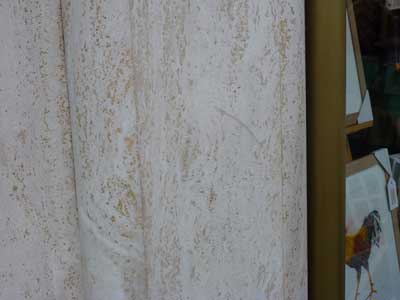
Travertine cladding. A distinctive type of limestone characterised by wavy-banded algal growths.
9. Coxwell Street
Coxwell Street is the best preserved of the streets exhibiting the wealth of the 17th and 18th century wool merchants. Most of the houses are built of local Cotswold Jurassic oolitic limestone with some sandstone dressings and the occasional use of ragstone, particularly as footings.
The gateway pillars of Coxwell Court have inset panels of Dagstone, which comes from the nearby Daglingworth quarry. Dagstone is a sparsely oolitic Jurassic limestone which cemented and hardened on the seafloor shortly after deposition, rather than much later following deep burial by younger sediments. The holes were made by burrowing animals called piddocks, a bivalve mollusc closely resembling a clam.

The gateway pillars of Coxwell Court. More examples of Dagstone Stone were seen at Cirencester Park.
Time was getting on, so we went straight on to…
13. Cirencester Park
The ornamental gateway to Lord Bathurst’s estate is constructed of ashlar freestone oolite framing panels of Dagstone. The yew hedge behind is said to be the tallest in the country.
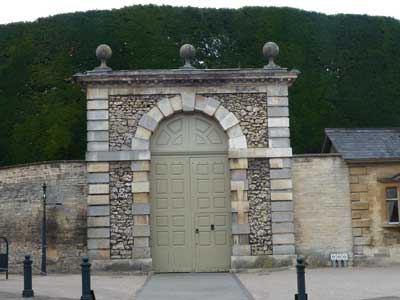
The ornamental gateway to Cirencester Park. The Estate has been in the Bathurst family since 1695.
14. Tetbury Road pavements
We walked across paving slabs made of York Stone from the Upper Carboniferous of the Pennines area. The structures were probably formed in an ancient river delta. We saw examples of graded bedding and cross bedding, both formed in flowing water.

A good example of graded bedding in the Tetbury Road pavements.
Lunchtime
Those of us who were able to climb six flights of stairs had an extra treat at lunchtime! The elaborate porch of St John Baptist church was built in 1550 as an office for the abbot and the town hall. It is, in fact, not actually part of the church, but a separate structure though built very close. To this day it is a secular building and has never been consecrated.
Recently it has become a danger to the public, and was in urgent need of repair. Part of the funding for this has come from public money, so the public are allowed to climb the scaffolding in small groups with a very knowledgeable guide to view the conservation work at close quarters. It was pointed out that this is conservation work, not restoration, so they are only making good what is still there and making the building safe. They are not restoring the building to what it was originally.
Major repairs had taken place in 1908-09 and again in 1954-55, but only lime and cement based renders were used with virtually no replacement of decayed stone. This had eroded to such an extent that lumps of concrete were actually falling off! This time they want to make more permanent repairs, hopefully lasting up to 200 years.
They thought they would have to go abroad to obtain the replacement stone because all the original quarries had been worked out years ago. But then a match was found at Syreford, a small quarry near Cheltenham, so ‘local’ stone has been used after all. New stone is being added where previous repairs have failed, or are likely to fail over the next 10 to 15 years.
Other areas are being consolidated using a range of lime mortar techniques. Red tiles were inserted in the 1908 repair, then washed over with a lime mortar. This same technique is being used in the 2011 restoration, but the tiles are beige-coloured this time so that future generations will easily be able to date the areas of repair. The tiles, or parts of tiles, are stuck on with epoxy resin, then washed over with lime mortar which hardens to form a more permanent repair. They look like new, in stark contrast to the areas which have eroded a little but are not in need of repair.
A discreet lead shroud will be profiled and fitted at the base of the parapet when the stone work is finished. Hopefully this will stop the rain running down in ‘strings’ forming channels of erosion. Finally the whole edifice will be painted in a light off-white colour as it was when it was originally built. Our guide told us, with a wry smile, that this is certain to cause a lot of controversy locally, and fill out the letters page in the local paper for many weeks!

Some of the repair work witnessed on St John Baptist church.
It was wonderful to be up on a level with this external stonework and inspect it at close quarters. It was an opportunity not to be missed as it won’t happen again for two hundred years! The work is due to be completed by February 2012. Meanwhile these free tours will be held on an almost daily basis. So if you missed out this time, get over there before next February!
Afternoon
We spent the afternoon in the Corinium Museum which traces the history of the Cotswolds. Before exploring the exhibits, we had a talk with slides telling us the main ‘treasures’ to look out for.
These included:
Bronze Age
Burial beakers, including one containing the ashes of an infant.
The Poulton gold hoard, including enamelled bronze harness mounts.
Iron Age
Gold coin, a Dobunnic slater.
Pommel.
Belt fitting.
Romans
Tombstone of Genialis who died in AD60 aged 40 years.
Set of silvered and decorated military saddle plates.
Mosaics.
Mother goddess reliefs.
Romano-British copper alloy miniature figurine.
Anglo-Saxon
A square-headed brooch.
Reconstruction of the grave of ‘Mrs Getty’, so called because she was obviously a very rich and important lady.
Three gold disc pendants containing garnets.
A silver hooked tag.
An ‘Alfred’ coin.
Medieval
Miniature silver arm.
Miniatures of St George.
Silver-gilt pendant crucifix.
Tudor dress hook.
A shield-shaped mount.
Lead ampulla.
A silver ring.
A 14th century font.
Altogether a fascinating day, and thoroughly enjoyable.
Thank you Richard and James for organising it!