Crickley Hill
The Crickley Hill site
Grid Ref: SO929163 (Car Park Quarry).
Importance: An excellent exposure of Lower Freestone rock from the Middle Jurassic period.
Further information: For £1.95, a trail guide to Crickley Hill is available at the Gloucestershire Geology Trust (info@glosgeotrust.org.uk) ,The Tithe Barn Centre , Brockworth. GL3 4QU. Click here. Car Park Quarry is Site 7.
Visit report, based on input from Lis Dobb-Sandi.
The Quarries in the Crickley Hill area, now over 100 years old, were once worked by hand to supply stone for walling and road mending. The Car Park Quarry, which we visited here, is the most recent to have been worked. The stone was excavated with a ripping hook on a large bulldozer and crushed on site to provide hardcore for building. The rocks are Lower Freestone. These are part of the Birdlip Limestone Formation (Inferior Oolite Group), which is Middle Jurassic in age.
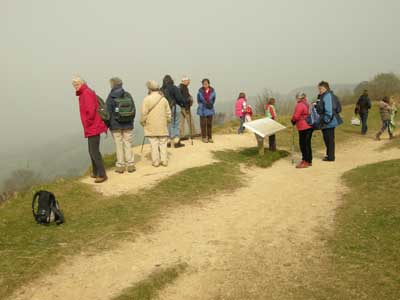
The Crickley Hill Viewpoint, where the interpretive signboard shows what can be seen on a clear day. Part of the U3A Geology Group strains to see, through the haze.
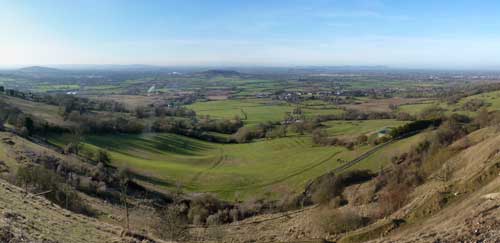
What we might have seen. The panoramic view, visible on a clear day, looking towards Bredon and Malvern Hills.
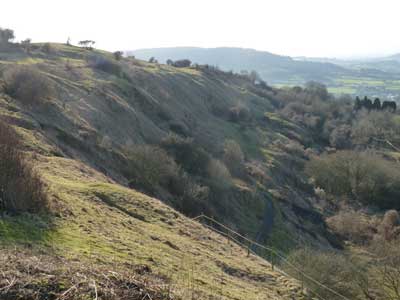
To the left of the viewpoint there is a good example of land slipped ground. The hummocky, uneven ground is a result of landslips along the escarpment edge. It is a result of soft clays lying beneath the mass of limestone above.
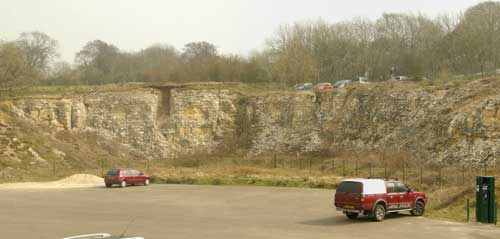
A panoramic view of Crickley Hill’s Car Park Quarry. This rock structure formed about 180 Ma (million years ago) in the Jurassic period. At that time the surface was submerged beneath a tropical, shallow sea and corals were common. During the later Cretaceous period [146 - 65 Ma] this structure was submerged and covered by later thick deposits [all of which were subsequently eroded] and this probably introduced vertical stress factors into this limestone.
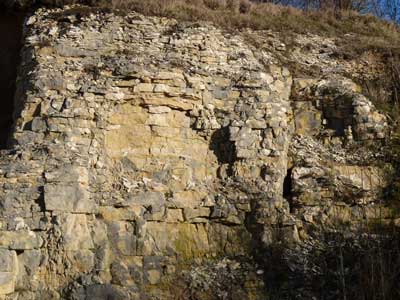
Here we see the exposure in more detail, with both horizontal and vertical cracks in the rock face. The horizontal lines are the bedding planes, and were created as the rock was laid down. They are a primary part of the rock structure. The vertical joints are created later, due to stresses and rock movement. Cambering can occur, opening up joints which then fill with limestone rubbish. These are known as gulls, the dissolved limestone cementing the rubbish together add creating solid structures.
Note at the top of the cliff the jointing becomes closer together. This is due to pressure release, there is less weight on the rock, so it cracks more easily.
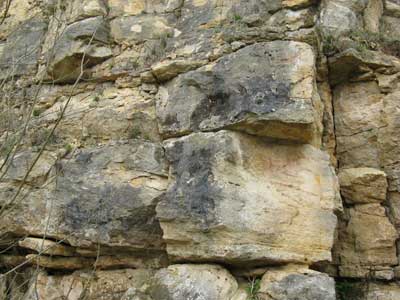
A close up of the bedding structure of the limestone slabs. The effects of weathering can be seen. There was some debate as to what causes the dark surface layering on the rock face, and some form of ferrous reaction or pollution was suggested. We believe it is actually a lichen, Verrucaria maura.
We had an extremely informative and enjoyable visit to Crickley. Thank you Richard and Colin, Jim and Pat, Mary, Alan and Elizabeth, and all others who worked so hard and made the visit so enjoyably memorable.