HEREFORD TOWN WALK
Wednesday 8th August 2012
Malvern U3A Geology group organized a day out, by train, on Wednesday 8th August. We looked at the geology and architecture in Hereford town centre. This was led by Richard Newton and Geoffrey Carver.
Ideas for the day’s itinerary came from three sources. Firstly there is an excellent City Centre Trail written by Joe McCall, to download this click here. Secondly there are two Earth Heritage Trust Guides, the first on Hereford City Centre and the second on Hereford Cathedral. These guides can be purchased from Herefordshire and Worcestershire Earth Heritage Trust; Geological Records Centre; University of Worcester; Henwick Grove; Worcester WR2 6AJ (01905 855184) ; cost around £2 each.
Write up by Rosemary Fretwell.
1. Geological background
Geoffrey explained the geology of the bedrock on which Hereford is built. It is from the Devonian period which was laid down approximately 400million years ago. Mainly sandstone, formerly known as ‘Old Red Sandstone’ because of the dominance of this colour, the red is due to its iron content. This varies, so Old Red Sandstone can also occur in shades of orange, yellow, purple, grey or green.
The land on which we were standing was then south of the equator and part of a huge continent. It was desert, and considerably warmer than it is now. This was due to carbon dioxide levels which were approximately eight times higher than they are today. Oxygen levels were very low because there were few plants, and those that grew were small. The rivers were wide and shallow, in fact the area was very much like Death Valley, in America, is today.
Pre-Devonian, most life was in the oceans. During the Devonian, animals crawled on to land using their strong pectoral fins which later evolved into legs. Plants also took off during the Devonian period, using the carbon dioxide and replacing it with oxygen. Life, both plant and animal, abounded and radiated. At the end of the Devonian there occurred an Ice Age, as well as an extinction where 83% of all species became extinct, the cause of which is uncertain.
2. History
Richard then told us a little about the history of Hereford. The city straddles the River Wye and has fifty-five-thousand inhabitants at present. It grew up in Saxon times as a defence against the Welsh, and the street plan is mostly unchanged since those early days.
The cathedral was first built in the 7th century, but the present building dates from the 12th century. The city walls were built in 1300, and enclose seventy-five acres. Since the Civil War there has been no more need to defend the city, and Hereford is a market town in the present day.
3. Venn Arch
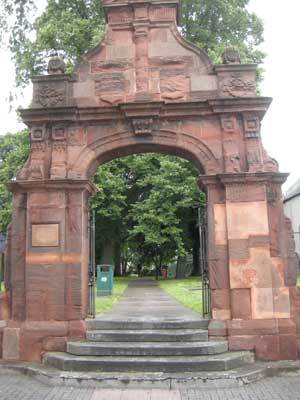
This ornate arch was built as a memorial to John Venn in 1890. It is built from Old Red Sandstone which is not believed to be local. This is because it is too red, and it has weathered very rapidly. The coarse cross-bedding we could see suggests a continental desert sandstone deposited by aeolian (wind) action.
4. Chadds
(Actually the shop that used to be Chadds!)
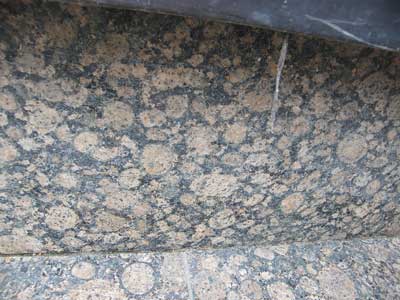
The cladding here is an orbicular granite called Rapakiwi. It is Precambrian in age and really a metamorphic rock — it recrystallised after its initial melt.
5. MacDonald’s
The cladding used here is a cream-coloured banded Travertine from Italy. The banding is arranged vertically for an attractive finish. Travertine is a limestone formed by the rapid precipitation of calcium carbonate in hot springs.
6. St Peter’s Church
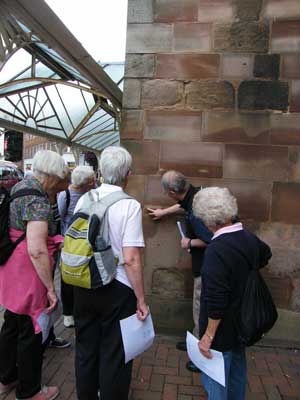
The building is a mixture of Old and New Red Sandstone which is not always red — it depends whether the rock was formed in oxidising or non-oxidising conditions. Originally it was built from local roughly shaped ‘Old Red Sandstone’ blocks called ‘Rubble Stone’, but this weathered badly, and the replacements are a deeper red ‘New Red Sandstone’ from the Midlands. This can be seen particularly on the clock tower, the ‘Old’ stones are grey, the ‘New’ stones are much redder. We were intrigued to find different coloured sandstone within the same block.
7. Shire Hall
This building resembles the British Museum in London but is on a smaller scale. This is hardly surprising since both buildings were designed by the same architect, Sir Robert Smirke. Hereford’s version was built in 1817. We looked for examples of cross-bedding on the sandstone blocks which are not believed to be local, but come from the Ross-on-Wye area. The window surrounds are of a local sandstone from the Bromyard area, and the columns have been repaired and rendered with cement!
8. Statue of Sir George Cornwallis Lewis
Situated in front of the Shire Hall, this statue is made of green-weathered bronze — an alloy of copper and tin which is harder than copper on its own. The plinth is made of a dark granite which contains large crystals of feldspar and ferro-magnesium. The size of the crystals tell us that this plutonic igneous rock cooled very slowly.
9. Jail – or ‘Gaol’
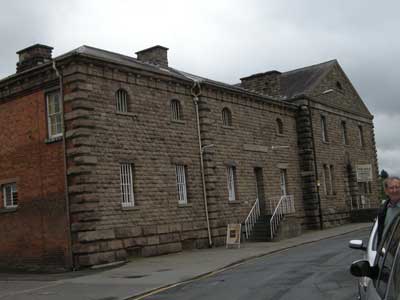
The back and sides of this building are brick, probably to save expense. But the front has a rough sandstone facing. It is probably Old Red Sandstone, but formed in reducing conditions — eg under water — because it is not red. There are small pebbles in the stone suggesting it was laid down in a river.
10. Town Hall
Built in 1902, it has been described as an ‘idiosyncratic’ design. But we all thought it was beautiful! The basic building is brick, but terracotta tiling has been used to great effect to face it in a very decorative way. A green-weathered copper domelet crowns all!
11. War Memorial
The design is modelled on the ‘Eleanor’ crosses. The figures on top are of Portland Stone. The column is Darley Dale sandstone, a Carboniferous sandstone which was brought here from Derbyshire. The steps are Jurassic Pea Grit from the Cotswolds. This is a limestone, and we were fascinated to find it was full of tiny fossils. We found several crinoid stalks which look like tiny starfish!
12. Old House
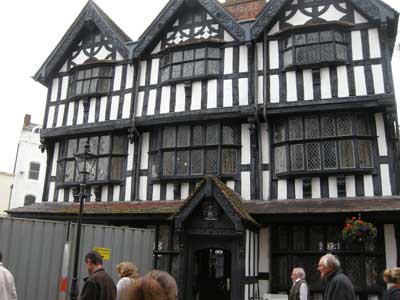
Prominent in the middle of ‘High Town’ is this preserved lath and timber house which once formed part of Butcher’s Row. It was built in 1621.
13. W H Smith
This is Alban House, a neoclassical building constructed in 1865. It is built of Bath Stone, a Jurassic Oolitic limestone.
14. Market Hall
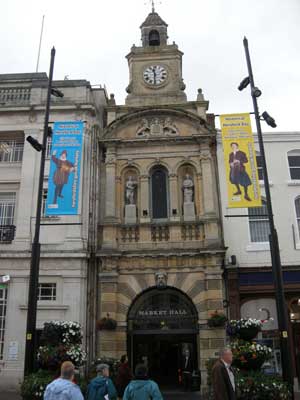
The ornate entrance to the Butter Market is built from a coarse buff-coloured shelly oolitic limestone, probably quarried in the Cotswolds. The blocks each side of the entrance are alternately smooth and rusticated, ie roughened. This gives the ‘columns’ an attractive striped appearance.
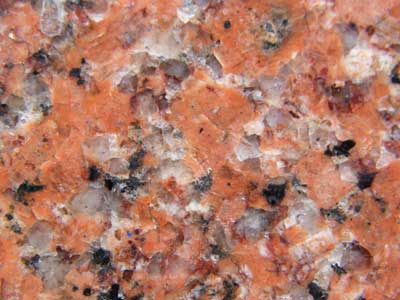
The shop to the right is fronted with polished red granite, probably from Scotland (Peterhead district). It has distinct cut crystal shapes.
Lloyds TSB Bank to the left is built of Portland Stone, a shelly material but smooth.
15. Marks & Spencers
The cladding on this building is dark granite. The crystal boundaries are fuzzy.
16. Primark
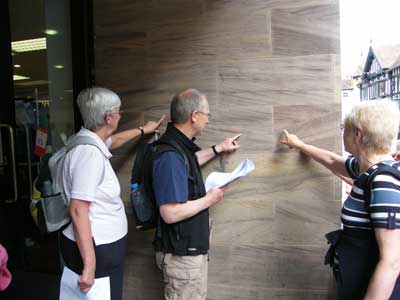
Built of a sandstone where we found many clear examples of cross-bedding. We could tell which stones were the right way up by looking at which way the bedding planes had been cut off. If they seemed to be cut off in a downward direction, then they had been inserted upside down.
17. Cookmate
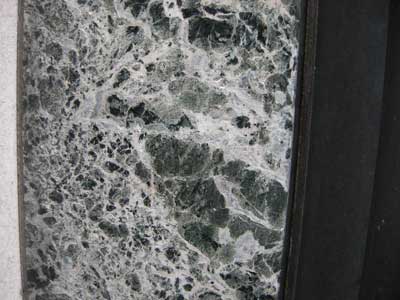
This shop has been clad with Serpentine, a metamorphic rock most famously occurring on the Lizard Peninsula in Cornwall. The original materials were formed very deep, below the earth’s crust, then pushed to the surface in tectonic activity.
18. Paving slabs
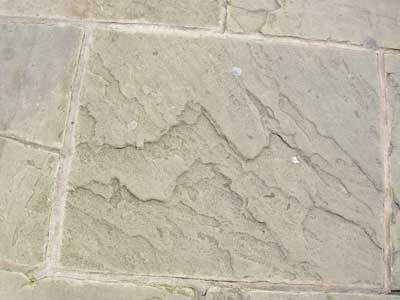
As we walked around Hereford we noticed iron-staining in some of the paving slabs. Many of the older slabs exhibited wavy lines suggesting they were laid down in a marine environment. Modern replacements are usually York Stone, a much smoother paving slab.
19. Cathedral
After an excellent lunch we visited Hereford Cathedral.
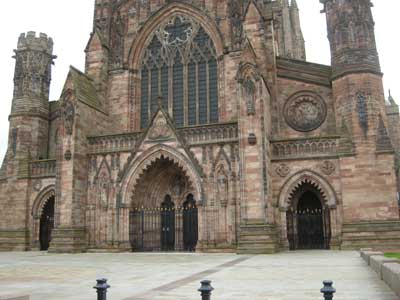
Originally built in the 12th Century from local Old Red Sandstone, it has suffered many disasters in more recent years and has been restored using imported sandstones from several sources which weather better.
In 1786 the western tower collapsed in a storm bringing down the western end of the nave including the roof and upper parts of the nave walls. This was restored, but in a different style.
Later that century the spire on the central tower was deemed unsafe and removed. A low conical cap was put in place until the main pinnacles were added in 1830.
In 1842, subsidence, cavitation, fissuring and shattering of stonework below the bell chamber was discovered. The piers of the crossing were rebuilt and the tower was saved.
In 1896 Hereford suffered an earthquake. As a result of this, the western tower was again deemed unsafe and pulled down before it fell down. A few years later it was rebuilt in a rather extreme and poorly proportioned Decorated Gothic imitation – so ‘tis said. Personally, I think it looks magnificent!
So the cathedral is a mixture of styles, and a mixture of sandstones.
I always like to stand at the western end of a cathedral’s nave for about ten minutes or more just drinking in the enormity of such a building. Hereford greeted me with decorated sandstone Norman arches and a fan-vaulted ceiling – wonderful!
These are some of the features we looked at:-
(i) Pillars. These are Norman in age and style. There are tooling marks on them to make plaster stick, but the plaster has long since gone.
(ii) Tomb of Jacobus Atlay. The figure on the tomb is carved from alabaster, an evaporite. It is a soft rock, easy to carve because it is calcium sulphate, not calcium carbonate. Alabaster does not weather well, but the tomb is indoors so this is not a problem. The tomb has a veined marble base.
(iii) Tomb of St Thomas Cantilupe. This is made from a shelly limestone.
(iv) Altar Stone. In the south transept is an altar stone of Purbeck ‘Marble’. It is a not a marble at all, but a dark shelly limestone laid down in the Cretacious period. It has been polished to a high degree, and is stuffed with fossils which look like snails.
(v) Font. The font is of an oolitic limestone with a sandstone top. It is pale in colour because it contains a lot of quartz. This is the original Norman font.
20. Library and Museum
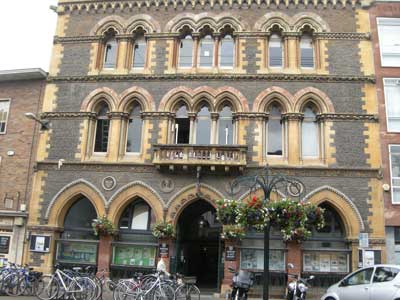
Finally, before returning to the station to catch our train home, we looked briefly at the library/museum building. It has a magnificent edifice made from a variety of stones. The main stone is a blue-grey Carboniferous sandstone from Pontypridd. The window shafts are a red sandstone from Bridgend. Also used is cream-coloured Campden Stone, a Jurassic Oolite from the Cotswolds. And Rodyr Stone from Cardiff, an orange-red conglomerate with clasts up to three centimetres across. High on the walls are excellent sculptures of monkeys, lizards, owls and pachyderms in the limestone.
Thank you, Richard and Geoffrey, for a fascinating day out!
It was much enjoyed.