Wye Gorge walk
18 April 2012
The U3A Geology group visited the Wye Gorge on 18 April 2012. The walk was led by Moira Jenkins and followed her talk, Some Wye Meanders and their Rocks and Valleys, given on 11April 2012.
Visit report by Elaine and Bob Tilley
A group of 18 Malvern U3A Geology Group members arrived at Symonds Yat West with varying degrees of expectation. The weather forecast for the day was not promising so Moira made the decision to walk the Earth Heritage Trust Trail - Wye Gorge in reverse. So we started with the youngest Carboniferous rocks and proceeded down hill and back in time to Devonian rocks.
After a quick look at a limekiln we walked into a quarry of Crease Limestone which until quite recently had been worked to supply the kiln. From this we moved to a dry valley to complete with frolicking lambs and birdsong everywhere. On our left was as series of caves and arches in the Carboniferous Crease Limestone at King Arthur’s caves. Moira described an interesting thesis by P Wood as to how the dry valley, caves and exposed cliffs might have been formed by the River Wye meandering at this point in earlier times. More research is needed to develop this thesis but the visual evidence is compelling. The term Crease Limestone was interesting, as we had not heard it before. There were few fossils but plenty of calcite crystals.
As we walked down the valley we travelled back in time to Lower Dolomite and on to Lower Limestone Shales. We had to visualise the clear shallow tropical seas in which the limestone was formed. Again not many fossils but evidence of cross bedding. We saw the edge of a limestone platform. It was interesting to note the change in vegetation associated with the underlying geology. The beech woods at this point were impressive, both large mature trees and younger saplings. Also man has used the geology. A carriage route carved through the wood and valley side at this point followed the geology to provide a more enjoyable experience.
We were now walking down to the River Wye across limestone from the Devonian period. An interesting outcrop of Tintern Sandstone had been exposed by a Champions Project and just beyond was a large cliff of Quartz Conglomerate, which was deeply weathered along the joints. Huge blocks had fallen away. We had a picnic lunch here and this gave us plenty of time to appreciate the wood anemones, bluebells, violas and wild garlic and also study the conglomerate where the large ungraded pebbles were set in a fine but hard matrix, stained red by haematite.
Walking further down the valley side we came on a newly restored limekiln. We can understand Moira’s frustration that the information board made a passing reference to the nearby limestone not how it was formed and came to be there. Nevertheless it was another example of man’s use of the geology.
We were now just a few yards from the valley bottom and the River Wye, which at this point is a narrow gorge, and we walked through the gorge with further evidence of past quarrying into a small flood plain at Biblins. From here we had good views back to the Severn Sisters which were above the quarries we had passed. These Lower Dolomite cliffs were better seen from a wooden suspension bridge.
Our last viewpoint was a cliff face where the limestone has tufa deposits and a tunnel has been cut in to the cliff in search of iron ore.
To this point there had been only a short shower but now it started to rain. The weather had been kind to us but the decision to walk in reverse was a good one as we could have got back more easily before we started the decent into the valley.
Being a spring walk we were able to see long vistas through the trees, as there was little foliage. It would be good to return in other seasons. Although the geology will not have changed the flora and agriculture will be different.
Pictures from the walk
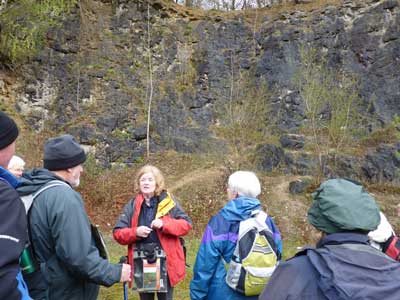
Moira explaining black lichen covered crease limestone.
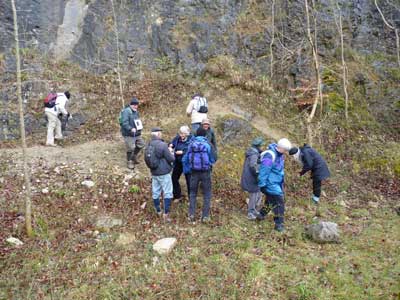
Fossil hunting in crease limestone.
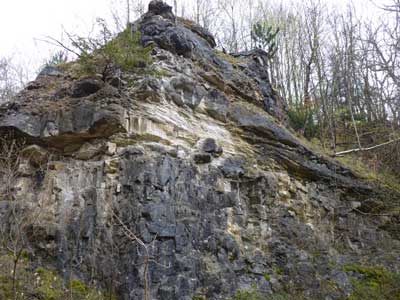
Sandstone lense within crease limestone.
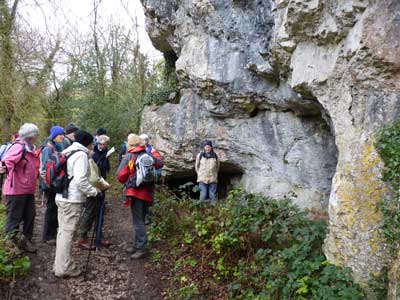
Discussing source of water that has eroded base of crease limestone.
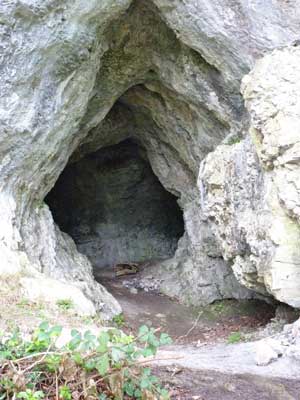
King Arthur's Cave.
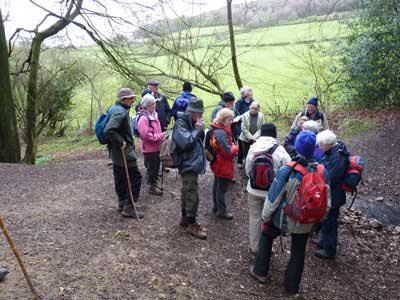
Discussing dry valley opposite King Arthur's Cave.
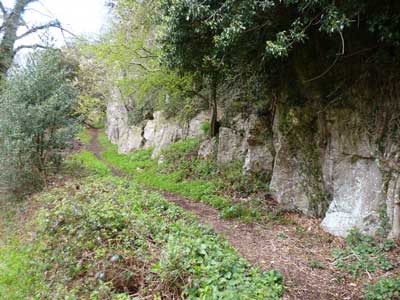
Seven Sisters on Little Doward.
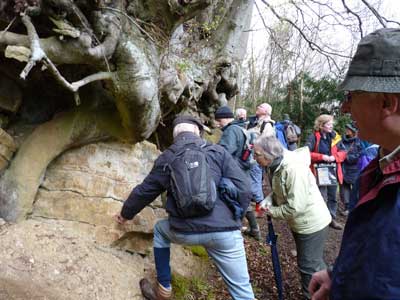
Tree roots or fossils in limestone shales.
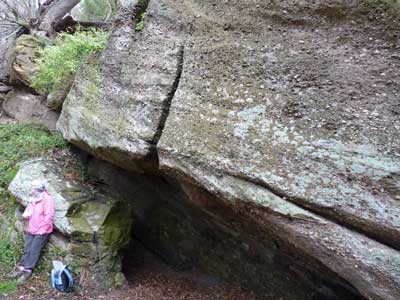
Lunch at quartz conglomerate cliff.
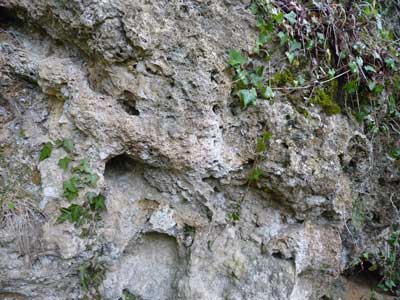
Tufa Deposits at The Biblins