AUST CLIFF AND WESTBURY GARDEN CLIFF
Wednesday July 9th 2014
On Wednesday 9th July 2014 a contingent of the Geology Group set out to explore the drowned Triassic desert that is now clearly exposed at the Aust Cliff, which is on the eastern bank of the Severn under the old Severn Bridge, and Westbury on Severn Garden Cliff which is upstream on the west bank.
LOCATIONS AND ACCESS
AUST CLIFF (grid ref ST 565 895)
Access is via a concrete track from the Old Passage road (ST 563 888)
A short walk brings you to the base of the cliff with access even beyond the bridge foundations but be careful.
Abundant samples with fossils cover the beach.
Hard hats are necessary.
WESTBURY GARDEN CLIFF (grid ref SO 715132)
Access is from a lay-by (SO 719139) in front of the National Trust house with a pleasant walk across the fields to the cliff. A scramble over the river wall down to the beach is the only obstacle.
(it is possible to drive closer to the cliff if only one car is taken.)
Hard hats advisable.
Both sites are tidal so selection of time and date is important. Choose low tide at around lunch time during neap tides. Visit Aust first as tide is later at Westbury.
It is also possible to fit in a visit to the spectacular dolomite beds in Day house quarry (National diving school) as a lunchtime stop.
AUST CLIFF GEOLOGY
This location is impressive with the huge Severn Bridge stretching away across the river and the high colorful cliffs looming over you. A glance at the river swirling out exposing mud banks reminds you how fast it will rise later and that you need to keep an eye on it all the time.
As always the group scatters, spreading out along the foreshore hunting fossils so any hope of an organised tour disappears but you can’t miss the sedimentary sequence in front of you.
At the base of the bridge and exposed in the river is the reason the bridge is here- Carboniferous limestone for support.
Looking at the cliff face we see, firstly the red and green Triassic marls, evidence of a desert coastal landscape 210 MYA when we were 30deg north of the Equator where North Africa is today. Thick veins of the evaporate Gypsum are found in the basal layers, again evidence for dried out shallow lakes.
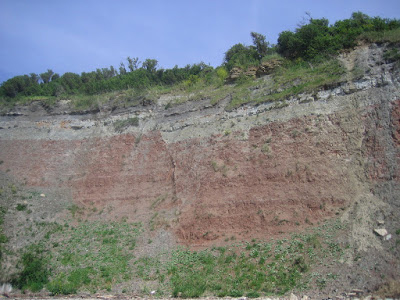
The red beds are the Mercia Mudstone Group (formerly called Keuper Marls) and form the Branscombe Mudstone Formation (206 - 221 Ma) from the cliff base. These pass up to the green-grey beds of the Blue Anchor Formation (206 – 221 Ma), (formerly called Tea Green Marls). Above the Blue Anchor Formation rest the dark then lighter grey beds of the Penarth Group: the Westbury Formation and Cotham Member, (formerly called Rhaetic Beds) from the Late Triassic, or Rhaetian (206 – 210 Ma). At the cliff top are the light brown beds of the Blue Lias Formation from the Early Jurassic, (195 – 210 Ma).
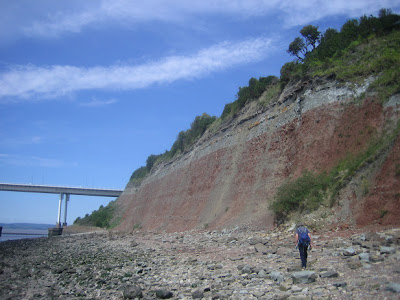
There are no fossils in the red mudstones but following the marine transgressions later in the Triassic and early Jurassic fossils of marine creatures become abundant in the Westbury formation beds and fish teeth, bones and coprolite can be found in the rocks on the beach
Standing back it can be seen that the strata form a gentle anticline which is reflected across the river and the strata are continued upstream at Westbury.
Also conspicuous is a fault which all the members of the Maps sub-group can now easily identify as a normal fault including which is the downthrow side.
WESTBURY ON SEVERN GARDEN CLIFF GEOLOGY
The thing to remember about the Garden Cliff is that the sequence is the same as at the Aust Cliff but that they dip down to your right so that you can closely study the full height just by walking along the beach.
Looking closely at the red mudstones makes you wonder how they have survived so long as they are very friable and looking up at the fence line shows the farmer is moving it back all the time. Sometimes exquisite, rose shaped nodules of the red sandstones can be found on the beach. I think they are a feature of weathering and frost but will disintegrate in your hands.
Look at the lines of the edges of the earlier beds running across the beach.
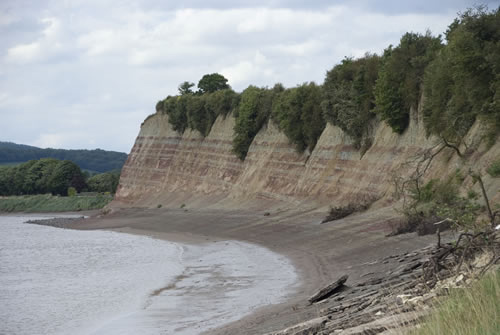
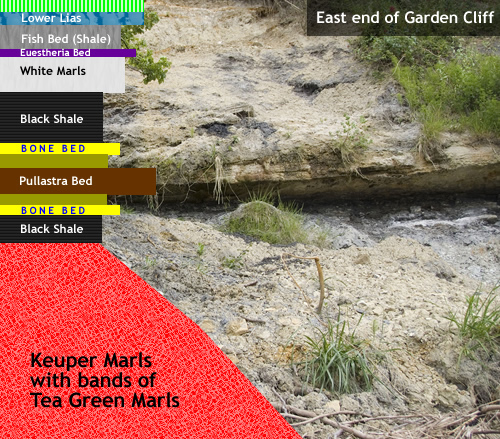
The big draw of Westbury Cliff is the famous ‘bone bed’
Here is a diagram of the bedding at the eastern end to help you find the bone bed. This was my third visit and this time it was found this time but not by me.
Finally, don’t get carried away hunting fossils because the river is creeping up behind you and it is easy to get cut off.
Alan Hughes 13 April 2015