MANTLE ROCKS OF THE CYPRUS OPHIOLITE
Basalt Bastite Boninite Bronzite Dunite Eclogite Gabbro Garnet Granodiorite Harzburgite Komatiite Lherzolite Norite
Omphacite Ophiolite Peridotite Pyroxenite Serpentinite Tonalite Wadsleyite Websterite Wehrlite
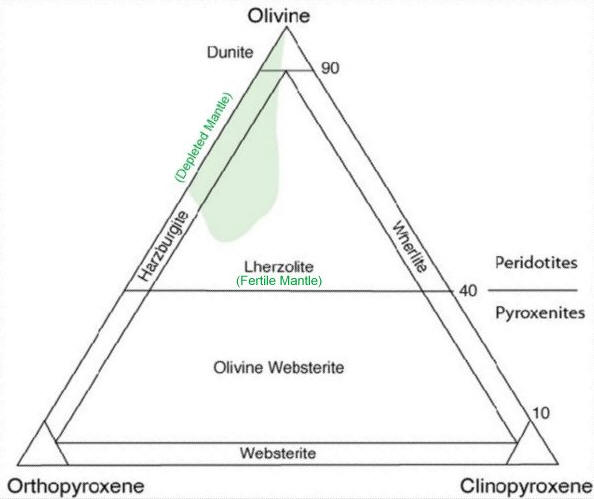
Classification diagram for peridotite and pyroxenite, with the pale green area approximately indicating the most common compositions for upper mantle peridotite.
Pyroxenite is an ultramafic igneous rock consisting essentially of minerals of the pyroxene group, such as augite and diopside, hypersthene, bronzite or enstatite. They are classified (see diagram above) into clinopyroxenites, orthopyroxenites, and the websterites which contain both pyroxenes. Closely allied to this group are the hornblendites, consisting essentially of hornblende and other amphiboles. They are essentially of igneous origin, though some pyroxenites are included in the metamorphic Lewisian complex of Scotland. The pyroxene-rich rocks which result from the contact metamorphism of impure limestones are described as pyroxene hornfelses (calc-silicate hornfelses).
The igneous pyroxenites are closely allied to the gabbros and norites, from
which they differ by the absence of feldspar, and to the peridotites, which are
distinguished from them by containing more than 40% olivine. This connection is
indicated also by their mode of occurrence, for they usually accompany masses of
gabbro and peridotite and seldom are found by themselves.
They are often very coarse-grained,
containing individual crystals which may be several inches in length. The
principal accessory minerals, in addition to olivine and feldspar, are chromite
and other spinels, garnet, magnetite, rutile, and scapolite. Pyroxenites
can be formed as cumulates in ultramafic intrusions by accumulation of pyroxene
crystals at the base of the lava chamber. Here they are generally associated
with gabbro and anorthite cumulate layers and are typically high up in the
intrusion. They may be accompanied by magnetite layers, ilmenite layers, but
rarely chromite cumulates.
Pyroxenites are also found as layers
within masses of peridotite. These layers most commonly have been interpreted as
products of reaction between ascending magmas and peridotite of the upper
mantle. The layers typically are a few centimetres to a metre or so in
thickness. Pyroxenites that occur as xenoliths in basalt and in kimberlite have
been interpreted as fragments of such layers. Although some mantle pyroxenites
contain garnet, they are not eclogites, as clinopyroxene in them is less sodic
than omphacite and the pyroxenite compositions typically are unlike that of
basalt. It has been proposed that large volumes of pyroxenite form in the upper
mantle as a result of reaction between peridotite and magma derived from partial
melting of eclogite, and that such pyroxenite volumes are important sources of
basalt magma (e.g., Sobolev and others, 2007).
The pyroxenites are often subject to serpentinization under low temperature retrograde metamorphism and weathering. The rocks are often completely replaced by serpentines, which sometimes preserve the original structures of the primary minerals, such as the lamination of hypersthene and the rectangular cleavage of augite. Under pressure-metamorphism hornblende is developed and various types of amphibolite and hornblende-schist are produced. Occasionally rocks rich in pyroxene are found as basic facies of nepheline syenite; a good example is provided by the melanite pyroxenites associated with the borolanite variety found in the Loch Borolan igneous complex of Scotland.


Peridotite is the dominant rock of the upper part of the Earth's mantle above a depth of about 400 km; below that depth, olivine is converted to the higher-pressure mineral wadsleyite. It is a dense, coarse-grained igneous rock, consisting mostly of the minerals olivine and pyroxene. Peridotite is ultramafic, as the rock contains less than 45% silica. It is high in magnesium, reflecting the high proportions of magnesium-rich olivine, with appreciable iron. Peridotite is derived from the Earth's mantle, either as solid blocks and fragments, or as crystals accumulated from magmas that formed in the mantle. The compositions of peridotites from these layered igneous complexes vary widely, reflecting the relative proportions of pyroxenes, chromite, plagioclase, and amphibole. Common varieties of peridotites are lherzolite, wehrlite, harzburgite and dunite. The word ‘peridotite’ comes from the gemstone peridot, which consists of pale green olivine.
The rocks of the peridotite family are uncommon at the surface and are highly unstable, because olivine reacts quickly with water at typical temperatures of the upper crust and at the Earth's surface. Many, if not most, surface outcrops have been at least partly altered to serpentinite, a process in which the pyroxenes and olivines are converted to green serpentine. This hydration reaction involves considerable increase in volume with concurrent deformation of the original textures. Serpentinites are mechanically weak and so flow readily within the earth. Distinctive plant communities grow in soils developed on serpentinite, because of the unusual composition of the underlying rock. Peridotite that has been hydrated at low temperatures forms serpentinite, which may include chrysotile asbestos (a form of serpentine) and talc.
Layered intrusions with cumulate peridotite are typically associated with sulfide or chromite ores. Sulfides associated with peridotites form nickel ores and platinoid metals; most of the platinum used in the world today is mined from the Bushveld Igneous Complex in South Africa and the Great Dyke of Zimbabwe. The chromite bands commonly associated with peridotites are the world's major ores of chromium.
The compositions of peridotite nodules found in certain basalts and diamond pipes (kimberlites) are of special interest, because they provide samples of the Earth's mantle brought up from depths from about 30 km or so to depths at least as great as 200 km. Some of the nodules preserve isotope ratios of osmium and other elements that record processes of when the earth was formed, and so they are of special interest to paleogeologists because they provide clues to the composition of the Earth's early mantle and the complexities of the processes that were involved.
Peridotites are rich in magnesium, reflecting the high proportions of magnesium-rich olivine. The compositions of peridotites from layered igneous complexes vary widely, reflecting the relative proportions of pyroxenes, chromite, plagioclase, and amphibole. Minor minerals and mineral groups in peridotite include plagioclase, spinel (commonly the mineral chromite), garnet (especially the mineral pyrope), amphibole, and phlogopite. In peridotite, plagioclase is stable at relatively low pressures (crustal depths), aluminous spinel at higher pressures (to depths of 60 km or so), and garnet at yet higher pressures.
Peridotites have two primary modes of origin, as mantle rocks formed during the accretion and differentiation of the Earth, or as cumulate rocks formed by precipitation of olivine ± pyroxenes from basaltic or ultramafic magmas; these magmas are ultimately derived from the upper mantle by partial melting of mantle peridotites.
Mantle peridotites are sampled as alpine-type massifs in collisional mountain ranges or as xenoliths in basalt or kimberlite. In all cases these rocks are pyrometamorphic (that is, metamorphosed in the presence of molten rock) and represent either fertile mantle (lherzolite) or partially depleted mantle (harzburgite, dunite). Alpine peridotites may be either of the ophiolite association and representing the uppermost mantle below ocean basins, or masses of subcontinental mantle emplaced along thrust faults in mountain belts.
Layered peridotites are igneous sediments and form by mechanical accumulation of dense olivine crystals. Some peridotite forms by precipitation and collection of cumulate olivine and pyroxene from mantle-derived magmas, such as those of basalt composition. Peridotites associated with Alaskan-type ultramafic complexes are cumulates that probably formed in the root zones of volcanoes. Cumulate peridotites are also formed in komatiite lava flows.
Mantle lherzolites may be the principal source rock for basaltic magmas, whereas mantle harzburgites probably form both from the crystalline residue left after basaltic magma migrates out of lherzolite and from a crystalline accumulation of early solidification products of some basaltic magmas within the mantle.
Pyroxenites are related ultramafic rocks, which are composed largely of orthopyroxene and/or clinopyroxene. They are classified (see diagram above) into clinopyroxenites, orthopyroxenites, and the websterites which contain both pyroxenes. minerals that may be present in lesser abundance include olivine, garnet, plagioclase, amphibole, and spinel. Closely allied to this group are the hornblendites, consisting essentially of hornblende and other amphiboles. The igneous pyroxenites are closely allied to the gabbros and norites, from which they differ by the absence of feldspar, and to the peridotites, which are distinguished from them by containing more than 40% olivine. This connection is indicated also by their mode of occurrence, for they usually accompany masses of gabbro and peridotite and seldom are found by themselves.
Dunite: more than 90% olivine, typically with Mg/Fe ratio of about 9:1.
Wehrlite: mostly composed of olivine plus clinopyroxene.
Lherzolite: mostly composed of olivine, orthopyroxene (commonly enstatite), and clinopyroxene (diopside), and have relatively high proportions of basaltic ingredients (garnet and clinopyroxene). Partial fusion of lherzolite and extraction of the melt fraction can leave a solid residue of harzburgite.
Harzburgite: mostly composed of olivine plus orthopyroxene, and relatively low proportions of basaltic ingredients (because garnet and clinopyroxene are minor).
Komatiites are high degree partial melts of peridotite.
Eclogite, a rock similar to basalt in composition, is composed primarily of sodic clinopyroxene and garnet. Eclogite is associated with peridotite in some xenolith occurrences; it also occurs with peridotite in rocks metamorphosed at high pressures during processes related to subduction.
Dunite is an igneous, plutonic rock, of ultramafic composition, with coarse-grained or phaneritic texture. The mineral assemblage is greater than 90% olivine, with minor amounts of other minerals such as pyroxene, chromite and pyrope. Dunite is the olivine-rich end-member of the peridotite group of mantle-derived rocks. Dunite and other peridotite rocks are considered the major constituents of the Earth's mantle above a depth of about 400 kilometers. Dunite is rarely found within continental rocks, but where it is found, it typically occurs at the base of ophiolite sequences where slabs of mantle rock from a subduction zone have been thrust onto continental crust by obduction during continental or island arc collisions (orogeny). It is also found in alpine peridotite massifs that represent slivers of sub-continental mantle exposed during collisional orogeny. Dunite typically undergoes retrograde metamorphism in near-surface environments and is altered to serpentinite and soapstone.
Dunite may represent the refractory residue left after the extraction of basaltic magmas in the upper mantle. This is the type of dunite found in the lowermost parts of ophiolites, alpine peridotite massifs, and xenoliths. However, a more likely method of dunite formation in mantle sections is by interaction between lherzolite or harzburgite and percolating silicate melts, which dissolve orthopyroxene from the surrounding rock, leaving a progressively olivine-enriched residue. Dunite may also form by the accumulation of olivine crystals on the floor of large basaltic or picritic magma chambers. These "cumulate" dunites typically occur in thick layers in layered intrusions, associated with cumulate layers of wehrlite, olivine pyroxenite, harzburgite, and even chromitite (a cumulate rock consisting largely of chromite). Small layered intrusions may be of any geologic age, for example, the Triassic Palisades Sill in New York and the larger Eocene Skaergaard complex in Greenland. The largest layered mafic intrusions are tens of kilometers in size and almost all are Proterozoic in age, e.g., the Stillwater igneous complex (Montana), the Muskox intrusion (Canada), and the Great Dyke (Zimbabwe). Cumulate dunite may also be found in ophiolite complexes, associated with layers of wehrlite, pyroxenite, and gabbro.
Dunite was named by the German geologist, Ferdinand von Hochstetter in 1859 after Dun Mountain near Nelson, New Zealand. Dun Mountain was given its name because of the dun colour of the underlying ultramafic rocks. This color results from surface weathering that oxidizes the iron in olivine in temperate climates (weathering in tropical climates creates a deep red soil). Dun Mountain is separated from its sister massif, Red Mountain, at the southern end of South Island, New Zealand, by the Alpine Fault, an approximately 600 km long right lateral strike slip fault similar to the San Andreas fault in California, USA. A massive exposure of dunite in the United States can be found as Twin Sisters Mountain, near Mount Baker in the northern Cascade Range of Washington.
A Wehrlite is an ultrabasic igneous rock dominated by essential olivine and clinopyroxene with or without small amounts of orthopyroxene. Accessory minerals include plagioclase, spinel, garnet, ilmenite, chromite and magnetite. Wehrlites are peridotites and a minor component of the upper mantle where they form due to crystallisation of partial melts. Wehrlite occurs as mantle xenoliths within mantle-derived magmas and within the upper portions of the mantle sequence of ophiolites. It can occur in both xenoliths and ophiolites as veins and dykes. Wehrlite can also form as cumulates within layered intrusions associated with gabbro and norite
Lherzolite is a type of ultramafic igneous rock. It is a coarse grained rock consisting of 40 to 90% olivine along with significant orthopyroxene and lesser calcic chromium rich clinopyroxene. Minor minerals include chromium and aluminium spinels and garnets. Plagioclase can occur in lherzolites and other peridotites that crystallize at relatively shallow depths (20 – 30 km). At greater depth plagioclase is unstable and is replaced by spinel. At approximately 90 km depth, pyrope garnet becomes the stable aluminous phase. Garnet lherzolite is a major constituent of the Earth's upper mantle (extending to ~300 km depth). Lherzolite is known from the lower ultramafic part of ophiolite complexes (although harzburgite is more common in this setting), from alpine-type peridotite massifs, from fracture zones adjacent to mid-oceanic ridges, and as xenoliths in kimberlite pipes and alkali basalts. Partial fusion of lherzolite and extraction of the melt fraction can leave a solid residue of harzburgite.
Due to partial melting of spinel, mantle lherzolites may be the principal source rock for basaltic magmas, whereas mantle harzburgites probably form both from the crystalline residue left after basaltic magma migrates out of lherzolite and from a crystalline accumulation of early solidification products of some basaltic magmas within the mantle.
The name is derived from the Lherz Massif, an alpine peridotite complex (also known as orogenic lherzolite complex), (the type locality) at Etang de Lers, near Massat in the French Pyrenees; Lherz is the archaic spelling of this location. The Lherz massif is unique because it has been emplaced into Paleozoic carbonates (limestones and dolostones), which form mixed breccias of limestone-lherzolite around the margins of the massif.
The Lherz massif also contains harzburgite and dunite, as well as layers of spinel pyroxenite, garnet pyroxenite, and hornblendite. The layers represent partial melts extracted from the host peridotite during decompression in the mantle long before emplacement into the crust.
The Lherz massif is unique because it has been emplaced into Paleozoic carbonates (limestones and dolostones), which form mixed breccias of limestone-lherzolite around the margins of the massif. The Moon's lower mantle is said to be composed of lherzolite.
The ultramafic igneous rock, harzburgite, is a variety of peridotite consisting mostly of the two minerals, olivine and low-calcium (Ca) pyroxene (enstatite); it is named for occurrences in the Harz Mountains of Germany. It commonly contains a few percent chromium-rich spinel as an accessory mineral. Garnet-bearing harzburgite is much less common, found most commonly as xenoliths in kimberlite.
Harzburgite typically forms by the extraction of partial melts from the more pyroxene-rich peridotite called lherzolite. The molten magma extracted from harzburgite may then erupt on the surface as basalt. If partial melting of the harzburgite continues, all of the pyroxene may be extracted from it to form magma, leaving behind the pyroxene-poor peridotite called dunite. Harzburgite may also form by the accumulation of olivine and low-Ca pyroxene in large magma chambers of basalt deep in continental crust (layered intrusions).
Harzburgite is the most commonly found variety of peridotite in ophiolites, which are thought to represent oceanic crust and the underlying oceanic mantle exposed during collision with continental crust. Examples of ophiolites with extensive harzburgite include the Troodos ophiolite in Cyprus, the Semail ophiolite in Oman, the Coast Range ophiolite of California, and the Bay of Islands ophiolite in Newfoundland. The so-called "abyssal peridotites" dredged from the seafloor near fracture zones (where oceanic lithosphere may be exposed at the surface) are typically lherzolites, not harzburgites. Lherzolites may also form by the extraction of magma from more pyroxene-rich peridotite, but are less depleted than harzburgites. This is consistent with the observation that many ophiolites probably form in the fore-arc region of island arcs, not at mid-oceanic ridges.
Harzburgite may also be found in some Alpine peridotite massifs that consist mostly of lherzolite. Alpine or orogenic lherzolites represent subcontinental mantle lithosphere (the upper mantle below continental crust) exposed during the plate tectonic collision of continental plates. Examples of orogenic lherzolite massifs with harzburgite include the Lherz massif in France (Pyrenees Mountains), the Lanzo massif in northern Italy, and the Horoman massif in Japan.
Garnet-bearing harzburgite is found as a xenolith in some kimberlite pipes, which are found almost exclusively in ancient continental cratons of Archean or Paleoproterozoic age. The mantle lithosphere under these cratons is particularly thick (up to 200 km or more) and cool. Garnet harzburgites are less depleted in the basalt component than most ophiolite harzburgites. Garnet harzburgite xenoliths from kimberlites in South Africa have been particularly well-characterized.
Cumulate harzburgite is found in some large layered igneous intrusions. At the Earth's surface, basaltic magmas typically crystallize the minerals: olivine, plagioclase, and augite (a high-Ca pyroxene); low-Ca pyroxenes can only co-exist with olivine at low pressure in magma that is high in both MgO and SiO2 (boninites). At pressures greater than 5 kilobars (0.5 GPa, or 5000x atmospheric pressure), olivine and low-Ca pyroxene (enstatite or bronzite) may crystallize together from normal basalt magmas to form harzburgite. These conditions were common in some layered mafic intrusions, most of which are Proterozoic in age, which formed from enormous sill-like intrusions of basalt into lower continental crust. The classic example of a Proterozoic layered intrusion with cumulate harzburgite is the Stillwater igneous complex of Montana, U.S.A. It is also found in the Bushveld Igneous Complex, a large layered intrusion in South Africa.
Cyprus lies on the southern border of the Eurasian Plate and on the southern margin of the Anatolian Plate. The southern margin of the Anatolian Plate is in collision with the African Plate, which has created the uplift of the Cyprus arc and Cyprus itself. The Troodos Ophiolite represents a Late Cretaceous spreading axis (mid-ocean ridge) that has since been uplifted due to its positioning on the overriding Anatolian plate at the Cyprus arc and subduction to the south of the Eratosthenes Seamount. A sheeted dyke complex or sheeted dike complex is a normal component of an ophiolite, a piece of oceanic crust that has been emplaced within a sequence of continental rocks. In the original formation environment below the sea floor the dykes acted as feeders for the overlying sequence of extrusive rocks, typically pillow lavas forming a layer of the oceanic crust. As each injection of a dyke represents one increment of seafloor spreading, each dyke was normally intruded into earlier dykes. The dykes are typically dolerites but plagiogranites (trondhjemites) often form a significant part of the complex.
The lowest units of the ophiolite are the Lower Pillow Lavas, controversially separated from the Upper Pillow Lavas. Filling spaces in between the pillows in the pillow lava units are dispersed metal oxide sediments that can also be seen as veins filling cooling fractures within the lavas. The metal oxides are ferruginous with ferromanganese oxides, clays, carbonates, volcanic glass and pelagic sediments.
Above the pillow lava units lies a layer of ferromaganiferous mudstones and clastic volcanics (the epiclastics). The epiclastites are massive altered lava fragments in a mud matrix, usually ferromanganiferous. Overlying this is the massive-finely laminated ferromanganese muds. Between the epiclastics and muds lie background accumulations of pelagic sediment.
To the south there is the Mathiati-Margi massive sulfide ore body and stockwork mineralisation. The sulfide ore occurs at the same stratigraphic level as the Lower and Upper pillow lava contact, and is overlain by unmineralised lavas. Dunite bodies (olivine) are common in the mantle series of the Troodos, and contain chromite concentrations.
The sheeted dykes show a general tholeiitic trend, of basalts, andesites and dacites. There is no obvious boundary for the compositional differences, but the lower lavas are generally more enriched and evolved (silicic) while the upper lavas are less evolved and depleted.
The geochemical evidence implies that the Troodos ophiolite has come from mantle that has already been depleted, with extraction of mid ocean ridge basalt, but then subsequently enriched in certain trace elements as well as water. Along with the alkaline character of the plagiogranites it can be assumed that the spreading ridge of the Troodos was situated above a subduction zone, but the mantle from which lavas were extruded was that of mantle that had recently lost a melt fraction.
The Troodos is a unique ophiolite in terms of observing hydrothermal alteration, because it has not been metamorphosed to a high extent or deformed extensively. Therefore it is easy to see the successions and relationships of the hydrothermal processes to the structure of the ridge. This is difficult to observe in modern ridges due to accessibility problems, and so the Troodos gives a unique view into these processes. The fact that the same kinds of alteration can be seen in modern axes implies the same processes happened at the Troodos, even through it was formed in a supra-subduction zone.
Alteration of the lavas is related to both axial hydrothermal systems and crustal aging in a submarine environment. Fluid can be shown to have penetrated at least to the base of the plutonic sequence where high temperature and secondary phases in the plutonics and cumulates imply alteration close to the ridge axis. The presence of alteration in all of the extrusive levels but the very highest imply a succession of numerous hydrothermal convection cells active during eruption.
As the crustal sequence gradually moved off of the spreading axis, there was cessation of the main metalliferous deposition and progressive restriction of water/rock action and eventually water interaction was restricted to within rock units as the crust was sealed off. This caused precipitation of late stage zeolites and carbonates. The massive sulfide deposits can also be shown to have formed at the same temperature as modern day black smokers, which provides evidence that these could be formed from the smokers.
Boninite is a mafic extrusive rock high in both magnesium and silica, formed in fore-arc environments, typically during the early stages of subduction. The rock is named for its occurrence in the Izu-Bonin arc south of Japan. It is characterized by extreme depletion in incompatible trace elements that are not fluid mobile (e.g., the heavy rare earth elements plus Nb, Ta, Hf) but variable enrichment in the fluid mobile elements (e.g., Rb, Ba, K). They are found almost exclusively in the fore-arc of primitive island arcs (that is, closer to the trench) and in ophiolite complexes thought to represent former fore-arc settings. Similar Archean intrusives called sanukitoids have been reported in the rocks of several early cratons.
Boninite is considered to be a primitive andesite derived from melting of metasomatised mantle. Boninite typically consists of phenocrysts of pyroxenes and olivine in a crystallite-rich glassy matrix.
Boninite is defined by
high magnesium content (MgO = 8-15%)
low titanium (TiO2 < 0.5%)
silica content is 57 - 60%
high Mg/(Mg + Fe) (0.55-0.83)
Mantle-normal compatible elements Ni = 70-450 parts per million, Cr = 200-1800 ppm
Ba, Sr, LREE enrichments compared to tholeiite
Characteristic Ti/Zr ratios (23-63) and La/Yb ratios (0.6-4.7)
Boninite magma is formed by second stage melting in forearcs via hydration of previously depleted mantle within the mantle wedge above a subducted slab, causing further melting of the already depleted peridotite. The extremely low content of titanium, which is an incompatible element within melting of peridotite is the result of previous melting events that removed most of the incompatible elements from the residual mantle source. The first stage melting typically forms island arc basalt.
Boninite attains its high magnesium and very low titanium content via high degrees of partial melting within the convecting mantle wedge. The high degrees of partial melting are caused by the high water content of the mantle. With the addition of slab-derived volatiles, and incompatible elements derived from the release of low-volume partial melts of the subducted slab, the depleted mantle in the mantle wedge undergoes melting.
Evidence for variable enrichment or depletion of incompatible elements suggests that boninites are derived from refractory peridotite which has been metasomatically enriched in LREE, Sr, Ba and alkalis. Enrichment in Ba, Sr and alkalis may result from a component derived from subducted oceanic crust. This is envisaged as contamination from the underlying subducted slab, either as a sedimentary source or as melts derived from the dehydrating slab.
Boninites can be derived from the peridotite residue of earlier arc tholeiite generation which is metasomatically enriched in LREE before boninite volcanism, or arc tholeiites and boninites can be derived from a variably depleted peridotite source which has been variably metasomatised in LREE.
Areas of fertile peridotite would yield tholeiites while refractory areas would yield boninites.
Serpentinite is a rock composed of one or more serpentine group minerals, Mg3Si2O5(OH)4. Minerals in this group are formed by serpentinization, a hydration and metamorphic transformation of ultramafic rock from the Earth's mantle. The alteration is particularly important at the sea floor at tectonic plate boundaries.
Serpentinization is a geological low-temperature metamorphic process involving heat and water in which low-silica mafic and ultramafic rocks are oxidized (anaerobic oxidation of Fe2+ by the protons of water leading to the formation of H2) and hydrolyzed with water into serpentinite. Peridotite, including dunite, at and near the seafloor and in mountain belts is converted to serpentine, brucite, magnetite, and other minerals — some rare, such as awaruite (Ni3Fe), and even native iron. In the process large amounts of water are absorbed into the rock increasing the volume and destroying the structure.
The density changes from 3.3 to 2.7 g/cm3 with a concurrent volume increase of about 40%. The reaction is exothermic and large amounts of heat energy are produced in the process. Rock temperatures can be raised by about 260 °C, providing an energy source for formation of non-volcanic hydrothermal vents. The magnetite-forming chemical reactions produce hydrogen gas under anaerobic conditions prevailing deep in the mantle, far from the Earth atmosphere. Carbonates and sulfates are subsequently reduced by hydrogen and form methane and hydrogen sulfide. The hydrogen, methane, and hydrogen sulfide provide energy sources for deep sea chemotroph microorganisms.
The degree to which a mass of ultramafic rock undergoes serpentinisation depends on the starting rock composition and on whether or not fluids transport calcium, magnesium and other elements away during the process. If an olivine composition contains sufficient fayalite, then olivine plus water can completely metamorphose to serpentine and magnetite in a closed system. In most ultramafic rocks formed in the Earth's mantle, however, the olivine is about 90% forsterite endmember, and for that olivine to react completely to serpentine, magnesium must be transported out of the reacting volume.
Serpentinitization of a mass of peridotite usually destroys all previous textural evidence because the serpentine minerals are weak and behave in a very ductile fashion. However, some masses of serpentinite are less severely deformed, as evidenced by the apparent preservation of textures inherited from the peridotite, and the serpentinites may have behaved in a rigid fashion.
Fluids involved in serpentinite formation commonly are highly reactive and may transport calcium and other elements into surrounding rocks; fluid reaction with these rocks may create metasomatic reaction zones enriched in calcium and called rodingites.
Eclogite is a mafic (basaltic in composition) metamorphic rock; "mafic eclogite" is redundant. Eclogite is of special interest for at least two reasons. First, it forms at pressures greater than those typical of the crust of the Earth. Second, being unusually dense rock, eclogite can play an important role in driving convection within the solid Earth.
The fresh rock can be striking in appearance, with red to pink garnet (almandine-pyrope) in a green matrix of sodium-rich pyroxene (omphacite). Accessory minerals include kyanite, rutile, quartz, lawsonite, coesite, amphibole, phengite, paragonite, zoisite, dolomite, corundum, and, rarely, diamond. Plagioclase is not stable in eclogite.
Eclogite typically results from high-pressure metamorphism of mafic igneous rock (typically basalt or gabbro) as it plunges into the mantle in a subduction zone. Such eclogites are generally formed from precursor mineral assemblages typical of blueschist-facies or amphibolite-facies metamorphism. Eclogite can also form from magmas that crystallize and cool within the mantle or lower crust.
Eclogite facies is determined by the temperatures and pressures required to metamorphose basaltic rocks to an eclogite assemblage. The typical eclogite mineral assemblage is garnet (pyrope to almandine) plus clinopyroxene (omphacite).
Eclogites record pressures in excess of 1.2 GPa (45 km depth) at >400–1000 °C and usually in excess of 600-650 °C. This is high-pressure, medium- to high-temperature metamorphism. Diamond and coesite occur as trace constituents in some eclogites and record particularly high pressures. In fact, such ultrahigh-pressure (UHP) metamorphism has been defined as metamorphism within the eclogite facies but at pressures greater than those of the quartz-coesite transition (the two minerals have the same composition—silica). Some UHP rocks appear to record burial at depths greater than 150 km.
Eclogites containing lawsonite (a hydrous calcium-aluminium silicate) are rarely exposed at Earth's surface, although they are predicted from experiments and thermal models to form during normal subduction of oceanic crust at depths between ~ 45-300 kilometers. The rarity of lawsonite eclogites therefore does not reflect unusual formation conditions but unusual exhumation processes. Lawsonite eclogite is known from the U.S. (Franciscan Complex of California; xenoliths in Arizona); Guatemala (Motagua fault zone), Corsica, Australia, the Dominican Republic, Canada (British Columbia), and Turkey.
Eclogite is the highest pressure metamorphic facies and is usually the result of advancement from blueschist metamorphic conditions.
Peridotite is the dominant rock type of the upper mantle, not eclogite, as established by seismic and petrologic evidence. Likewise, peridotite is a much more important source rock of common magmas.
Melting of eclogite to produce basalt directly is generally not supported in modern petrology. Unreasonably high degrees of partial melting are required to attain basaltic compositions. To get a basalt from melting an eclogite (i.e.; a rock with basalt composition) it has to undergo 100% partial melting. Instead, basalts can be modelled as having been produced by 1 to 25% partial melting of peridotite, such as harzburgite and lherzolite. Some andesite-like rocks could be produced from partial melting of eclogite; for instance, an unusual rock type called adakite (first described from Adak Island in the Aleutians) has been proposed to be a product of partial melting of eclogite in subducting oceanic crust. Likewise, partial melting of eclogite has been modeled to produce tonalite-trondhjemite-granodiorite melts.
Basalt is generally created as a partial melt of peridotite at 20–120 km depth. Eclogite is denser than the surrounding asthenosphere. Unless the eclogite is created in very young oceanic crust, it is cool at the time of initial subduction and so is carried down into the mantle. If that subducted eclogite is subsequently carried upward with peridotite, as in a mantle plume, it may melt by decompression melting (see discussion in igneous rock) at lower temperature than the accompanying peridotite. Eclogite-derived melts may be common in the mantle, and contribute to volcanic regions where unusually large volumes of magma are erupted.
The eclogite melt may then react with enclosing peridotite to produce pyroxenite, which in turn melts to produce basalt.
Garnets are a group of nesosilicates having the general formula X3Y2(Si O4)3. The X site is usually occupied by divalent cations (Ca2+, Mg2+, Fe2+) and the Y site by trivalent cations (Al3+, Fe3+, Cr3+) in an octahedral/tetrahedral framework with [SiO4]4− occupying the tetrahedra. They have been used since the Bronze Age as gemstones and abrasives. All species of garnets possess similar physical properties and crystal forms, but differ in chemical composition. The different species are pyrope, almandine, spessartine, grossular (varieties of which are hessonite or cinnamon-stone and tsavorite), uvarovite and andradite. The garnets make up two solid solution series: pyrope-almandine-spessarite and uvarovite-grossular-andradite.
Garnet species are found in many colours including red, orange, yellow, green, purple, brown, blue, black, pink and colourless. The rarest of these is the blue garnet, discovered in the late 1990s in Bekily, Madagascar. It is also found in parts of the United States, Russia, Kenya, Tanzania, and Turkey. It changes colour from blue-green in the daylight to purple in incandescent light, as a result of the relatively high amounts of vanadium (about 1 wt.% V2O3). Other varieties of colour-changing garnets exist. In daylight, their colour ranges from shades of green, beige, brown, grey, and blue, but in incandescent light, they appear a reddish or purplish/pink colour. Because of their color-changing quality, this kind of garnet is often mistaken for Alexandrite.
Garnet species' light transmission properties can range from the gemstone-quality transparent specimens to the opaque varieties used for industrial purposes as abrasives. The mineral's lustre is categorized as vitreous (glass-like) or resinous (amber-like).
For gem identification purposes, a pick-up response to a strong neodymium magnet separates garnet from all other natural transparent gemstones commonly used in the jewellery trade. Magnetic susceptibility measurements in conjunction with refractive index can be used to distinguish garnet species and varieties, and determine the composition of garnets in terms of percentages of end-member species within an individual gem. See http://gemstonemagnetism.com
Omphacite is a member of the pyroxene group of silicate minerals with formula: (Ca, Na)(Mg, Fe2+, Al)Si2O6. It is a variably deep to pale green or nearly colourless variety of pyroxene. Omphacite compositions are intermediate between calcium-rich augite and sodium-rich jadeite. It crystallizes in the monoclinic system with prismatic, typically twinned forms, though usually anhedral. Its space group (P2/n) is distinct from that of augite and jadeite (C2/c). It exhibits the typical near 90° pyroxene cleavage. It is brittle with specific gravity of 3.29 to 3.39 and a Mohs hardness of 5 to 6.
It is a major mineral component of eclogite along with pyrope garnet and also occurs in blueschist facies and UHP (ultrahigh-pressure) metamorphic rocks. It also occurs in eclogite xenoliths from kimberlite as well as in crustal rocks metamorphosed at high pressures. Associated minerals in eclogites include garnet, quartz or coesite, rutile, kyanite, phengite, and lawsonite. Minerals such as glaucophane, lawsonite, titanite, and epidote occur with omphacite in blueschist facies metamorphic rocks. The name "jade," usually referring to rocks made of jadeite, is sometimes also applied to rocks consisting entirely of omphacite.
The name "omphacite" has been applied to compositions that contain between 20% and 80% jadeite. The stability of intermediate compositions between augite and jadeite is not well-understood, but miscibility gaps appear to be present at temperatures below 300 °C to 400 °C, and perhaps at higher temperatures. Pairs of pyroxenes -- both augite plus omphacite and omphacite plus jadeite -- appear to have existed in equilibrium at low temperatures.
It was first described in 1815 in the Münchberg Metamorphic complex, Franconia, Bavaria, Germany. The name omphacite derives from the Greek omphax or unripe grape for the typical green colour.
Komatiite is a type of ultramafic mantle-derived volcanic rock. Komatiites have low silicon, potassium and aluminium, and high to extremely high magnesium content. Komatiite was named for its type locality along the Komati River in South Africa.
True komatiites are very rare and essentially restricted to rocks of Archaean age, with few Proterozoic or Phanerozoic komatiites known (although high-magnesian lamprophyres are known from the Mesozoic). This restriction in age is thought to be due to cooling of the mantle, which may have been up to 500 °C hotter during the early to middle Archaean (3.8 to 2.8 Ga). The early Earth had much higher heat production, due to the residual heat from planetary accretion, as well as the greater abundance of radioactive elements.
Geographically, komatiites are restricted in distribution to the Archaean shield areas. Komatiites occur with other ultramafic and high-magnesian mafic volcanic rocks in Archaean greenstone belts. The youngest komatiites are from the island of Gorgona on the Caribbean oceanic plateau off the Pacific coast of Colombia.
Magmas of komatiite compositions have a very high melting point with calculated eruption temperatures in excess of 1600 °C. Basaltic lavas normally have eruption temperatures of about 1100 to 1250 °C. The higher melting temperatures required to produce komatiite have been attributed to the presumed higher geothermal gradients in the Archean Earth.
Komatiitic lava would have behaved as a supercritical fluid when it erupted (possessing the viscosity of gas but with the density of rock). Compared to the basaltic lava of the Hawaiian plume basalts at ~1200 °C which behaves as treacle or honey, the komatiitic lava would have flowed swiftly across the surface, leaving extremely thin lava flows (down to 10 mm thick). The major komatiite sequences preserved in Archaean rocks are thus considered to be lava tubes, ponds of lava or other conduits, where the komatiitic lava accumulated.
Komatiite chemistry is thought to be different from that of basaltic and other common mantle-produced magmas, because of differences in degrees of partial melting. Komatiites are considered to have been formed by high degrees of partial melting, usually greater than 50%, and hence have high MgO with low K2O and other incompatible elements. Kimberlite, another magnesium-rich igneous rock, is relatively rich in potassium and in other incompatible elements, and is thought to form as a result of less than a percent or so of partial melting fluxed by water and carbon dioxide.
There are two geochemical classes of komatiite; aluminium undepleted komatiite (AUDK) (also known as Group I komatiites) and aluminium depleted komatiite (ADK) (also known as Group II komatiites). These two classes of komatiite represent a real petrological source difference between the two types related to depth of melt generation. Al-depleted komatiites have been modeled by melting experiments as being produced by high degrees of partial melting of hydrous mantle at low pressure where Al-bearing pyroxenes in the source are not melted, whereas Al-undepleted komatiites are produced by high degree partial melts at greater depth, allowing melting of Al-rich pyroxene.
Boninite magmatism is similar to komatiite magmatism but is driven more by melting induced by volatile flows above a subduction zone than by decompression melting. Boninites with 10-18% MgO tend to have higher large-ion lithophile elements (LILE) (Ba, Rb, Sr) than komatiites.
Komatiitic magmas are considered to be a source for spatially associated tholeiite basalts based on a study linking the two rock types in the Karelian greenstone belt of northwest Russia.
All known komatiites have been metamorphosed, therefore should technically be termed 'metakomatiite' though the prefix meta is inevitably assumed. Because of this ubiquitous metamorphism, the mineralogy of a komatiite reflects primary magmatic chemistry, and the metamorphic fluids which have affected the rocks. Komatiites are usually highly altered and serpentinized or carbonated from metamorphism and metasomatism. This results in significant changes to the mineralogy of the komatiites and the texture is rarely preserved.
Bronzite is a member of the orthopyroxene group of minerals, belonging with enstatite and hypersthene to the orthorhombic series of the group. Rather than a distinct species, it is really a ferriferous variety of enstatite, which owing to partial alteration has acquired a bronze-like sub-metallic lustre on the cleavage surfaces.
Enstatite is magnesium silicate, MgSiO3, with the magnesium partly replaced by small amounts (up to about 12%) of Fe+2. In the bronzite variety, (Mg,Fe)SiO3, the iron(II) oxide ranges from about 12 to 30%, and with still more iron there is a passage to hypersthene. The ferriferous varieties are liable to a particular kind of alteration, known as schillerization, which results in the separation of the iron as very fine films of oxide and hydroxides along the cleavage cracks of the mineral. The cleavage surfaces therefore exhibit a metallic sheen or schiller, which is even more pronounced in hypersthene than in bronzite
Mention may be made of an altered form of enstatite or bronzite known as bastite or schiller spar. Here, in addition to schillerization, the original enstatite has been altered by hydration and the product has the approximate composition of serpentine. In colour bastite is brown or green with the same metallic sheen as bronzite. The type locality is Baste in the Radauthal, Harz, where patches of pale greyish-green bastite are embedded in a darker-coloured serpentine.
Gabbro refers to a large group of dark, coarse-grained, intrusive mafic igneous rocks chemically equivalent to basalt. The rocks are plutonic, formed when molten magma is trapped beneath the Earth's surface and slowly cools into a crystalline mass. The vast majority of the Earth's surface is underlain by gabbro within the oceanic crust, produced by basalt magmatism at mid-ocean ridges.
Gabbro was named by the German geologist Christian Leopold von Buch after a town in the Italian Tuscany region. Essexite is named after the type locality in Essex County, Massachusetts, U.S.A.
Gabbro is dense, greenish or dark-colored and contains pyroxene, plagioclase, amphibole, and olivine (olivine gabbro when olivine is present in a large amount). The pyroxene is mostly clinopyroxene; small amounts of orthopyroxene may be present. If the amount of orthopyroxene is substantially greater than the amount of clinopyroxene, the rock is then a norite. Quartz gabbros are also known to occur and are probably derived from magma that was over-saturated with silica. Essexites represent gabbros whose parent magma was under-saturated with silica, resulting in the formation of the feldspathoid mineral nepheline. (Silica saturation of a rock can be evaluated by normative mineralogy). Gabbros contain minor amounts, typically a few percent, of iron-titanium oxides such as magnetite, ilmenite, and ulvospinel.
Gabbro is generally coarse grained, with crystals in the size range of 1 mm or greater. Finer grained equivalents of gabbro are called diabase, although the vernacular term microgabbro is often used when extra descriptiveness is desired. Gabbro may be extremely coarse grained to pegmatitic, and some pyroxene-plagioclase cumulates are essentially coarse grained gabbro, although these may exhibit acicular crystal habits. Gabbro is usually equigranular in texture, although it may be porphyritic at times, especially when plagioclase oikocrysts have grown earlier than the groundmass minerals.
Gabbro can be
formed as a massive, uniform intrusion via in-situ crystallisation of pyroxene
and plagioclase, or as part of a layered intrusion as a cumulate formed by
settling of pyroxene and plagioclase. Cumulate gabbros are more properly termed
pyroxene-plagioclase orthocumulate.
Gabbro is an essential part of the oceanic crust, and can be found in many
ophiolite complexes as parts of zones III and IV (sheeted dyke zone to massive
gabbro zone). Long belts of gabbroic intrusions are typically formed at
proto-rift zones and around ancient rift zone margins, intruding into the rift
flanks. Mantle plume hypotheses may rely on identifying mafic and ultramafic
intrusions and coeval basalt volcanism.
Gabbro often contains valuable amounts of chromium, nickel, cobalt, gold, silver, platinum, and copper sulfides. Ocellar varieties of gabbro can be used as ornamental facing stones, paving stones and it is also known by the trade name of 'black granite', which is a popular type of graveyard headstone used in funerary rites. It is also used in kitchens and their countertops, also under the misnomer of 'black granite'.
Norite is a mafic intrusive igneous rock composed largely of the calcium-rich plagioclase labradorite and hypersthene with olivine. Norite is essentially indistinguishable from gabbro without thin section study under the petrographic microscope. The principal difference between norite and gabbro, however, is the type of pyroxene of which it is composed; norite is predominately composed of orthopyroxenes, largely high magnesian enstatites, whereas the principal pyroxenes in gabbro are clinopyroxenes, generally medially iron-rich augites.
It occurs with gabbro and other mafic to ultramafic rocks in layered intrusions which are often associated with platinum orebodies such as in the Bushveld Igneous Complex in South Africa, the Skaergaard igneous complex of Greenland, and the Stillwater igneous complex in Montana, USA. Norite is also the basal igneous rock of the Sudbury Basin complex in Ontario, which is the site of a meteorite impact and the world's second-largest nickel mining region. Norite is a common rock type of the Apollo samples. On a smaller scale, norite can be found in small localized intrusions such as the Gombak Norite in Bukit Gombak, Singapore.
The name Norite is derived from the Norwegian name for Norway: Norge.
Basalt is a common extrusive igneous (volcanic) rock formed from the rapid cooling of basaltic lava exposed at or very near the surface of a planet or moon. By definition, basalt is an aphanitic igneous rock with less than 20% quartz and less than 10% feldspathoid by volume, and where at least 65% of the feldspar is in the form of plagioclase. (In comparison, granite has more than 20% quartz by volume.)
Basalt is usually grey to black in colour, but rapidly weathers to brown or rust-red due to oxidation of its mafic (iron-rich) minerals into rust. Although usually characterized as "dark", basaltic rocks exhibit a wide range of shading due to regional geochemical processes; indeed some basalts are quite light coloured, in some cases superficially resembling rhyolite to untrained eyes. Basalt almost always has a fine-grained mineral texture due to the molten rock cooling too quickly for large mineral crystals to grow, although it can sometimes be porphyritic, containing the larger crystals formed prior to the extrusion that brought the lava to the surface, embedded in a finer-grained matrix. Basalt with a vesicular or frothy texture is called scoria, and forms when dissolved gases are forced out of solution and form vesicles as the lava decompresses as it reaches the surface.
On Earth, most basalt magmas have formed by decompression melting of the mantle. Basalt commonly erupts on Io, the third largest moon of Jupiter, and has also formed on Earth's Moon, Mars, Venus, and the asteroid Vesta.
Source rocks for the partial melts probably include both peridotite and pyroxenite (e.g., Sobolev et al., 2007). The crustal portions of oceanic tectonic plates are composed predominantly of basalt, produced from upwelling mantle below ocean ridges.
The term basalt is at times applied to shallow intrusive rocks with a composition typical of basalt, but rocks of this composition with a phaneritic (coarse) groundmass are generally referred to as diabase (also called dolerite) or gabbro.
In the Hadean and Archean (and the early Precambrian) eras of Earth's history the chemistry of erupted basalts was significantly different from today's, due to crustal and asthenosphere differentiation issues -- so much so that there is an alternate (but less well known) name for this kind of basalt.
The word "basalt" is ultimately derived from Late Latin basaltes, misspelling of L. basanites "very hard stone," which was imported from Ancient Greek βασανίτης (basanites), from βάσανος (basanos, "touchstone") and originated in Egyptian bauhun "slate". The modern petrological term basalt describing a particular composition of lava-derived rock originates from its use by Georgius Agricola in 1556 in his famous work of mining and mineralogy De re metallica, libri XII. Agricola applied "basalt" to the volcanic black rock of the Schloßberg (local castle hill) at Stolpen, believing it to be the same as Pliny the Elder's "very hard stone".
The mineralogy of basalt is characterized by a preponderance of calcic plagioclase feldspar and pyroxene. Olivine can also be a significant constituent. Accessory minerals present in relatively minor amounts include iron oxides and iron-titanium oxides, such as magnetite, ulvospinel, and ilmenite. Because of the presence of such oxide minerals, basalt can acquire strong magnetic signatures as it cools, and paleomagnetic studies have made extensive use of basalt.
In tholeiitic basalt, pyroxene (augite and orthopyroxene or pigeonite) and calcium-rich plagioclase are common phenocryst minerals. Olivine may also be a phenocryst, and when present, may have rims of pigeonite. The groundmass contains interstitial quartz or tridymite or cristobalite. Olivine tholeiite has augite and orthopyroxene or pigeonite with abundant olivine, but olivine may have rims of pyroxene and is unlikely to be present in the groundmass.
Alkali basalts typically have mineral assemblages that lack orthopyroxene but contain olivine. Feldspar phenocrysts typically are labradorite to andesine in composition. Augite is rich in titanium compared to augite in tholeiitic basalt. Minerals such as alkali feldspar, leucite, nepheline, sodalite, phlogopite mica, and apatite may be present in the groundmass.
Websterite is an ultramafic and ultrabasic rock that consists of roughly equal proportions of orthopyroxene and clinopyroxene. It is a special type of pyroxenite. Websterite takes its name from the town of Webster, in North Carolina.
During the last decade, the role of garnet clinopyroxenites (and, more generally, basaltic compositions metamorphosed to high-density assemblages in the mantle) in basaltic petrogenesis has been the subject of several detailed investigations. Experimental studies and geochemical / petrological modelling suggest that pyroxenitic in sensu lato material is a potential source component in basaltic magmatism in general. For example, recycling of former basaltic material (in the form of garnet-clinopyroxenites, granulites, eclogites, websterites and olivine websterites) has been proposed to explain variability in MORB (Mid-Ocean Ridge Basalt) geochemistry, as well as in HiMu-OIB (High Mu Oceanic Island Basalts, where Mu = μ = 238U/204Pb) lavas, both continental and oceanic EMI-like (Enriched Mantle type 1) basalts, subduction-related magmas, intra-plate igneous rocks and continental flood basalts (CFBs). ( see http://www.mantleplumes.org/LowerCrust.html for the full paper.)
Wadsleyite is a high-pressure polymorph of olivine, and is an orthorhombic mineral found in the Peace River meteorite in Alberta, Canada. In phase transformations with increasing pressure from Mg2SiO4-Fe2SiO4 (forsterite – fayalite), olivine is transformed to wadsleyite (β-Mg2SiO4) and then to a spinel-structured ringwoodite (γ-Mg2SiO4). This series of transformations is thought to occur during an extraterrestrial shock event in the meteorite prior to its fall on Earth. With a formula of (Mg,Fe2+)2(SiO4), it is polymorphous with ringwoodite and is found to be stable in the transition zone of the Earth’s upper mantle. These regions are from 400–525 kilometres (249–326 mi) in depth. Because of oxygens not bound to silicon in the Si2O7 groups of wadsleyite, it leaves some oxygen atoms underbonded, and as a result, these oxygens are hydrated easily. As a result, there can be high concentrations of hydrogen atoms in the mineral. Hydrous wadsleyite is considered a potential site for water storage in the Earth’s mantle due to the low electrostatic potential of the underbonded oxygen atoms. Although wadsleyite does not contain H in its chemical formula, it may contain more that 3 percent by weight H2O, and may coexist with a hydrous melt at transition zone pressure-temperature conditions. The water solubility and density of wadsleyite are ultimately affected by the temperature and pressure inside of the Earth.
Wadsleyite was first identified by Ringwood and Major in 1966 and was confirmed
to be a stable phase by Akimoto and Sato in 1968. The phase was originally
known as β-Mg2SiO4 or “beta-phase ” and is a polymorph of olivine, along with
minerals ringwoodite. Wadsleyite was named for mineralogist Arthur David Wadsley
(1918-1969).
Tonalite is an igneous, plutonic (intrusive) rock, of felsic composition, with phaneritic texture. Feldspar is present as plagioclase (typically oligoclase or andesine) with 10% or less alkali feldspar. Quartz is present as more than 20% of the rock. Amphiboles and pyroxenes are common accessory minerals. In older references tonalite is sometimes used as a synonym for quartz-diorite. However the current IUGS classification defines quartz-diorite as having between 5 to 20% quartz, and tonalite as having greater than 20% quartz.
The name is derived from the type locality of tonalites, adjacent to the Tonale Line, a major structural lineament and mountain pass, Tonale Pass, in the Italian and Austrian Alps. Trondhjemite is an orthoclase-deficient variety of tonalite, with minor biotite as the only mafic mineral, named after Norway's third largest city, Trondheim.
Tonalite–trondhjemite–granodiorite (TTG) series are an aggregation of rocks that are formed by melting of hydrous mafic crust at high pressure. It is widely accepted that most Archaean granite–greenstones are dominated by TTG, although Late Archaean terranes, such as in the Yilgarn Craton, are dominated by potassium-rich granitoid rocks that are derived through remelting of older felsic TTG-dominated crust. According to this model, a much greater degree of crustal reworking has occurred in the Pilbara craton than is required by TTG-dominated crust.
The origin of TTG suites is debated; their chemistry is similar to modern-day subduction zone magmas, but there is disagreement as to whether modern plate tectonic processes operated during the Archaean. Some authors have suggested alternate styles of subduction, while others attribute the development of TTG to direct melting of the lithosphere by mantle plumes.
Trondhjemite is a leucocratic (light-coloured) intrusive igneous rock. It is a variety of tonalite in which the plagioclase is mostly in the form of oligoclase. Trondhjemites are sometimes known as plagiogranites.
Trondhjemite is common in Archean terranes occurring in conjunction with tonalite and granodiorite as the TTG (tonalite-trondhjemite-granodiorite) orthogneiss suite. Trondhjemite (or plagiogranite) dikes also commonly form part of the sheeted dike complex of an ophiolite.
Granodiorite is an intrusive igneous rock similar to granite, but containing more plagioclase than orthoclase-type feldspar. Officially, it is defined as a phaneritic igneous rock with greater than 20% quartz by volume where at least 65% of the feldspar is plagioclase. It usually contains abundant biotite mica and hornblende, giving it a darker appearance than true granite. Mica may be present in well-formed hexagonal crystals, and hornblende may appear as needle-like crystals. On average the upper continental crust has the same composition as granodiorite.
Granodiorite is a plutonic igneous rock, formed by an intrusion of silica-rich magma, which cools in batholiths or stocks below the Earth's surface. It is usually only exposed at the surface after uplift and erosion have occurred. The volcanic equivalent of granodiorite is dacite.
The name comes from two related rocks: granite and diorite. The grano- root comes from the Latin for 'grain', an English language cognate. Granodiorite is most often used as crushed stone for road building. However, it is also used as ornamental stone. The Rosetta Stone was carved out of granodiorite, and Plymouth Rock was a glacial erratic boulder of granodiorite.