

CONTENTS:
Albite Amphibole Anorthite Augite Biotite Bytownite Chromite Epidote Fayalite Feldspars Feldspathoids Forsterite Garnet Gypsum Hornblende Iddingsite Lawsonite Muscovite Olivine Pyroxene Quartz Serpentine Spinel Umber Zircon
=========================================================
Albite is a felsic plagioclase feldspar mineral. It was first reported in 1815 for an occurrence in Finnbo, Falun, Dalarna, Sweden. The name is derived from Latin, albus, for the typical white colour.
It is the sodium endmember of the plagioclase solid solution series. As such it represents a plagioclase with less than 10% anorthite content. The pure albite endmember has the formula NaAlSi3O8. It is a tectosilicate, usually pure white, hence its name from Latin albus.
Albite crystallizes with triclinic pinacoidal forms. Its specific gravity is about 2.62 and it has a Mohs hardness of 6 - 6.5. Albite almost always exhibits crystal twinning often as minute parallel striations on the crystal face. Albite often occurs as fine parallel segregations alternating with pink microcline in perthite as a result of exolution on cooling. It occurs in granitic and pegmatite masses, in some hydrothermal vein deposits and forms part of the typical greenschist metamorphic facies for rocks of originally basaltic composition.
The amphiboles are an important group of generally dark-coloured rock-forming inosilicate minerals, composed of double chain SiO4 tetrahedra, linked at the vertices and generally containing ions of iron and/or magnesium in their structures. Amphiboles can be green, black, colourless, white, yellow, blue, or brown.
The name amphibole (Greek αμφιβολος - amphibolos meaning 'ambiguous') was used by René Just Haüy to include tremolite, actinolite, tourmaline and hornblende. The group was so named by Haüy in allusion to the protean variety, in composition and appearance, assumed by its minerals. This term has since been applied to the whole group. Numerous sub-species and varieties are distinguished. The formulae of each will be seen to be built on the general double-chain silicate formula RSi4O11. On account of the wide variations in chemical composition, the different members vary considerably in properties and general appearance.
Amphiboles crystallize into two crystal systems, monoclinic and orthorhombic. In chemical composition and general characteristics they are similar to the pyroxenes. The chief differences from pyroxenes are that (i) amphiboles contain essential hydroxyl (OH) or halogen (F, Cl) and (ii) the basic structure is a double chain of tetrahedra (as opposed to the single chain structure of pyroxene). Most apparent, in hand specimens, is that amphiboles form oblique cleavage planes (at around 120 degrees), whereas pyroxenes have cleavage angles of approximately 90 degrees. Amphiboles are also specifically less dense than the corresponding pyroxenes. In optical characteristics, many amphiboles are distinguished by their stronger pleochroism and by the smaller angle of extinction (Z angle c) on the plane of symmetry. Amphiboles are the primary constituent of amphibolites.
In rocks, amphiboles are minerals of either igneous or metamorphic origin. Hornblende is an important constituent of many igneous rocks, such as granite, diorite, andesite and others. Calcium is sometimes a constituent of naturally occurring amphiboles. Those of metamorphic origin include examples such as those developed in limestones by contact metamorphism (tremolite) and those formed by the alteration of other ferromagnesian minerals (hornblende). Pseudomorphs of amphibole after pyroxene are known as uralite.
In thin section hornblende is strongly pleochroic in shades of brown, green, yellow and bluish green. Cleavage is very prominent, sections cut parallel to the c-axis show one cleavage trace with extinction angles up to 25 degrees, while basal sections (cut normal to c) show two cleavages at 124 degrees. In hand specimens this 124 degree cleavage distinguishes amphiboles from otherwise similar pyroxenes. The small extinction angle onto the cleavage helps to distinguish the amphiboles from the orthopyroxenes (straight extinction) and the clinopyroxenes (45 degree extinction).
Actinolite is an important and common member of the monoclinic series, forming radiating groups of acicular crystals of a bright green or greyish-green colour. It occurs frequently as a constituent of greenschists. The name (from Greek ακτις - aktis, a 'ray' and λιθος - lithos, a 'stone') is a translation of the old German word Strahlstein (radiated stone).
Glaucophane, crocidolite, riebeckite and arfvedsonite form a somewhat special group of alkali-amphiboles. The first two are blue fibrous minerals, with glaucophane occurring in blueschists and crocidolite (blue asbestos) in ironstone formations, both resulting from dynamo-metamorphic processes. The latter two are dark green minerals, which occur as original constituents of igneous rocks rich in sodium, such as nepheline-syenite and phonolite.
Anorthite is the calcium end-member of plagioclase feldspar. Plagioclase is an abundant mineral in the Earth's crust. The formula of pure anorthite is CaAl2Si2O8. Anorthite is the calcium-rich end-member of the plagioclase solid solution series, the other end-member being albite, NaAlSi3O8. Anorthite also refers to plagioclase compositions with more than 90 molecular percent of the anorthite endmember.
Anorthite
is a rare compositional variety of plagioclase. It occurs in mafic igneous rock.
It also occurs in granulite facies metamorphic rocks, in metamorphosed carbonate
rocks and corundum deposits. Its type localities are Monte Somma and Valle di
Fassa, Italy. It was first described in 1823. It is more rare in surficial rocks
than it normally would be due to its high weathering potential in the Goldich
dissolution series.
It also makes up much of the lunar highlands; the Genesis Rock is made of
anorthosite, which is composed largely of anorthite. Anorthite was discovered in
samples from comet Wild 2, and the mineral is an important constituent of
Ca-Al-rich inclusions in rare varieties of chondritic meteorites.
Augite is a common rock forming single chain inosilicate mineral with formula (Ca,Na)(Mg,Fe,Al,Ti)(Si,Al)2O6. The crystals are monoclinic and prismatic. Augite has two prominent cleavages, meeting at angles near 90 degrees.
Augite is a solid solution in the pyroxene group. Diopside and hedenbergite are important endmembers in augite, but augite can also contain significant aluminium, titanium, and sodium and other elements. The calcium content of augite is limited by a miscibility gap between it and pigeonite and orthopyroxene: when occurring with either of these other pyroxenes, the calcium content of augite is a function of temperature and pressure, but mostly of temperature, and so can be useful in reconstructing temperature histories of rocks. With declining temperature, augite may exsolve lamellae of pigeonite and/or orthopyroxene. There is also a miscibility gap between augite and omphacite, but this gap occurs at lower temperature and is not well understood.
It's an essential mineral in mafic igneous rocks; for example, gabbro and basalt and common in ultramafic rocks. It also occurs in relatively high-temperature metamorphic rocks such as mafic granulite and metamorphosed iron formations. It commonly occurs in association with orthoclase, sanidine, labradorite, olivine, leucite, amphiboles and other pyroxenes.
Occasional specimens have a shiny appearance that give rise to the mineral's name, which is from the Greek augites, meaning "brightness", although ordinary specimens have a dull (dark green, brown or black) lustre. It was named by Abraham Gottlob Werner in 1792.
Biotite is a common phyllosilicate mineral within the mica group, with the approximate chemical formula K(Mg,Fe)3AlSi3O10(F,OH)2. More generally, it refers to the dark mica series, primarily a solid-solution series between the iron-endmember annite, and the magnesium-endmember phlogopite; more aluminous endmembers include siderophyllite. Biotite was named by J.F.L. Hausmann in 1847 in honour of the French physicist Jean-Baptiste Biot, who, in 1816, researched the optical properties of mica, discovering many unique properties.
Biotite is a sheet silicate. Iron, magnesium, aluminium, silicon, oxygen, and hydrogen form sheets that are weakly bound together by potassium ions. It is sometimes called "iron mica" because it is more iron-rich than phlogopite. It is also sometimes called "black mica" as opposed to "white mica" (muscovite) – both form in some rocks, in some instances side-by-side. Under cross-polarized light biotite can generally be identified by the gnarled bird's eye extinction.
Like other mica minerals, biotite has a highly perfect basal cleavage, and consists of flexible sheets, or lamellae, which easily flake off. It has a monoclinic crystal system, with tabular to prismatic crystals with an obvious pinacoid termination. It has four prism faces and two pinacoid faces to form a pseudohexagonal crystal. Although not easily seen because of the cleavage and sheets, fracture is uneven. It appears greenish to brown or black, and even yellow when weathered. It can be transparent to opaque, has a vitreous to pearly lustre, and a grey-white streak. When biotite is found in large chunks, they are called “books” because it resembles a book with pages of many sheets. The largest documented single crystals of biotite were approximately 7 m2 (75 sq ft) sheets found in Iveland, Norway.
Biotite is found in a wide variety of igneous and metamorphic rocks. For instance, biotite occurs in the lava of Mount Vesuvius and in the Monzoni intrusive complex of the western Dolomites. It is an essential phenocryst in some varieties of lamprophyre. Biotite is occasionally found in large cleavable crystals, especially in pegmatite veins, as in New England, Virginia and North Carolina. Other notable occurrences include Bancroft and Sudbury, Ontario. It is an essential constituent of many metamorphic schists, and it forms in suitable compositions over a wide range of pressure and temperature.
Biotite is used extensively to constrain ages of rocks, by either potassium-argon dating or argon-argon dating. Because argon escapes readily from the biotite crystal structure at high temperatures, these methods may provide only minimum ages for many rocks. Biotite is also useful in assessing temperature histories of metamorphic rocks, because the partitioning of iron and magnesium between biotite and garnet is sensitive to temperature.
Bytownite is a calcium rich member of the plagioclase solid solution series of feldspar minerals. It is usually defined as having "%An" between 70 and 90. Like others of the series, bytownite forms grey to white triclinic crystals commonly exhibiting the typical plagioclase twinning and associated fine striations.
Bytownite is a rock forming mineral occurring in mafic igneous rocks such as gabbros and anorthosites. It also occurs as phenocrysts in mafic volcanic rocks. It is rare in metamorphic rocks. It is typically associated with pyroxenes and olivine. The mineral was first described in 1835 and named for an occurrence at Bytown (now Ottawa), Canada. Other noted occurrences in Canada include the Shawmere anorthosite in Foleyet Township, Ontario, and on Yamaska Mountain, near Abbotsford, Quebec. It occurs on Rhùm island, Scotland and Eycott Hill, near Keswick, Cumberland, England.
Chromite is an iron chromium oxide: FeCr2O4. It is an oxide mineral belonging to the spinel group. Magnesium can substitute for iron in variable amounts as it forms a solid solution with magnesiochromite (MgCr2O4); substitution of aluminium occurs leading to hercynite (FeAl2O4). It is an industrially important mineral for the production of metallic chromium, used as an alloying ingredient in stainless and tool steels.
Chromite is found as orthocumulate lenses of chromitite in peridotite from the Earth's mantle. It also occurs in layered ultramafic intrusive rocks. In addition, it is found in metamorphic rocks such as some serpentinites. Ore deposits of chromite form as early magmatic differentiates. It is commonly associated with olivine, magnetite, serpentine, and corundum. The vast Bushveld igneous complex of South Africa is a large layered mafic to ultramafic igneous body with some layers consisting of 90% chromite making the rare rock type, chromitite. The Stillwater igneous complex in Montana also contains significant chromite.
Afghanistan has significant deposits of high grade chromite ore, which is mined illegally in Khost Province and then smuggled out of the country. In Pakistan, chromite is mined from the ultramafic rocks in mainly the khanozai area of Pishine District of Balochistan. Most of the chromite is of metallurgical grade with Cr2O3 averaging 54% and a chrome to iron ratio of 2.6:1. Recently, the biggest user of chromite ore has been China, importing large quantities from South Africa, Pakistan and other countries. The concentrate is used to make ferrochromium, which is in turn used to make stainless steel and some other alloys.
Epidote is an abundant rock-forming mineral, but one of secondary origin. It occurs in marble and schistose rocks of metamorphic origin. It is also a product of hydrothermal alteration of various minerals (feldspars, micas, pyroxenes, amphiboles, garnets, and others) composing igneous rocks. A rock composed of quartz and epidote is known as epidosite. The name is derived from the Greek word "epidosis" (επίδοσις) which means "addition", an allusion to one side of the ideal prism being longer than the other.
Well-developed crystals of epidote, Ca2Al2(Fe3+;Al)(SiO4)(Si2O7)O(OH), crystallizing in the monoclinic system, are of frequent occurrence: they are commonly prismatic in habit, the direction of elongation being perpendicular to the single plane of symmetry. The faces are often deeply striated and crystals are often twinned. Many of the characters of the mineral vary with the amount of iron present for instance, the colour, the optical constants, and the specific gravity. The colour is green, grey, brown or nearly black, but usually a characteristic shade of yellowish-green or pistachio-green. It displays strong pleochroism, the pleochroic colours being usually green, yellow and brown.
Well-developed crystals are found at many localities: Knappenwand, near the Großvenediger in the Untersulzbachthal in Salzburg, as magnificent, dark green crystals of long prismatic habit in cavities in epidote schist, with asbestos, adularia, calcite, and apatite; the Ala valley and Traversella in Piedmont; Arendal in Norway; Le Bourg-d'Oisans in Dauphiné; Haddam in Connecticut; Prince of Wales Island in Alaska, here as large, dark green, tabular crystals with copper ores in metamorphosed limestone.
The perfectly transparent, dark green crystals from the Knappenwand and from Brazil have occasionally been cut as gemstones.
Fayalite (Fe2SiO4) is the iron-rich end-member of the olivine solid-solution series. In common with all minerals in the olivine group, fayalite crystallizes in the orthorhombic system. Iron rich olivine is a relatively common constituent of acidic and alkaline igneous rocks such as volcanic obsidians, rhyolites, trachytes and phonolites and plutonic quartz syenites where it is associated with amphiboles. Its main occurrence is in ultramafic volcanic and plutonic rocks and less commonly in felsic plutonic rocks and rarely in granite pegmatite. It also occurs in lithophysae in obsidian. It also occurs in medium-grade thermally metamorphosed iron-rich sediments and in impure carbonate rocks.
Fayalite
is stable with quartz at low pressures, whereas more magnesian olivine is not,
because of the reaction olivine + quartz = orthopyroxene. Iron stabilizes the
olivine + quartz pair. The pressure and compositional dependence of the reaction
can be used to calculate constraints on pressures at which assemblages of
olivine + quartz formed.
Fayalite can also react with oxygen to
produce magnetite + quartz: the three minerals together make up the "FMQ" oxygen
buffer. The reaction is used to control the fugacity of oxygen in laboratory
experiments. It can also be used to calculate the fugacity of oxygen recorded by
mineral assemblages in metamorphic and igneous processes.
The name fayalite is derived from Faial (Fayal)
Island in the Azores where it was first described in 1840.
Forsterite
(Mg2SiO4) is the magnesium rich end-member of the olivine solid solution series.
Forsterite crystallizes in the orthorhombic system. Forsterite is
associated with igneous and metamorphic rocks and has also been found in
meteorites. In 2005 it was also found in cometary dust returned by the Stardust
probe. In 2011 it was observed as tiny crystals in the dusty clouds of gas
around a forming star.
Two polymorphs of forsterite are known: wadsleyite (also orthorhombic) and
ringwoodite (isometric). Both are mainly known from meteorites. Peridot is
the gemstone variety of forsterite olivine. Forsterite reacts with quartz
to form the orthopyroxene mineral enstatite in the following reaction: Mg2SiO4
+ SiO2 → 2 MgSiO3.
Forsterite-rich
olivine is the most abundant mineral in the mantle above a depth of about 400
km; pyroxenes are also important minerals in this upper part of the mantle.
Although pure forsterite does not occur in igneous rocks, dunite often contains
olivine with forsterite contents at least as Mg-rich as Fo92 (92% forsterite –
8% fayalite); common peridotite contains olivine typically at least as Mg-rich
as Fo88. Forsterite-rich olivine is a common crystallization product of
mantle-derived magma. Olivine in mafic and ultramafic rocks typically is rich in
the forsterite end-member.
Forsterite also occurs in dolomitic marble
which results from the metamorphism of high magnesium limestones and dolostones.
Nearly pure forsterite occurs in some metamorphosed serpentinites.
Fayalite-rich olivine is much less common. Nearly pure fayalite is a minor
constituent in some granite-like rocks, and it is a major constituent of some
metamorphic banded iron formations.
Forsterite was first described in 1824 for an occurrence at Mte. Somma, Vesuvius, Italy. It was named by Armand Lévy in 1824 after the English naturalist and mineral collector Jacob Forster.
Feldspars (KAlSi3O8 – NaAlSi3O8 – CaAl2Si2O8) are a group of rock-forming tectosilicate minerals which make up as much as 60% of the Earth's crust. Feldspars crystallize from magma in both intrusive and extrusive igneous rocks, as veins, and are also present in many types of metamorphic and sedimentary rocks. Rock formed almost entirely of calcic plagioclase feldspar is known as anorthosite. The name "feldspar" derives from the German words Feld, "field", and Spath, "a rock that does not contain ore". "Feldspathic" refers to materials that contain feldspar.
This group of minerals consists of framework tectosilicates. Compositions of major elements in common feldspars can be expressed in terms of three endmembers:
Potassium-Feldspar (K-spar) endmember KAlSi3O8
Albite endmember NaAlSi3O8
Anorthite endmember CaAl2Si2O8
Solid solutions between K-feldspar and albite are called alkali feldspar. Solid solutions between albite and anorthite are called plagioclase, or more properly plagioclase feldspar. Only limited solid solution occurs between K-feldspar and anorthite, and in the two other solid solutions, immiscibility occurs at temperatures common in the crust of the earth. Albite is considered both a plagioclase and alkali feldspar. In addition to albite, barium feldspars are also considered both alkali and plagioclase feldspars. Barium feldspars form as the result of the replacement of potassium feldspar.
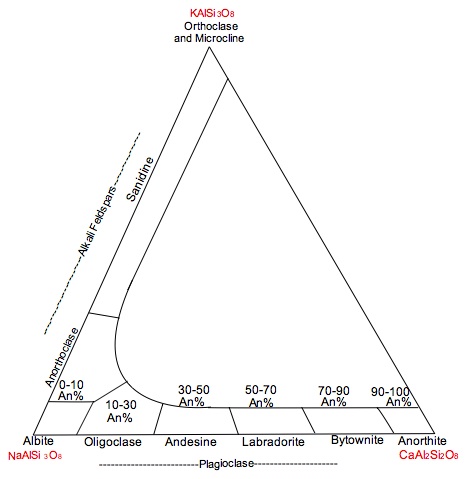
Feldspar phase diagram
The alkali feldspars are as follows:
orthoclase (monoclinic) — KAlSi3O8
sanidine (monoclinic) — (K,Na)AlSi3O8
microcline (triclinic) — KAlSi3O8
anorthoclase (triclinic) — (Na,K)AlSi3O8
Sanidine is stable at the highest temperatures, and microcline at the lowest. Perthite is a typical texture in alkali feldspar, due to exsolution of contrasting alkali feldspar compositions during cooling of an intermediate composition. The perthitic textures in the alkali feldspars of many granites can be seen with the naked eye. Microperthitic textures in crystals are visible using a light microscope, whereas cryptoperthitic textures can be seen only with an electron microscope.
The plagioclase feldspars are triclinic. The plagioclase series follows (with percent anorthite in parentheses):
albite (0 to 10) — NaAlSi3O8
oligoclase (10 to 30) — (Na,Ca)(Al,Si)AlSi2O8
andesine (30 to 50) — NaAlSi3O8 — CaAl2Si2O8
labradorite (50 to 70) — (Ca,Na)Al(Al,Si)Si2O8
bytownite (70 to 90) — (NaSi,CaAl)AlSi2O8
anorthite (90 to 100) — CaAl2Si2O8
Intermediate compositions of plagioclase feldspar also may exsolve to two feldspars of contrasting composition during cooling, but diffusion is much slower than in alkali feldspar, and the resulting two-feldspar intergrowths typically are too fine-grained to be visible with optical microscopes. The immiscibility gaps in the plagioclase solid solution are complex compared to the gap in the alkali feldspars. The play of colours visible in some feldspar of labradorite composition is due to very fine-grained exsolution lamellae.
The feldspathoids are a group of tectosilicate minerals which resemble feldspars but have a different structure and much lower silica content. They occur in rare and unusual types of igneous rocks.
Foid, contraction of the term feldspathoid, is applied to any igneous rock containing up to 60% modal feldspathoid minerals. For example, a syenite with significant nepheline present can be termed a ‘(nepheline)-bearing syenite’, or a ‘(nepheline)-syenite’, with the term (nepheline) replaceable by any 'foid' mineral. Such terminology is used in the Streckeisen (QAPF) classification of igneous rocks.
Feldspathoids include: Leucite, Nepheline, Analcime, Cancrinite, Hauyne, Lazurite, Nosean, Sodalite and Kalsilite.
Garnets are a group of silicate minerals that have been used since the Bronze Age as gemstones and abrasives. All species of garnets possess similar physical properties and crystal forms, but differ in chemical composition. The different species are pyrope, almandine, spessartine, grossular (varieties of which are hessonite or cinnamon-stone and tsavorite), uvarovite and andradite. The garnets make up two solid solution series: pyrope-almandine-spessarite and uvarovite-grossular-andradite.
Garnet species are found in many colours including red, orange, yellow, green, purple, brown, blue, black, pink and colourless. The rarest of these is the blue garnet, discovered in the late 1990s in Bekily, Madagascar. It is also found in parts of the United States, Russia, Kenya, Tanzania, and Turkey. It changes colour from blue-green in the daylight to purple in incandescent light, as a result of the relatively high amounts of vanadium (about 1 wt.% V2O3). Other varieties of colour-changing garnets exist. In daylight, their colour ranges from shades of green, beige, brown, grey, and blue, but in incandescent light, they appear a reddish or purplish/pink colour. Because of their colour-changing quality, this kind of garnet is often mistaken for Alexandrite. Garnet species' light transmission properties can range from the gemstone-quality transparent specimens to the opaque varieties used for industrial purposes as abrasives.
Garnets are nesosilicates having the general formula X3Y2(Si O4)3. The X site is usually occupied by divalent cations (Ca2+, Mg2+, Fe2+) and the Y site by trivalent cations (Al3+, Fe3+, Cr3+) in an octahedral/tetrahedral framework with [SiO4]4− occupying the tetrahedra. Garnets are most often found in the dodecahedral crystal habit, but are also commonly found in the trapezohedron habit. (Note: the word "trapezohedron" as used here and in most mineral texts refers to the shape called a Deltoidal icositetrahedron in solid geometry.) They crystallize in the cubic system, having three axes that are all of equal length and perpendicular to each other. Garnets do not show cleavage, so when they fracture under stress, sharp irregular pieces are formed.
Because the chemical composition of garnet varies, the atomic bonds in some species are stronger than in others. As a result, this mineral group shows a range of hardness on the Mohs scale of about 6.5 to 7.5. The harder species like almandine are often used for abrasive purposes.
For gem identification purposes, a pick-up response to a strong neodymium magnet separates garnet from all other natural transparent gemstones commonly used in the jewellery trade. Magnetic susceptibility measurements in conjunction with refractive index can be used to distinguish garnet species and varieties, and determine the composition of garnets in terms of percentages of end-member species within an individual gem.
Gypsum is a soft sulfate mineral composed of calcium sulfate dihydrate, with the chemical formula CaSO4·2H2O. It can be used as a fertilizer, is the main constituent in many forms of plaster and is widely mined. A massive fine-grained white or lightly tinted variety of gypsum, called alabaster, has been used for sculpture by many cultures including Ancient Egypt, Mesopotamia, Ancient Rome, Byzantine empire and the Nottingham alabasters of medieval England. It is the definition of a hardness of 2 on the Mohs scale of mineral hardness. It forms as an evaporite mineral and as a hydration product of anhydrite.
The word
gypsum is derived from the Greek word γύψος (gypsos), "chalk" or "plaster".
Because the quarries of the Montmartre district of Paris have long furnished
burnt gypsum (calcined gypsum) used for various purposes, this dehydrated gypsum
became known as plaster of Paris. Upon addition of water, after a few tens of
minutes plaster of Paris becomes regular gypsum (dihydrate) again, causing the
material to harden or "set" in ways that are useful for casting and
construction.
Gypsum was known in Old English as spærstān,
"spear stone", referring to its crystalline projections. (Thus, the word spar in
mineralogy is by way of comparison to gypsum, referring to any non-ore mineral
or crystal that forms in spearlike projections.) Gypsum may act as a source of
sulphur for plant growth, which was discovered by J. M. Mayer, and in the early
19th century, it was regarded as an almost miraculous fertilizer. American
farmers were so anxious to acquire it that a lively smuggling trade with Nova
Scotia evolved, resulting in the so-called "Plaster War" of 1812.
Gypsum occurs in nature as flattened and often twinned crystals, and transparent, cleavable masses called selenite. Selenite contains no significant selenium; rather, both substances were named for the ancient Greek word for the Moon.
Hornblende is a complex inosilicate series of minerals (ferrohornblende – magnesiohornblende). It is not a recognized mineral in its own right, but the name is used as a general or field term, to refer to a dark amphibole. Hornblende is an isomorphous mixture of three molecules; a calcium-iron-magnesium silicate, an aluminium-iron-magnesium silicate, and an iron-magnesium silicate. The general formula can be given as (Ca,Na)2–3(Mg,Fe,Al)5(Al,Si)8O22(OH,F)2.
Hornblende has a hardness of 5–6, a specific gravity of 2.9–3.4 and is typically an opaque green, greenish-brown, brown or black colour. Its cleavage angles are at 56 and 124 degrees. It is most often confused with various pyroxene minerals and with biotite mica, which are black and can be found in granite and in charnockite.
Hornblende is a common constituent of many igneous and metamorphic rocks such as granite, syenite, diorite, gabbro, basalt, andesite, gneiss, and schist. It is the principal mineral of amphibolites. Very dark brown to black hornblendes that contain titanium are ordinarily called basaltic hornblende, from the fact that they are usually a constituent of basalt and related rocks. Hornblende alters easily to chlorite and epidote.
Iddingsite is an alteration of olivine that consists of a mixture of clay minerals, iron oxides and ferrihydrites. Iddingsite forms from the weathering of basalt in the presence of liquid water and can be described as a phenocryst, i.e. it has megascopically visible crystals in a fine-grained groundmass of a porphyritic rock. It is a pseudomorph that has a composition that is constantly transforming from the original olivine that pass though many stages of structural and chemical change to create a fully altered iddingsite.
The geologic occurrence of Iddingsite is limited to extrusive or hypabyssal rocks, and it is absent from deep-seated rocks. Iddingsite is an epimagmatic mineral derived during the final cooling of lava in which it occurs from a reaction between gases, water and olivine. The formation of iddingsite is not dependent on the original composition of the olivine. It is however dependent on oxidation conditions, hydration and the magma from which iddingsite forms must be rich in water vapour. The alteration of olivine to iddingsite occurs in a highly oxidizing environment under low pressure and at intermediate temperatures. Temperature needed for the alteration process has to be above temperatures that could cause the olivine to solidify, but below temperatures that would cause structural reorganization.
Because iddingsite is constantly transforming it does not have a definite structure or a definite chemical composition. The chemical formula for iddingsite has been approximated as MgO * Fe2O3 * 4 H2O where CaO can be substituted by MgO. The geologic occurrence of iddingsite is limited to extrusive or subvolcanic rocks that are formed by injection of magma near the surface. Iddingsite has been a subject researched in recent years because of its presence in the Martian meteorites. The formation of iddingsite requires liquid water, giving scientists an estimate as to when there has been liquid water on Mars. Potassium-argon dating of the meteorite samples showed that Mars had water on its surface anywhere from 1300 Ma to 650 Ma ago.
Lawsonite is a hydrous calcium aluminium sorosilicate mineral with formula CaAl2Si2O7(OH)2·H2O. It crystallizes in the orthorhombic system in prismatic, often tabular crystals. Crystal twinning is common. It forms transparent to translucent colourless, white, and bluish to pinkish grey glassy to greasy crystals. Refractive indices are nα=1.665, nβ=1.672 - 1.676, and nγ=1.684 - 1.686. It is typically almost colourless in thin section, but some lawsonite is pleochroic from colourless to pale yellow to pale blue, depending on orientation. The mineral has a Mohs hardness of 8 and a specific gravity of 3.09. It has perfect cleavage in two directions and a brittle fracture.
Lawsonite is a metamorphic mineral typical of the blueschist facies. It also occurs as a secondary mineral in altered gabbro and diorite. Associate minerals include epidote, titanite, glaucophane, garnet and quartz. It is an uncommon constituent of eclogite. It was first described in 1895 for occurrences in the Tiburon peninsula, Marin County, California and was named for geologist Andrew Lawson (1861–1952) of the University of California.
Lawsonite is a very widespread mineral and has attracted considerable interest over the last few years because of its importance as a marker of moderate pressure (6-12 kb) and low temperature (300 - 400 °C) conditions in nature (Clark et al., 2006). This mainly occurs along continental margins (subduction zones) such as those found in: the Franciscan Formation in California at Reed Station, Tiburon Peninsula of Marin County, California; the Piedmont metamorphic rocks of Italy; and schists in New Zealand, New Caledonia, China, Japan and from various points in the circum-Pacific orogenic belt. The substantial amount of water bound in lawsonite’s crystal structure is released during its breakdown to denser minerals during prograde metamorphism. This means lawsonite is capable of conveying appreciable water to shallow depths in subducting oceanic lithosphere (Clark et al., 2006). Lawsonite is a significant metamorphic mineral as it can be used as an index mineral for high pressure conditions. Index minerals are used in geology to determine the degree of metamorphism a rock has experienced. New metamorphic minerals form through solid-state cation exchanges following changing pressure and temperature conditions imposed upon the protolith (pre-metamorphosed rock). This new mineral that is produced in the metamorphosed rock is the index mineral, which indicates the minimum pressure and temperature the protolith must have achieved in order for that mineral to form.
Lawsonite is known to form in high pressure, low temperature conditions, most commonly found in subduction zones where cold oceanic crust subducts down oceanic trenches into the mantle (Comodi et al., 1996). The initially low temperature of the slab, and fluids taken down with it manage to depress isotherms and keep the slab much colder than the surrounding mantle, allowing for these unusual high pressure, low temperature conditions. Glaucophane, kyanite and zoisite are other common minerals in the blueschist facies and are commonly found to coexist with lawsonite (Pawley et al., 1996). This assemblage is diagnostic of the blueschist facies.
Muscovite (also known as common mica, isinglass, or potash mica) is a phyllosilicate mineral of aluminium and potassium with formula KAl2(AlSi3O10)(F,OH)2, or (KF)2(Al2O3)3(SiO2)6(H2O). It has a highly-perfect basal cleavage yielding remarkably-thin laminæ (sheets) which are often highly elastic. Sheets of muscovite 5×3 m have been found in Nellore, India.
Muscovite has a Mohs hardness of 2–2.25 parallel to the [001] face, 4 perpendicular to the [001] and a specific gravity of 2.76–3. It can be colourless or tinted through greys, browns, greens, yellows, or (rarely) violet or red, and can be transparent or translucent. It is anisotropic and has high birefringence. Its crystal system is monoclinic. The green, chromium-rich variety is called fuchsite; mariposite is also a chromium-rich type of muscovite.
Muscovite is the most common mica, found in granites, pegmatites, gneisses, and schists, and as a contact metamorphic rock or as a secondary mineral resulting from the alteration of topaz, feldspar, kyanite, etc. In pegmatites, it is often found in immense sheets that are commercially valuable. Muscovite is in demand for the manufacture of fireproofing and insulating materials and to some extent as a lubricant.
The name of muscovite comes from Muscovy-glass, a name formerly used for the mineral because of its use for windows in Russia.
The mineral olivine (when of gem-quality, it is also called peridot and chrysolite), is a magnesium iron silicate with the formula (Mg,Fe)2SiO4. It is a common mineral in the Earth's subsurface but weathers quickly on the surface. Olivine is one of the weaker common minerals on the surface according to the Goldich dissolution series. In the presence of water olivine readily weathers to iddingsite (a combination of clay minerals, iron oxides and ferrihydrites).
The ratio of magnesium and iron varies between the two endmembers of the solid solution series: forsterite (Mg-endmember) and fayalite (Fe-endmember). Compositions of olivine are commonly expressed as molar percentages of forsterite (Fo) and fayalite (Fa) (e.g., Fo70Fa30). Forsterite has an unusually high melting temperature at atmospheric pressure, almost 1900 °C, but the melting temperature of fayalite is much lower (about 1200 °C). The melting temperature varies smoothly between the two endmembers, as do other properties.
Olivine/peridot occurs in both mafic and ultramafic igneous rocks and as a primary mineral in certain metamorphic rocks. Mg-rich olivine crystallizes from magma that is rich in magnesium and low in silica. That magma crystallizes to mafic rocks such as gabbro and basalt. Ultramafic rocks such as peridotite and dunite can be residues left after extraction of magmas, and typically they are more enriched in olivine after extraction of partial melts. Olivine and high pressure structural variants constitute over 50% of the Earth's upper mantle, and olivine is one of the Earth's most common minerals by volume. The metamorphism of impure dolomite or other sedimentary rocks with high magnesium and low silica content also produces Mg-rich olivine, or forsterite.
Fe-rich olivine is relatively much less common, but it occurs in igneous rocks in small amounts in rare granites and rhyolites, and extremely Fe-rich olivine can exist stably with quartz and tridymite. In contrast, Mg-rich olivine does not occur stably with silica minerals, as it would react with them to form orthopyroxene ((Mg,Fe)2Si2O6).
Mg-rich olivine is stable to pressures equivalent to a depth of about 410 km within Earth. Because it is thought to be the most abundant mineral in Earth’s mantle at shallower depths, the properties of olivine have a dominant influence upon the rheology of that part of Earth and hence upon the solid flow that drives plate tectonics. Experiments have documented that olivine at high pressures (e.g., 12 GPa, the pressure at depths of about 360 kilometers) can contain at least as much as about 8900 parts per million (weight) of water, and that such water contents drastically reduce the resistance of olivine to solid flow; moreover, because olivine is so abundant, more water may be dissolved in olivine of the mantle than contained in Earth's oceans.
The pyroxenes are a group of important rock-forming inosilicate minerals found in many igneous and metamorphic rocks. They share a common structure consisting of single chains of silica tetrahedra and they crystallize in the monoclinic and orthorhombic systems. Pyroxenes have the general formula XY(Si,Al)2O6 (where X represents calcium, sodium, iron+2 and magnesium and more rarely zinc, manganese and lithium and Y represents ions of smaller size, such as chromium, aluminium, iron+3, magnesium, manganese, scandium, titanium, vanadium and even iron+2). Although aluminium substitutes extensively for silicon in silicates such as feldspars and amphiboles, the substitution occurs only to a limited extent in most pyroxenes.
The name pyroxene comes from the Greek words for fire (πυρ) and stranger (ξένος). Pyroxenes were named this way because of their presence in volcanic lavas, where they are sometimes seen as crystals embedded in volcanic glass; it was assumed they were impurities in the glass, hence the name "fire strangers". However, they are simply early-forming minerals that crystallized before the lava erupted.
The upper mantle of Earth is composed mainly of olivine and pyroxene. Pyroxene and feldspar are the major minerals in basalt and gabbro.
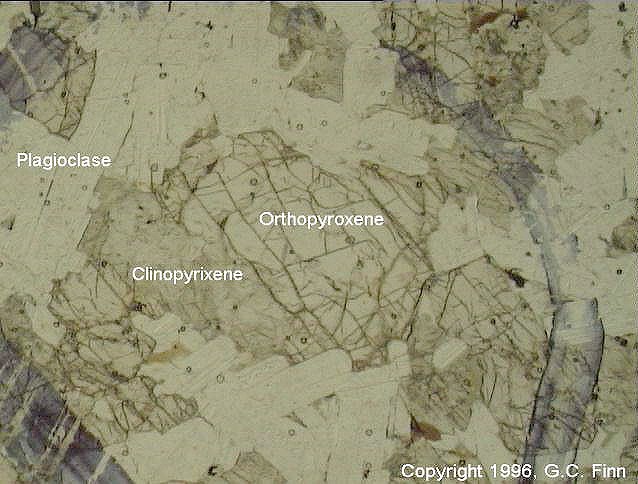
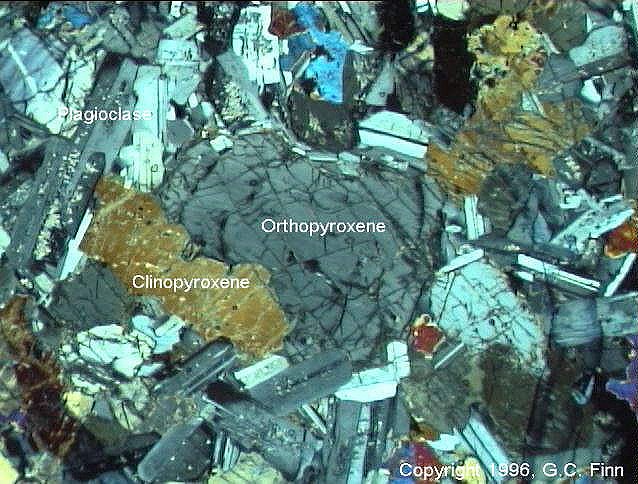
The main difference between ortho- and clino- pyroxenes are the structure of the minerals themselves - orthopyroxenes have orthorhombic structure, whereas clinopyroxenes have monoclinic structures. Pyroxenes can be found in a wide variety of rocks - both igneous and metamorphic as well as detritally from sediments - orthopyroxenes are common in igneous rocks such as gabbros and pyroxenites, and clinopyroxenes are found in a wide variety of rocks such as basalt, gabbro, pyroxenite, metamorphosed limestones and skarns, and metamorphosed iron rich sediments. The similar appearance in plane light of orthopyroxene and clinopyroxene are highlighted in the first image. Note that both grains lack any clear colour, although coloured and pleochroic varieties are common. The low interference colours characteristic of orthopyroxene compared to clinopyroxene are evident under crossed polars.
A good explanation of the inosilicates is given here: http://www.tulane.edu/~sanelson/eens211/inosilicates.htm
Quartz is the second most abundant mineral in the Earth's continental crust, after feldspar. It is made up of a continuous framework of SiO4 silicon–oxygen tetrahedra, with each oxygen being shared between two tetrahedra, giving an overall formula SiO2 There are many different varieties of quartz, several of which are semi-precious gemstones. Especially in Europe and the Middle East, varieties of quartz have been since antiquity the most commonly used minerals in the making of jewellery and hardstone carvings.
Quartz belongs to the trigonal crystal system. The ideal crystal shape is a six-sided prism terminating with six-sided pyramids at each end. In nature quartz crystals are often twinned, distorted, or so intergrown with adjacent crystals of quartz or other minerals as to only show part of this shape, or to lack obvious crystal faces altogether and appear massive. Well-formed crystals typically form in a 'bed' that has unconstrained growth into a void; usually the crystals are attached at the other end to a matrix and only one termination pyramid is present. However doubly-terminated crystals do occur where they develop freely without attachment, for instance within gypsum. A quartz geode is such a situation where the void is approximately spherical in shape, lined with a bed of crystals pointing inward.
Quartz is an essential constituent of granite and other felsic igneous rocks. It is very common in sedimentary rocks such as sandstone and shale and is also present in variable amounts as an accessory mineral in most carbonate rocks. It is also a common constituent of schist, gneiss, quartzite and other metamorphic rocks. Because of its resistance to weathering it is very common in stream sediments and in residual soils. Quartz, therefore, occupies the lowest potential to weather in the Goldich dissolution series.
Quartz occurs in hydrothermal veins as gangue along with ore minerals. Large crystals of quartz are found in pegmatites. Well-formed crystals may reach several meters in length and weigh hundreds of kilograms. The largest documented single crystal of quartz was found near Itapore, Goiaz, Brazil; it measured approximately 6.1×1.5×1.5 m and weighed more than 44 tonnes.
The serpentine group describes a group of common rock-forming hydrous magnesium iron phyllosilicate ((Mg, Fe)3Si2O5(OH)4) minerals; they may contain minor amounts of other elements including chromium, manganese, cobalt or nickel. In mineralogy and gemology, serpentine may refer to any of 20 varieties belonging to the serpentine group. Owing to admixture, these varieties are not always easy to individualize, and distinctions are not usually made. There are three important mineral polymorphs of serpentine: antigorite, chrysotile and lizardite.
The chrysotile group of minerals are polymorphous, meaning that they have the same chemical formulae, but the molecules are arranged into different structures, or crystal lattices. Chrysotile with a fiberous habit is one type of asbestos. Other minerals in the chrysotile group may have a platy habit.
Their olive green colour and smooth or scaly appearance is the basis of the name from the Latin serpentinus, meaning "serpent rock," according to Best (2003). They have their origins in metamorphic alterations of peridotite and pyroxene. Serpentines may also pseudomorphously replace other magnesium silicates. Alterations may be incomplete, causing physical properties of serpentines to vary widely. Where they form a significant part of the land surface, the soil is unusually high in clay.
Antigorite is the polymorph of serpentine that most commonly forms during metamorphism of wet ultramafic rocks and is stable at the highest temperatures - to over 600 °C at depths of 60 km or so. In contrast, lizardite and chrysotile typically form near the Earth's surface and break down at relatively low temperatures, probably well below 400 °C. It has been suggested that chrysotile is never stable relative to either of the other two serpentine polymorphs.
Samples of the oceanic crust and uppermost mantle from ocean basins document that ultramafic rocks there commonly contain abundant serpentine. Antigorite contains water in its structure, about 13 percent by weight. Hence, antigorite may play an important role in the transport of water into the earth in subduction zones and in the subsequent release of water to create magmas in island arcs, and some of the water may be carried to yet greater depths.
Soils derived from serpentine are toxic to many plants, because of high levels of nickel, chromium, and cobalt; growth of many plants is also inhibited by low levels of potassium and phosphorus and a low ratio of calcium/magnesium. The flora is generally very distinctive, with specialised, slow-growing species. Areas of serpentine-derived soil will show as strips of shrubland and open, scattered small trees (often conifers) within otherwise forested areas; these areas are called 'serpentine barrens'.
Many types of serpentine have been used for jewellery and hardstone carving, sometimes under the name false jade or Teton jade.
Spinel is the magnesium aluminium member of the larger spinel group of minerals. It has the formula (Mg,Fe)(Al,Cr)2O4 and is common in peridotite in the uppermost Earth's mantle, between approximately 20 km to approximately 120 km, possibly to lower depths depending on the chromium content. At significantly shallower depths, above the Moho, calcic plagioclase is the more stable aluminous mineral in peridotite, while garnet is the stable phase deeper in the mantle below the spinel stability region.
Umber is a natural brown or reddish-brown earth pigment that contains iron oxide and manganese oxide. It is darker than the other similar earth pigments, ochre and sienna. In its natural form, it is called raw umber. When heated (calcinated), the yellow haematite partially dehydrates to the more reddish hematite and the colour becomes more intense, it is then known as burnt umber.
The name comes from terra di ombra, or earth of Umbria, the Italian name of the pigment. Umbria is a mountainous region in central Italy where the pigment was originally extracted. The word also may be related to the Latin word Umbra. Umber was one of the first pigments used by man; it is found along with carbon black, red and yellow ocher in cave paintings from the Neolithic period.
Umber is not one precise colour, but a range of different colours, from medium to dark, from yellowish to reddish to greyish. The colour of the natural earth depends upon the amount of iron oxide and manganese in the clay. Limonite, or hydrated iron oxide, is the basic ingredient of the earth pigments ocher, sienna and umber. Umber earth pigments contain between five and twenty percent manganese oxide, which accounts for their being a darker colour than yellow ochre or sienna. Commercial colours vary depending upon the manufacturer or the colour list. Not all umber pigments contain natural earths; some contain synthetic iron and manganese oxide, indicated on the label. Pigments containing the natural umber earths indicate them on the label as PBr7 (Pigment brown 7), following the Colour Index International system, the ISCC-NBS colour list. Natural umber pigments are still being made, with Cyprus as a prominent source.
Zircon forms in silicate melts with large proportions of high field strength incompatible elements. For example, hafnium is almost always present in quantities ranging from 1 to 4%. The crystal structure of zircon is tetragonal crystal system. Zircon is ubiquitous in the Earth's crust, occuring in igneous rocks (as primary crystallization products), in metamorphic rocks and in sedimentary rocks (as detrital grains). Large zircon crystals are rare. Their average size in granite rocks is about 0.1–0.3 mm, but they can also grow to sizes of several centimetres, especially in pegmatites.
Zircon has played an important role during the evolution of radiometric dating. Zircons contain trace amounts of uranium and thorium (from 10 ppm up to 1 wt%) and can be dated using several modern analytical techniques. Because zircons can survive geologic processes like erosion, transport, even high-grade metamorphism, they contain a rich and varied record of geological processes. Currently, zircons are typically dated by uranium-lead (U-Pb), fission-track, and U+Th/He techniques. Because of their uranium and thorium content, some zircons undergo metamictization. Connected to internal radiation damage, these processes partially disrupt the crystal structure and partly explain the highly variable properties of zircon. As zircon becomes more and more modified by internal radiation damage, the density decreases, the crystal structure is compromised, and the colour changes.
Zircon is a common accessory to trace mineral constituent of most granite and felsic igneous rocks. Due to its hardness, durability and chemical inertness, zircon persists in sedimentary deposits and is a common constituent of most sands. Zircon is rare within mafic rocks and very rare within ultramafic rocks aside from a group of ultrapotassic intrusive rocks such as kimberlites, carbonatites, and lamprophyre, where zircon can occasionally be found as a trace mineral owing to the unusual magma genesis of these rocks.
Australia leads the world in zircon mining, producing 37% of the world total and accounting for 40% of world EDR (economic demonstrated resources) for the mineral. Zircons from Western Australia, have yielded U-Pb ages up to 4.404 billion years, interpreted to be the age of crystallization, making them the oldest minerals so far dated on Earth. In addition, the oxygen isotopic compositions of some of these zircons have been interpreted to indicate that more than 4.4 billion years ago there was already water on the surface of the Earth.