http://en.wikipedia.org/wiki/Forearc
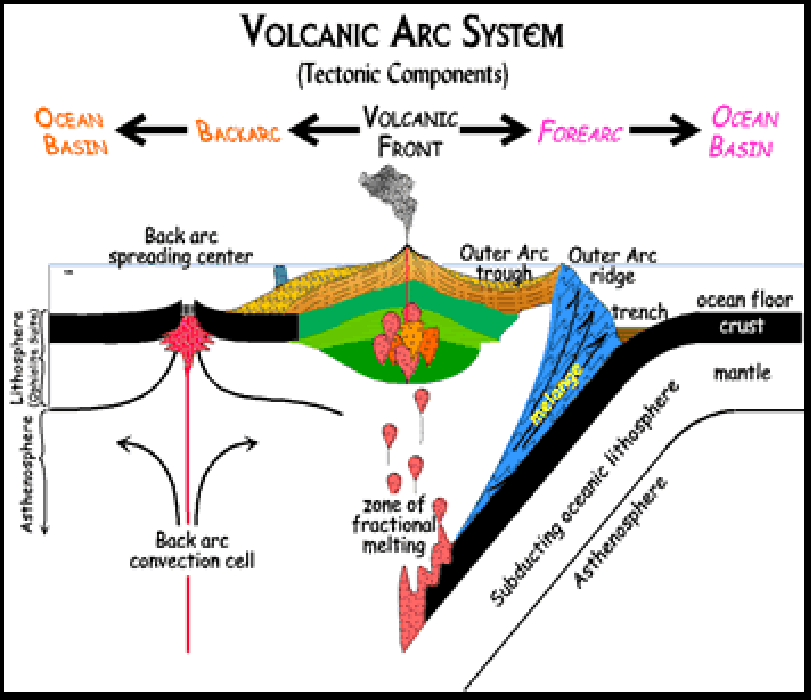
A forearc is the region between an oceanic trench and the associated volcanic arc. As such, forearc regions are found at convergent margins, and include any accretionary wedge and forearc basin that may be present. Due to tectonic stresses as on tectonic plate rides over another, forearc regions are sources for great thrust earthquakes.
Formation
During subduction, an oceanic plate is thrust below another tectonic plate,
which may be oceanic or continental. Water and other volatiles in the
down-going plate cause flux melting in the upper mantle, creating magma that
rises and penetrates the overriding plate, forming a volcanic arc. The
weight of the down-going slab flexes the down-going plate creating an oceanic
trench. The area between the trench and the arc is the forearc
region, and the area behind the arc (i.e., on the side away from the trench) is
the back-arc region.
Initial theories purposed that the oceanic trenches and magmatic arcs were the
primary suppliers of the accretionary sedimentation wedges in the forearc
regions. More recent discovery suggests that some of the accreted material
in the forearc region is from a mantle source along with trench turbidites
derived from continental material. This theory holds due to evidence of
pelagic sediments and continental crust being subducted in processes known as
sediment subduction and subduction erosion respectively.
Over geological time there is constant recycling of the forearc deposits due to
erosion, deformation and sedimentary subduction. The constant circulation
of material in the forearc region (accretionary prism, forarc basin and trench)
generates a mixture of igneous, metamorphic and sedimentary sequences. In
general, there is an increase in metamorphic grade from trench to arc where
highest grade (blueschist to eclogite) is structurally uplifted (in the prisms)
compared to the younger deposits (basins). Forearc regions are also where
ophiolites are emplaced should obduction occur, but such deposits are not
continuous and can often be removed by erosion.
As tectonic plates converge, the closing of an ocean will result in the
convergence of two landmasses, each of which is either an island arc or
continental margin. When these two bodies collide, the result is
orogenesis, at which time the underthrusting oceanic crust slows down. In
early stages of arc-continent collision, there is uplift and erosion of the
accretionary prism and forearc basin. In the later stages of collision,
the forearc region may be sutured, rotated and shortened which can form
syn-collisional folds and thrust belts.
Structure
The forearc region includes any forearc basin, outer-arc high, accretionary
prism and the trench itself. The accretionary prism is located at the
slope of the trench break where there is significantly decreased slope angle.
Between the break and the magmatic arc, a sedimentary basin filled with erosive
material from the volcanic arc and substrate can accumulate into a forearc basin
which overlays the oldest thrust slices in the wedge of the forearc region.
In general, the forearc topography (specifically in the trench region) is trying
to achieve an equilibrium between buoyancy and tectonic forces caused by
subduction. Upward motion of the forearc is related to buoyancy forces and
the downward motion is associated with the tectonic forcing which causes the
oceanic lithosphere to descend. The relationship between surface slope and
subduction thrust also plays a huge role in the variation of forearc structure
and deformation. A subduction wedge can be classified as either stable
with little deformation or unstable with pervasive internal deformation (see
section on Models). Some common deformation in forearc sediments are
synsedimentary deformation and olistostromes, which is seen in the Magnitogorsk
forearc region.
http://en.wikipedia.org/wiki/Back-arc_region
The back-arc region is the area behind a volcanic arc. In island volcanic arcs it consists of back-arc basins of oceanic crust with abyssal depths, which may be separated by remnant arcs, similar to island arcs. In continental arcs the back-arc region is part of continental platform, either dry land (subaerial) or forming shallow marine basins.

Formation
Back-arc deformation is a product of subduction at convergent plate tectonic
boundaries. It initiates and evolves behind the volcanic arc on the
overriding plate of a subduction zone. The stresses responsible for the deformation in
this region of a subduction zone result from a combination of processes.
The absolute motion of the upper plate as it moves towards or away from the
trench strongly contributes to deformation in the back-arc region. Since the downgoing slab is partly anchored in the viscous layers of the mantle, and
therefore its lateral movement is significantly slower than the surface plate,
then any motion of the overriding plate will cause extensional or compressional
stress in the back-arc region depending on the direction of motion. In
addition, mantle convection in the upper mantle wedge caused by the downward
movement of the subducted slab causes stress in the upper plate and the high
heat flow that characterizes back-arcs. The pulling effect of the
slab as it goes down into the mantle causes a rollback motion of the trench,
which also applies stress on the back-arc region of the upper plate.
However, this last process has less of an impact on deformation compared to
upper plate motion.
Back-arcs can form on either oceanic crust or continental crust. In the case of
oceanic crust, most back-arc regions are subjected to tensional stresses and
thus develop a spreading centre where new oceanic crust is formed. The
composition of this new crust is similar to MORB, although it contains higher
amounts of water.
Back-arc extension vs. compression
The back-arc deformation may be either extensional or compressional. The
overriding plate will shorten when its motion is directed towards the trench,
resulting in a compression of the back-arc region. This type of deformation
is associated with a shallow dipping subducted slab. Inversely, an
overriding plate moving away from the trench will result in extension, and a
back-arc basin will form. This extensional deformation is associated with
a steeply dipping slab.
The extreme cases of these two types of back-arc deformation can be found in
Chile and at the Marianas arc. The shallow dipping slab subducting beneath Chile
at an angle of about 10-15° causes a compressional stress on the back-arc region
behind the Andes. On the other extreme, the slab going down into the
mantle at the Marianas subduction zone is so steep it is nearly vertical. This is
the perfect example of an oceanic back-arc basin experiencing extensional
forces. The Oriente in Ecuador (the eastern part of the country covered by
rainforest) is also a good example of an extensional back-arc basin, this time
in a continental setting. The continental crust in this area east of the Andes
has been stretched out and covered by layers of sediments.