Day 1, Locality 4
2.5 km (approx) S of Troodos village; roadcut.
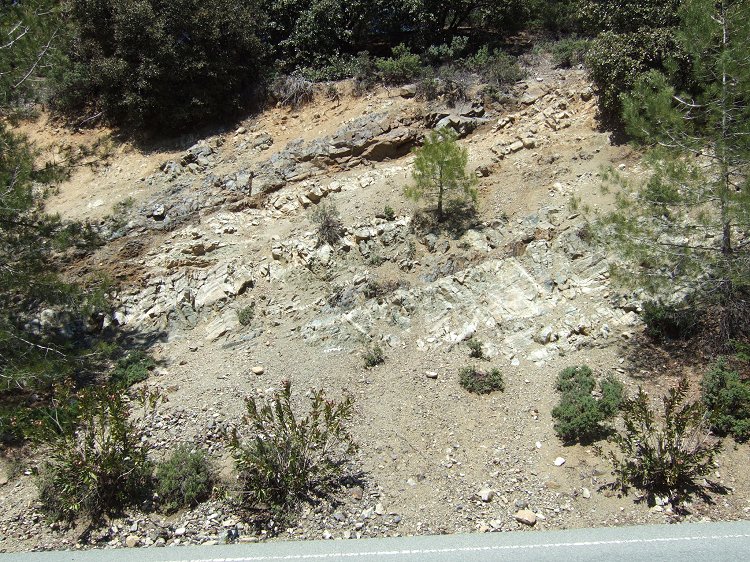
Walking uphill along the road from locality 3 we pass through several of the faults that complicate relationships between mantle and crustal rocks in this area. Approximately 800m from locality 3 the road levels out at locality 4, a section in the Crustal Sequence Lower Plutonic Intrusives. Here layered gabbros are well developed, with obvious leucocratic and melanocratic banding. These are all cumulate rocks, and differ from the lower layered dunites by the appearance of new mineral phases at these higher levels. Layering is on a centimetre to metre scale, and thin dunite layers can be seen. With the introduction of pyroxenes as a cumulus phase, wehrlite and pyroxenite layers are also well developed. The appearance of plagioclase, both as intercumulus and cumulus phases, gives gabbroic layers. Not only is mineral layering obvious, but a flow orientation of pyroxenes, olivines and plagioclases is also developed. This is thought to be the result of plastic flow deformation at high temperature.
View of layered gabbro exposure from roadside


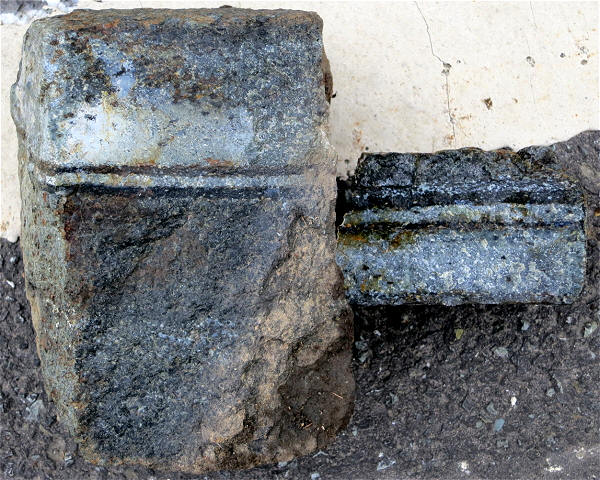
Two hand specimens showing well defined layering.



