
Day 2, Locality 7
7) Akaki River Canyon, Klirou bridge section; spectacular river cliff exposures.
There are 3 videos available. The first is taken from the viewpoint on the southern side of the gorge, after scrambling up the steep slope from the road: MPEG-1, WMV-1.
The second is taken from the stream, with Paul explaining as the camera pans upwards along the massive dykes: MPEG-2, WMV-2.
The final video is of Paul climbing the 'Giant's Staircase' on the other side of the stream - an indication of how powerful the erosion must have been: MPEG-3, WMV-3.
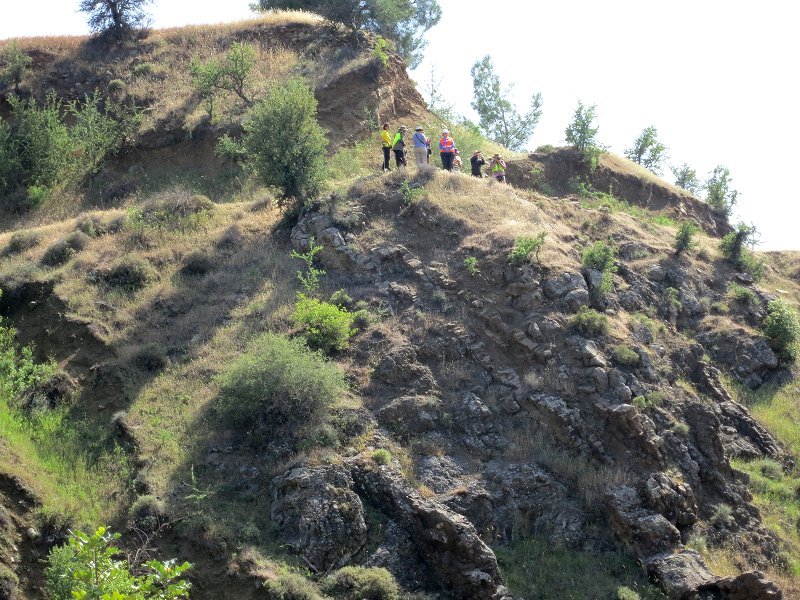
From the viewpoint on the south side of the canyon (above) the main features of the upper oceanic crustal sequence can be identified. Numerous steeply dipping dykes can be seen, together with more cross-cutting shallower angle examples. These are seen to cut a series of pillow lavas, with sheet flows both above and below. The classic Akaki Canyon gives probably the best view overall of the volcanic sequence of the ophiolite. The dykes here strike almost N-S, the oldest are steeply dipping, and rusty-red in colour.

Down on the canyon floor the dykes are seen to have chilled margins, and a range of cross-cutting relationships. These dykes are likely to have fed higher level volcanoes, with higher level pillow lavas subsequently removed by erosion during uplift of the ophiolite. At river level lower pillow lavas are seen, and are very amygdaloidal and vesicular. Broken ones show very thick glassy rinds, and the pillows are set in a dark, almost black matrix of hyaloclastite breccia. The hyaloclastites show amoeboid spatter and micropillows, in a finer matrix. At one point a later small dyke has fused a section of hyaloclastite to a solid glassy mass.
The orientation of the Akaki Canyon is aligned with the axis of the Mitsero graben, and the overall morphology, being at a rather lower level than the surrounding oceanic crustal rocks, seems to mimic the original submarine morphology of the depressed axial graben. With the axial graben developing at times of reduced magma supply and amagmatic extension, this might explain why we do not see here a complete sheeted sequence of dykes. However, we are probably close to the top of the dyke sequence here, a more likely reason for their paucity.
The abundant sheet flows probably formed at times when tectonic extension was significant, and lava supply was plentiful. Rapid outpouring of lavas in the extensional regime gave lateral spread instead of upwards, and flows ponded against fault scarps within the graben (Schminke and Bednarz, 1990).



