Day 6, Locality 3
3) Governor’s Beach; beach and cliff sections.
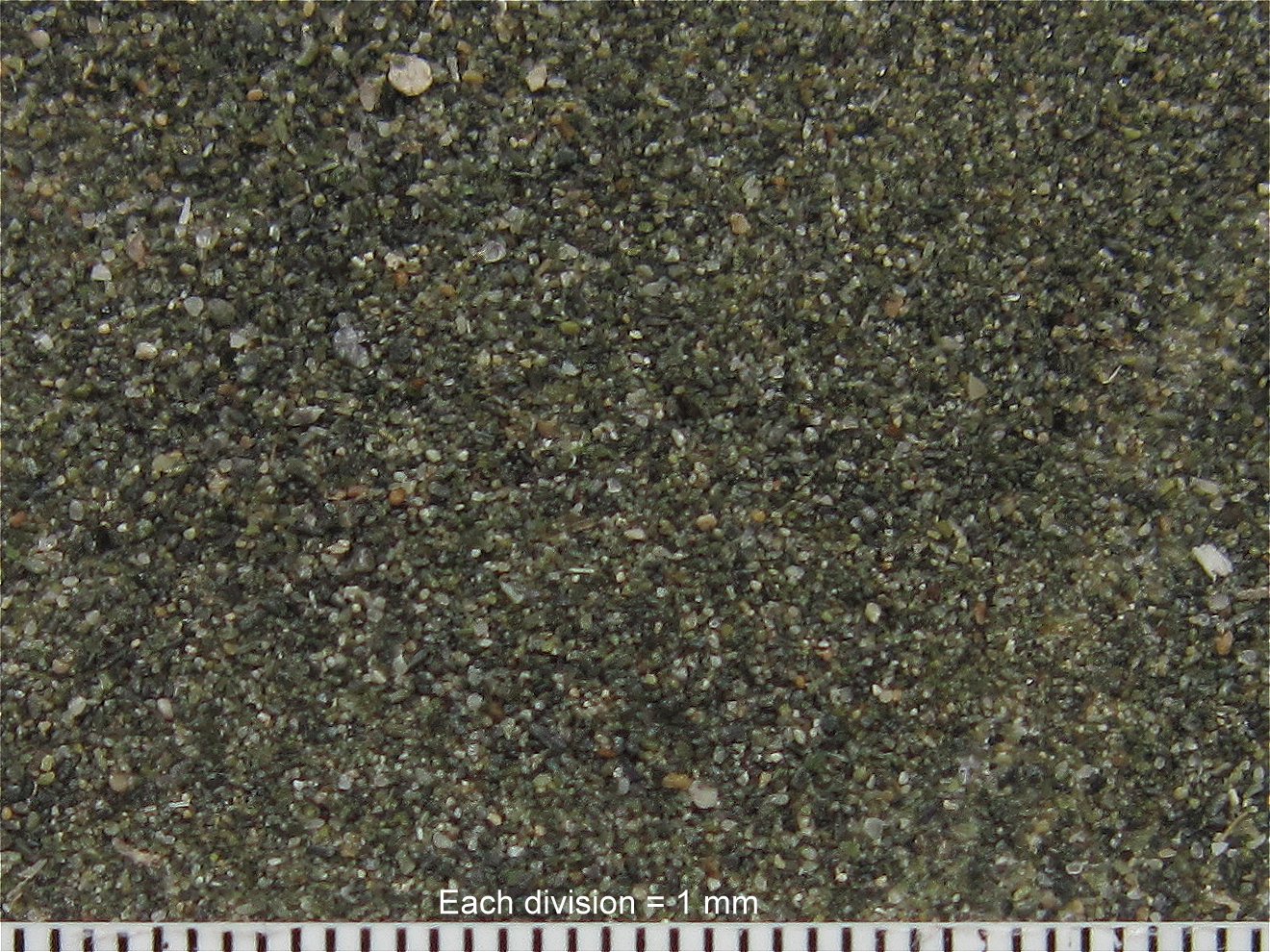
Along the beach dark patches of sand can be seen. When examined with a lens, olivine grains can be seen, together with more dark, opaque material.
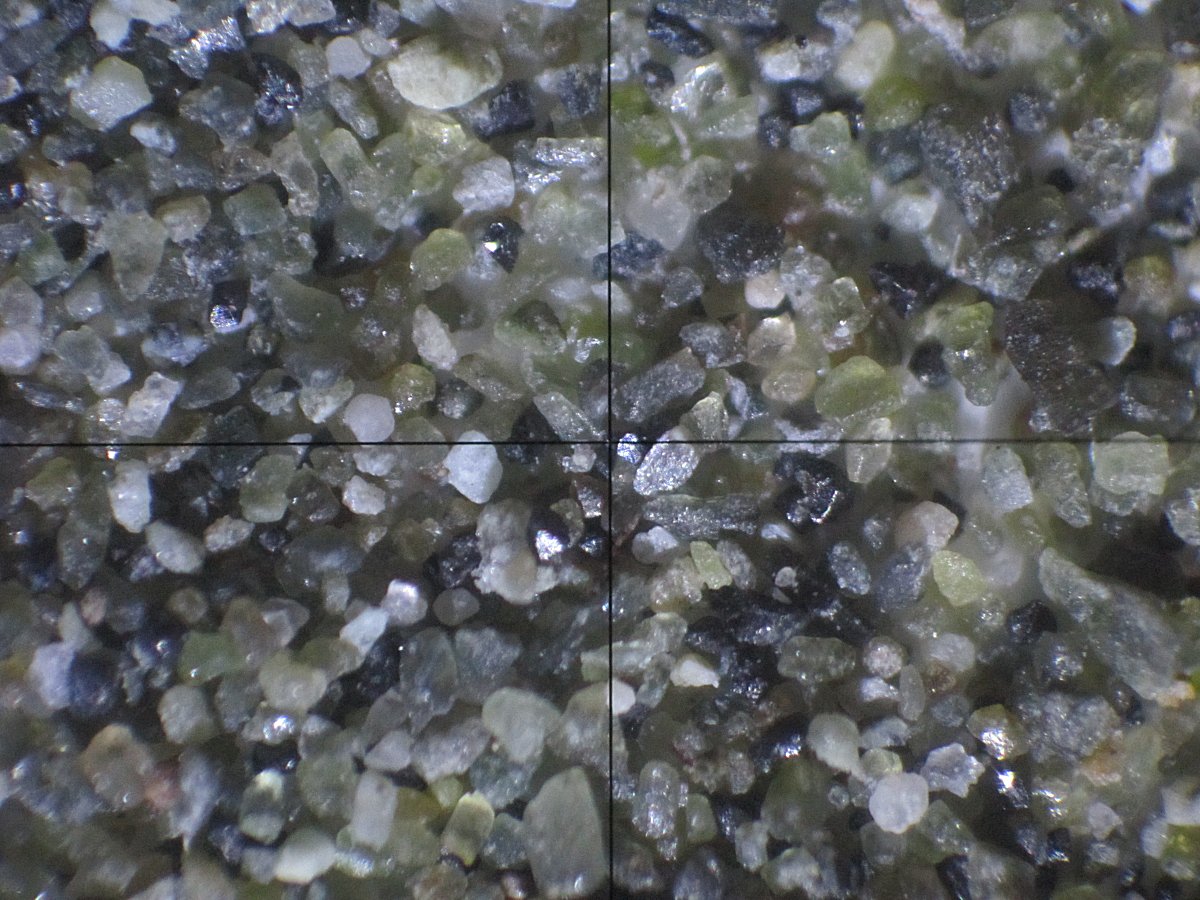
Under the reflective microscope the grains are seen to be relatively well-sorted, with the olivines and chalk grains fairly rounded (being soft) and the harder quartz and spinel sub-angular.

When seen under PP and XP the contrast between the transparent quartz and the opaque ferro-magnesian grains is very obvious, as is their angularity. These sediments are derived from the erosion of the Troodos mountains, and are igneous fragments transported by rivers to the beach.
Further up the beach out of the tidal zone, the sands appear to be weakly cemented into cohesive patches. This is beach rock in formation. Waters rich in mineral salts, particularly calcium derived from the surrounding chalks, act as the binders for the sand grains. Under daytime elevated temperatures, evaporation and cementation by calcite precipitation takes place to give ultimately a very hard, fully cemented rock. These processes also take place inland on chalk scree and talus slopes, which become cemented to calcretes. This can also happen at subsoil level at the top of the water table. The hard calcretes so formed can be a great problem for cultivation of the land.

A few metres above beach level is a terrace, capped with indurated beach rock. The terrace itself is a raised beach, one of several denoting episodic uplift of the island in Pleistocene-Holocene times.

The low cliffs underneath the terrace show white chalks of the Lefkara Formation. Here, bands of chert, up to around 10 cm thick can be seen between the more massive chalk beds.
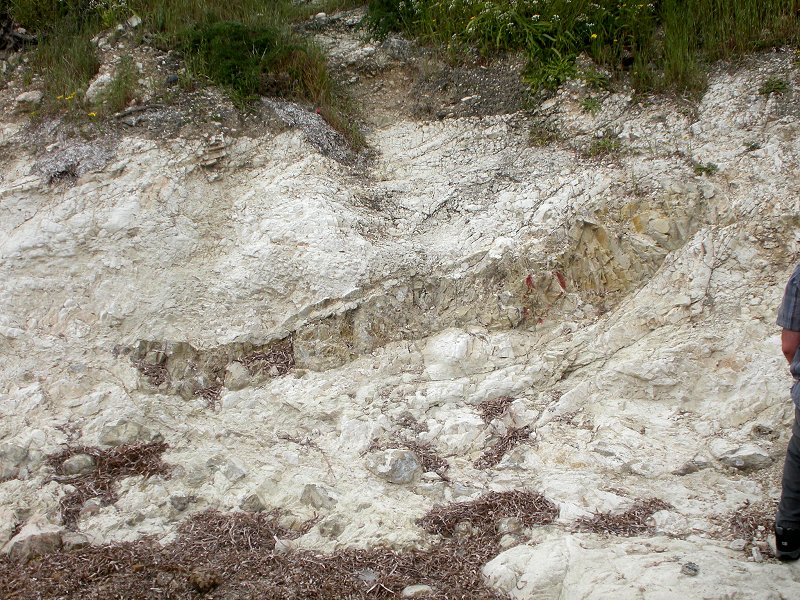
We are in the middle member of the formation here, the Chalk and Chert Unit. These are pelagites, calcareous oozes deposited in quiet waters around 3000m deep, with occasional radiolarian blooms. The presence of radiolarian cherts suggests absence of any significant bottom currents. The sediments here are of Eocene age, 56 to 34 Ma.


