Cyprus Field Trip
Day 4 - 22 March 2015
The Troodos Ophiolite: Ocean floor dynamics and tectonics of spreading ridges.
Introduction
The spreading centre – the geochemistry suggests a Mid Ocean Ridge Basalt (MORB) composition. The geochemistry of the sheeted dykes is not typical basalt. In Troodos the basalts are enriched in magnesium and large ion potassium; plus, Rubidium and Strontium that are mobilized under aqueous conditions. Therefore, this is not a MOR, but a spreading ridge (SR). This is an anomaly – how can the SR be identified when compared to a MORB. In the SR there is crustal tension and extension, driven by upwelling of convection currents from the mantle. These currents then arc back down into the mantle (first postulated by A. Holmes). Decompressional melting in the upper mantle (approximately 60 to 40km depth) gives the classic geochemistry, extensional conditions and shallow mantle depth that accounts for a MORB. The Troodos are not produced by a shallow melt. The only way this architecture is produced is through SR magmatism.
This poses two conundrums:
1. The creation of extensional forces.
2. How is extensional tectonics in a compressional scenario created?
Magma generation - the enhanced magnesium melt took place at depth and high temperature, higher than a MOR temperature. The spreading centre, recognized at the MOR, was described in the late 1970s-early 80s by Penrose when a standard section of oceanic crust was defined. The Penrose Oceanic Crust floors most ocean basins on the planet. Other types of ocean crust e.g. Canaries, do not have the Penrose architecture. Others are related to mantle plumes and extension, and under subduction zones (arc magnetism) where oceanic crust is also generated.
The Penrose architecture is only possible at spreading centres, but the geochemistry for Cyprus suggests there was not a MOR but a compression and convergent zone characterised by tectonics and subduction. In some places there is extension with subduction, and others where SR magnetism is not in the MOR position.
The Marianas arc system has the same rock geochemistry as the Troodos. Significant tracts of lavas, high in magnesium and wet with Rubidium and Strontium have created unique basalts named as boninites that can be found in other arc systems globally. The Cyprus Ophiolites can be called boninites.
A subduction zone generates magmas and extends under a compression regime. The trigger at the point of magma generation is not known. However once a fracture develops in oceanic crust the whole lot collapses and a slab of crust breaks away along the hinge and is responsible for extensional hinge collapse.
Pressure reduction induces melting with the greater inter-molecular space changing solids to liquids and is not temperature dependent. This decompression melting is by far the most common source of magma generation heat only has a minor role. The classic example is taking place at the African Rift where extension is taking place. Under MOR extension forces decompress the upper part of the mantle.
In subduction zones the trap door is opened causing the mantle to be squeezed and overheated. The lowering of pressure and an increase in temperature causes melting and the ingress of water. Rocks can melt by the addition of water. The mantle has an increased thermal effect with extension, compression and water all leading to the generation of a spreading ridge, a Supra Subduction Zone Ridge (SSZR). On a smaller scale it is curtailed to localized hinge descent when a slab descends and has the density and mass that is greater than the underneath. Things at the side are pulled down and subduction is initiated and generates classic arc magmas. However the ‘flame’ has gone out, the slab contributes to this and arc products are formed. The slab can still move away from the subduction zone, known as slab retreat, initiating a further stage of extension. The resultant back arc basalts have a different geochemistry. The attendant extension and decompression create another ridge behind the traditional arc volcanics.
Encapsulated as: Fracture – slab moves away – descends – boils water –hinge develops – volcanics behind - boninitic magmas in fore arc setting – finally a back arc ridge.
The setting for Day 4: Limassol Forest at the eastern end of the Ophiolite examining the fossil ridge-transform fault system and the transform sequence.
1. Dhierona road from Akrounta:
Roadside exposure: Exotic magmatism of the Troodos transform sequence; transform tectonised mantle harzburgite; serpentinisation; ultramafis wehrlite and beerbachite intrusions into mantle harzburgites; evidence for multiple magma generation phases and crosscutting relationships.
Exposure shows a mélange. Shear planes. The Ophiolite is transected by the shear planes of the Arakapas Fault Belt (AFB). Thrust planes are denoted by serpentine screens that have been mobilized under tectonic conditions, and have found their way by the lower tectonic pressure. Serpentinisation occurs when there is a volume increase and density decrease in products.
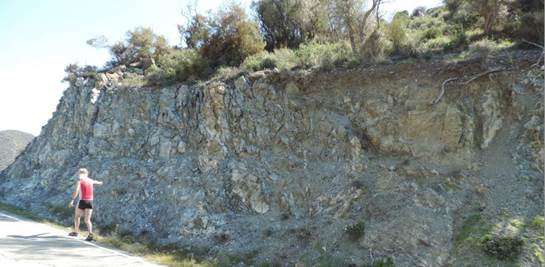
Roadside exposure: The sheeted dyke complex, showing fractured and faulted dykes, transform fracturing.
Mantle sequence harzburgites transform tectonised; E-W transform fracturing. Dykes - Larger dykes are dark and light. Earlier dykes are dark and similar to those in the Kalahari. The younger dykes are light, comprising quartz with evident granule and feldspar, and are called beerbachite. One orientation is overprinted by other almost vertical dykes that are consistently at different angles. There is a crosscutting relationship. The initial dyke emplacement of the darker colour and the later dyke emplacement not only differ in their orientation but also their geochemistry. The two-stage dyke complex is indicative of a massive tectonic influence that has disrupted the whole of the Ophiolite complex. It is fair to postulate that tectonic activity was happening during the emplacement of the first boninitic dykes. Secondary fracturing led to a later phase of magma generation and dyke emplacement during which there was a distinction that allowed a block of mantle to be incorporated in the dykes suggesting tectonic movement.
Roadside exposure: Mantle sequence harzburgites transform tectonised; E-W transform parallel serpentinised shear zones; cataclastites and mylonitisation; cataclastic mineralization.
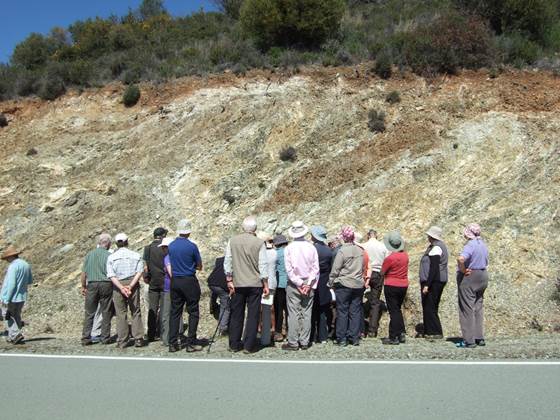
Intense shearing and folding. The whole of the Ophiolite complex is mixed up. The shear plane orientation is E-W. Serpentinite screens lubricate movement. The movement was enough to generate low temperature metamorphic minerals e.g. the white, hard mineral brucite (magnesium hydroxide) and soft, white, flaky talc. These cataclastic minerals are produced by the force of friction and grinding – a process known as mylonitisation.
The shear planes are accompanied by bands of serpentinite screens, which denote an even greater stage of tectonic dislocation; making it difficult to identify any lithologies. The shear planes denote the overall movement of the AFB in the east/west direction with its attendant slicing movement.
Dykes in the SR Ophiolites show a magnetic orientation ‘frozen’ within the Fe (iron) rich minerals. These suggest a N-S SR with parallel dykes. However, the AFB dykes align E-W where the AFB intersects the line of the SR. Where the dykes are neither predominately E-W nor N-S suggests that there has been an overall movement from N-S to E-W. The dykes were emplaced during SR magmatism, which is further evidence of tectonic activity. The rates of spreading were fairly uniform either side of the ridge. On a sphere the SR has to dislocate, hence the development of the transform faults. The equal spreading rates on a sphere offset the ridge.
The AFB is a fossilized, and now exhumed, transform fault belt.
3. North of Pano Lefkara:
Roadside exposure: crustal sequence extrusive pillow lavas tectonised and brecciated; numerous E-W faults, transform parallel; tectonic mineralization.
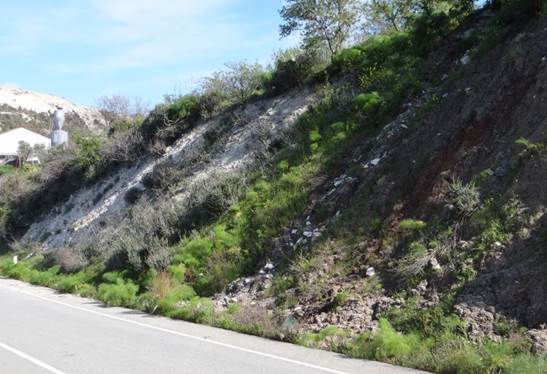
Chalk contact on pillow lava and volcaniclastics; tectonised volcanics and volcaniclastics; transform tectonic shear planes.
The spreading ridge has been dislocated by 40km. in the same series of transform faults.
4. Kato Drys:
Hilltop viewpoint: Evidence of recent seismicity; pelagic chalk/chert sedimentation onto oceanic crust; Arakapas Fault Belt; view along the fossil transform fault; exhumed ocean floor topography: pillow lava/chalk unconformity.
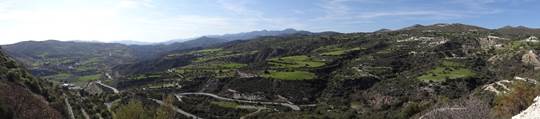
The AFB at 40km. in length cuts into the igneous complex, with an e/w axis. The zone in the middle of the fault area is due to a depression accompanied by stepped fault scarps orientated into the basinal part of the transform fault zone (TFZ). Formed 100 million years ago and at 3km. depth under the sea, the TFZ is an axial rift. Now the rift presents as an exhumed topography, and is a picture of the ocean floor before sedimentation took place. The AFB is the result of a dextral spreading ridge that is offset to the right.
The presence of banded cherts represents the first dribbles of pelagic, calcareous oozes onto the volcanic crust. The cherts form when enough silica is present to enable an outer layer to be deposited onto radiolaria, protozoa that produce intricate mineral skeletons. Upon death the radiolarian spicules form chert. The underlying nature of the contact between chert and oceanic crust is a reflection of the 100 million year old ocean sea floor topography. These are the Lefkara chalks with cherts.
5. Lageia:
Roadside section: Transform intrusives, boninitic pillow lavas; transform fault breccias, debrites and turbidites; transform fault scarp landslides; umbers and iron rich seafloor sedimentation.
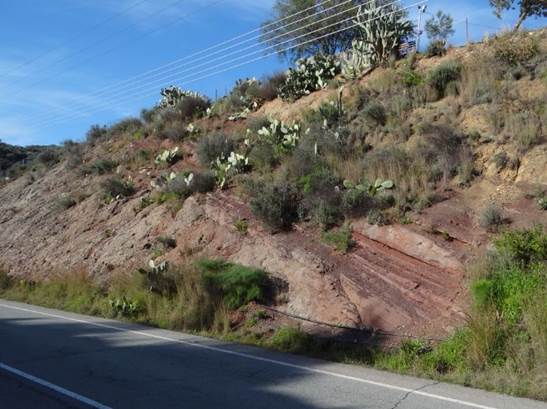
The section is In the TFZ with pillow breccias and bedded sediments. The sediments are not all fine grained, some have coarse grains, and some have iron content. Formed in the deep ocean, the grain size of the sediments decreases going upwards, where the grains settle out. This is the juxtaposition of coursing upwards, which is also apparent. The units of sediment are inter-bedded with breccias that possibly formed at the same time at the top of the ocean crust during the late Cretaceous.
The sediments are ferromanganoan umbers, fine-grained sediments rich in iron and manganese. Their position at the top of the volcanic crust signifies the last gasp of black smoker activity in the volcanic pile; essentially creating a thin veneer on top of the oceanic crust. Where they are present, they fill in little hollows.
The motion of the transform fault is one of strike/slip with a vertical displacement; this gives the axial rift of the TFZ. The displacement along the fault scarp was catastrophic and allowed for the movement of material from one place to another. The mechanism for transfer was one of catapulting material down the fault scarp into the fault scarp canyon; with the result that debrites, blocks of material (known as rafts) are cascaded down the fault and cemented in any orientation. This accounts for the changes in fining of the sediments, and the whole jumble of material being classified as a turbidite arrangement.
At this stage in the process the magma from the mantle is cooling and the extracting process is running out of steam. Iron and manganese minerals are dragged up trickle out and flow with clay minerals formed from the decomposition of igneous products. Silica is in solution on top of the oceanic crust. This creates a favourable environment for the growth of radiolaria. Their siliceous outer skeleton contributes to, and is incorporated with, pelagic chalk – hence the cherts.
Conclusion to Day 4: The Troodos Ophiolite.
The Troodos section of oceanic lithosphere, comprising the upper mantle and oceanic crust, is complete. Almost all other eastern Mediterranean Ophiolites have been disrupted by tectonics. The exception is Troodos which has not been tectonically dismembered and the Ophiolite units are in stratigraphic order. None of these Ophiolites are Penrose succession, as none of the Troodos Ophiolite is the result of a spreading ridge; however it is a Supra Subduction Zone (SSZ) spreading ridge, not a Mid Ocean Ridge (MOR).
Cyprus is part of a fore arc spreading ridge. Geochemical variations with their own fingerprint trace elements, have allowed the identification of the generation of the spreading ridge.
The geological history of the Cyprus Ophiolite began in the Triassic Period 230-240 mya with the Pangean supercontinent. In the late Permian rifting began and a large part split away forming the southern landmass of Gondwana and Eurasia. Spreading ridge magmatism and ocean floor volcanics developed as the Neotethys Ocean grew. The ocean floor was covered in Penrose type volcanics and deep intrusions – now recognized as oceanic crust. On the continental margins shelf sediments built up i.e. limestone, sandstone and coral reefs.
In the Jurassic Period 140-150 mya. the tectonics changed from extension to convergence; when the Alpine Orogeny (mountain building) took place 150 mya. With an E-W line of convergence between the African and Eurasian plates The convergence moved east over time, with a subduction zone along the same E-W axis. Subsequently the SR with the same e/w orientation formed. The SSZ spreading centre with the Ophiolite volcanic crust was positioned at the point of convergence between Africa and Eurasia. On top of the SSZ fore arc ,Tethyan crust developed, with an extension tectonic regime and the spreading centre of oceanic crust continuing. With the continued movement of the African and Eurasian plates towards one another, the Arabian promontory collided with the margin of Eurasia and became disrupted. The eastern oceanic crust sections became dislocated and disrupted, and moved southwards by obduction e.g. Oman, Syria and Turkey, which are all dismembered units.
During the collision the Eurasian Plate, which was moving at a much faster rate than the African Plate, slammed into the Cyprus ocean floor and created a microplate. The collision induced a 90°, anticlockwise rotation; this has been dated to 30-40 mya., and also accounts for the current position of the spreading ridge n/s alignment. Subsequent faulting along the TFZ has created a ridge cut into three sections.
After the disruption, subduction and spreading ridge magmatism stopped. Sedimentation began. Shallowing across the basin continued, with uplift caused by the lower density by volume of the serpentinites.
Continental material of low density reached the subduction zone; this under-plated the oceanic crust and created more uplift.
A sea-mount is now wedged into the subduction zone and is also under-plating creating even more uplift.
Answers to the two conundrums:
The creation of extensional conditions is found at the SSZ spreading ridge. This is not a MOR.
Extensional tectonics in a compressional scenario are formed over the top of an SSZ.