DETAILS OF DAY 1
The preservation of a relatively intact section of oceanic lithosphere in a terrestrial setting provides a rare opportunity to examine the characteristics of, and processes operating at a spreading ridge. The ideally preserved and well-exposed Troodos ophiolite allows a complete study to be made of a section of oceanic crust and mantle, free from any major post-spreading tectonic activity that usually fragments and complicates other of the world’s major ophiolite bodies.
The main aim of this first day is to see and examine spectacular sections in the mantle and lower crustal mafic and ultramafic sequence of the Troodos ophiolite. This will be the major opportunity on this trip to study the mantle in detail. The day will be spent in the high Troodos, in the Mt. Olympos area, at an altitude of nearly 2000m. In April it could still be quite cool here, and there is also the possibility of lingering snow patches as well. Lunch will be taken in Troodos village, before we pay a short visit to the Troodos geology visitor centre. Rocks, minerals and geological maps are usually available for sale here.
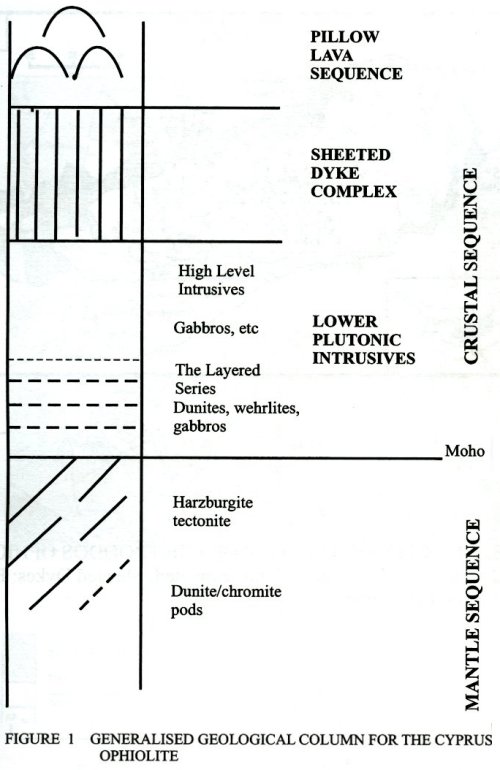
In the central part of the Troodos ophiolite the mantle section is succeeded by dunites, layered dunites, layered wehrlites and layered websterites of the lower crustal ultramafic series. The relationship between the main geological units is shown in the abbreviated column, figure 1.
Figure 2A shows the disposition of the main units of the Troodos ophiolite.

A more detailed sketch map, figure 2B, shows geological boundaries in the Mt. Olympos area of the high Troodos. There is geochemical evidence to suggest that partial melting of the supra-subduction zone mantle wedge took place at relatively shallow depth, possibly as little as 10-15 km, in a fore-arc basinal setting above a region of newly subducting lithosphere (Pearce et al., 1984; Shervais, 2001; Dilek and Flower, 2003). This melting occurred under elevated pH2O conditions, and from a mantle that had already been involved in a magma extraction event earlier (Green et al., 1979; Pearce, 1982; Cameron, 1985).

Hence when the Troodos ophiolite magmas were generated the mantle was already depleted in clinopyroxene, and already trending towards a more refractory harzburgitic composition (figure 3). The mantle sequence observed at the present day is thus residual depleted mantle, and is of harzburgite composition. A major phase of hydrothermal sea water circulation through the ophiolite in Pleistocene times has resulted in serpentinisation, and alteration of much of the olivine and orthopyroxene.

Mantle flow during diapiric ascent has imparted a tectonic fabric on the harzburgite, seen as orientation of orthopyroxene plates into a foliated texture. High temperature metamorphism (around 1100 degrees C) has also resulted in a broad segregation into bands of olivine and orthopyroxene layers, visible on a metre or less scale, and traceable over 10s of metres.
As partial melting took place within the mantle, bodies of magma would have coalesced into larger diapiric bodies which would rise within the upper mantle through melt channels. Dependant on the speed of ascent and temperature drop, bodies of melt could begin to crystallise and fractionate before they reached the top of the mantle. Olivine would be the first mineral to crystallise, followed by chrome spinel. Upward removal of the remaining residual liquid would result in the formation of bodies of olivine and chrome spinel crystal mush. Since these phases were crystallising at temperatures above the ductile/brittle transition, the uprising plastic flow fabric of the mantle would be imparted to the dunite bodies also. If the rising and further cooling of the dunite bodies plus surrounding mantle was sufficiently rapid then the sharp contacts between the mantle and dunite would be preserved, since there would have been little time for resorption or equilibration between the two. Once the mantle/melt segment had risen to the zone of spreading under the ridge crest a new sub-horizontal fabric would be developed by lateral movement away from the ridge axis. overprinting the earlier fabric. Again, depth and temperature would have determined whether ductile or brittle shearing predominated.
During melt formation trace concentrations of metallic elements, notably chromium and platinum group elements would also be mobilised. Percolation of melts through the upper part of the mantle would have carried and concentrated chromium in the melts, which then precipitated chromium minerals, mainly as chrome spinel, when liquids of varying composition began to mix in the higher parts of the mantle close to the base of the crust. Crystallisation of these chromium minerals resulted in the formation of bodies of chromitite, close to the top of the mantle sequence, forming an economic resource (Buchl et al., 2004).
Melts that had not crystallised early would rise to the top of the mantle and pond in subvolcanic reservoirs. For the Troodos ophiolite multiple chambers were present at several levels within the lower crust, varyingly replenished with fresh melts from below, as spreading took place (Moores and Vine, 1971; Robinson and Malpas, 1990). Two levels of magma chambers have been identified, supplying lavas of different compositions (Schouten and Kelemen, 2002). A deep subvolcanic chamber system was believed to have supplied lavas low in Ti, and crystallisation within these chambers produced the ultramafites of the lower plutonic crustal section. A series of shallower chambers supplied higher Ti-content lavas, and when magmas crystallised in-situ, the upper gabbroic units of the plutonic crustal sequence resulted.
Within all reservoirs, fractional crystallisation and crystal settling gave the Crustal Sequence lower plutonic intrusives, above the petrological Moho. At the base of the oceanic crust layered olivine cumulates (dunites) are the first members, with wehrlites developed where clinopyroxene forms an additional cumulus phase. Pyroxenites and websterites occur higher up the succession, when CPX and OPX become the major cumulus composition. Higher still, in higher level magma chambers, plagioclase begins to form the intercumulus phase and latterly the cumulus, often together with OPX. Here, initially olivine-rich gabbros give way to layered gabbro and norite in the upper parts of the Lower Crustal Sequence. Plagioclase becomes increasingly more abundant higher up this intrusive sequence. In all the above units, rhythmic layering, phase layering, grain size layering and mineral ratio layering are all developed on a variety of scales, from centimetre to tens of metres.
The Supra Subduction Zone (SSZ) fore-arc setting of the Troodos ophiolite influences the geochemistry of the melts in many ways, detailed in the accompanying guidebook. Of particular relevance here is the influence of hydrous magma generating conditions on the nature of the layered plutonics and their composition. Under hydrous conditions the olivine stability volume in basaltic-picritic melts increases significantly. This leads to conspicuous precipitation of olivine cumulates during coalescence and ascent through the mantle, and results in the greater abundance of olivine cumulus phases both in the dunite pods within the upper mantle, and the olivine-rich dunites, wehrlites and websterites of the layered plutonic sequence. Their abundance here is far in excess of those found in ‘classic’ MORB spreading systems.
Overall melt geochemistry is also setting-dependant. The higher than normal temperatures needed to melt refractory mantle lherzolite and harzburgite and generate the high magnesian primitive Troodos magmas is thought to have been achieved by particular conditions at the initiation of the subduction zone. Deeper asthenospheric upwelling and concentrated isotherms in the fore-arc region during the very early slab descent/subduction stage, aided by hydrous fluxing from volatiles released by the descending slab, are believed to have combined to provide suitable conditions to generate the boninitic composition melts which characterise the Troodos ophiolite (Pearce, 1982; Cameron, 1985; Taylor, 1990; Taylor and Martinez, 2003).