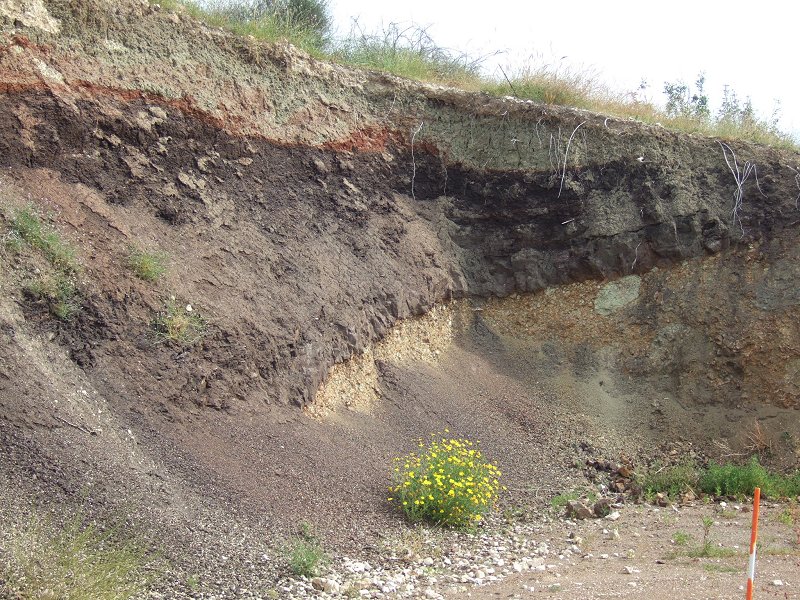
Day 6, Locality 1
1) Pyrgos village, temporary section; Moni Formation, with umbers and radiolarites of Perapehdi Formation, plus tectonised pillows, volcaniclastics, Kannaviou Clays, and Lelkara chalks.
Three videos here: MPG-1, WMV-1; MPG-2, WMV-2; MPG-3, WMV-3.
This section affords a unique and excellent opportunity to study the initial products of sedimentation over the neovolcanic crust, with many diverse lithologies displayed all in one place. The lower parts of the section show volcaniclastics, with broken pillows, and probably represents the top surface of the neovolcanic crust, exposed at sea floor level. In one part of the section red-brown ferromanganoan mudstones (umbers) and radiolarites are seen resting on the broken pillows, and represent the first stages of sedimentation over the volcanic crust.

The umbers are exhalative in origin, and were probably forming during the late stages of volcanic activity. The radiolarites represent radiolarian oozes forming over the new oceanic crust, supported by silica-rich exhalations from the still hot, new crust. These deposits are part of the Turonian-Campanian Perapehdi Formation.

In other parts of the exposure blocks of Perapehdi Formation are seen enclosed and surrounded by grey-green clays of the Kannaviou Clay Formation, and are all olistoliths. The Campanian age Kannaviou Clays represent more extensive deposition of pelagic oozes on the post-volcanic ocean floor. In the higher parts of the section isolated olistoliths of chalk are found, probably Lefkara Formation pelagic carbonates which succeed the Kannaviou Formation.

This whole section, with its jumbled blocks, is the Moni Formation, a major fault-scarp breccia of massive proportions. It is mainly related to the intra-oceanic slicing during the initiation of Troodos Microplate rotation in the Campanian-Maastrichtian, although in other localities earlier allochthonous Mamonia components are also related to accretionary wedge-building associated with on-going subduction and trenchaccretion. As major faults developed as a result of plate rotation, these massive fault-scarp breccias were incorporated with the ocean-floor oozes.