
The Plate Tectonics of Welsh Geological History
Dr Nigel Woodcock, University of Cambridge
Nigel’s talk addressed the present geology and landscape of Wales and explained in detail how this has come to be as a result of the complex plate tectonic history of the British Isles.
His approach also used well recognised unconformities in the laying down of the Welsh rock strata as distinct time markers. These markers can be readily identified in actual exposures of which he gave numerous examples.
There are two main characteristics of Welsh geology. The first of these is that it is essentially an upland country and the second is that it is a coastal country. Both of these characteristics result from the complex tectonic folding, faulting and uplift that have taken place from the Precambrian to the present.
During this period of some 600 MY the Earth’s tectonic plates have shifted over vast distances, coming together in collisions and then rifting apart in many cycles. This has caused both mountain building (orogeny) and basin formation. Wales and England started close to the South Pole, crossed the Equator before ending up where they are now. Scotland and Northern Ireland started on different plates only joining England and Wales later. Nigel summarised all this in the following diagram: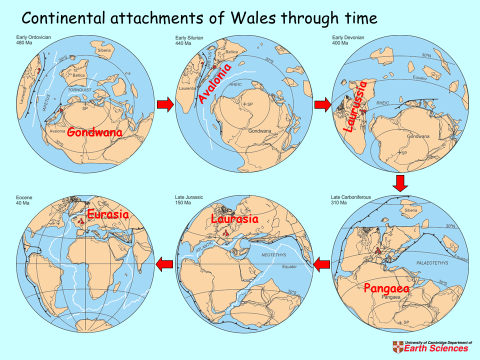
Originally part of Gondwana, Wales and England moved with Avalonia to join Laurussia (when Scotland and Northern Ireland join up). The supercontinent of Pangea then forms. Pangea then breaks up to eventually form the continents as we know them now.
All these collision and rifting events tend to produce unconformities in the geological record which can be seen in the present geology of Wales. This is summarised in the following diagram: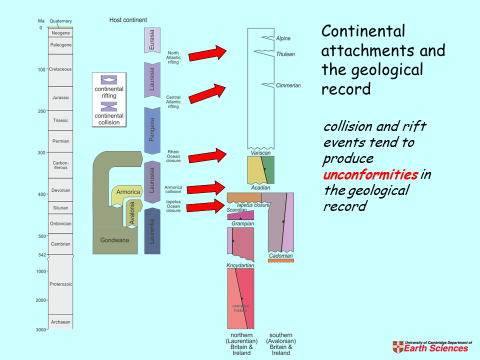
In addition to the collisions, orogenies and rifting the Northward movement of Wales resulted in major climate changes ranging through arid, tropical, subtropical and temperate. In addition sea level changes had Wales periodically submerged in deep and shallow seas.
Nigel then went through each significant tectonic event in detail from the Precambrian to the present setting each in the context of prevailing climate and continental position. In each case he gave examples of current geology exposures and rock types.
Of the many he gave, one example is: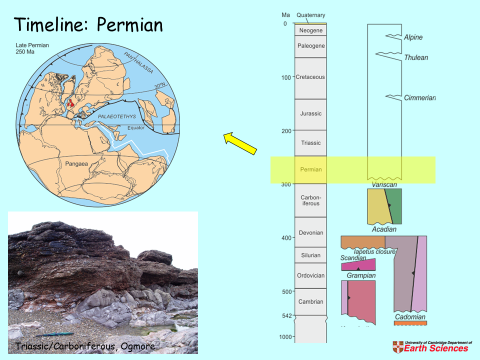
Here we are seeing the result of the Variscan orogeny producing outcrops at Ogmore.
Another example is from the earlier Proterozoic when England and Wales were in a subducting volcanic island arc before Avalonia detached from Gondwana and moved North: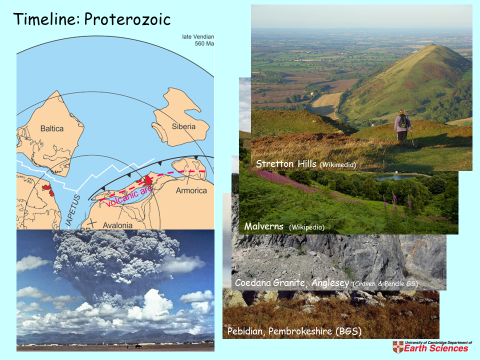
The geology examples given include the Coedana granite formation in Anglesey and the Malvern and Stretton Hills.
In the Cenozoic era as the North Atlantic opened up one of several ‘Hot Spots’ appeared initially under Wales. This Mantle Plume of upwelling hot magma uplifted Wales to produce the ‘Upland Country’ it now is and making it distinct from England. As the Atlantic opened further the mantle Plume remained stationary and plate tectonic activity moved Wales to the East. The plume is still active and raises the Atlantic mid-ocean ridge to form Iceland.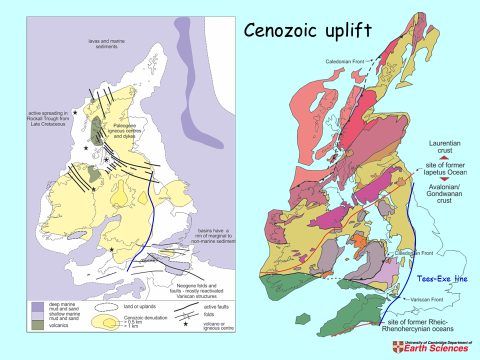
The final sculpting of the Welsh landscape was caused by the Devensian and Anglian glaciation which naturally flowed in all directions from the uplifted parts of central Wales.
Nigel concluded with a review of Wales’ potential for renewable energy including high rainfall (hydroelectricity and pumped storage), high prevailing wind speed (offshore and onshore wind turbines) and tidal power (e.g. Severn barrage and Swansea bay).
Dick Harris
April 2018
Views: 11